One traffic jam after another, annoying horns, endless lines of cars, impatient sighs from passengers on an overcrowded bus, the you-stomped-on-my-toe quarreling in the subway train, all have led to the unsurprising result that Beijing scored at the tail end of a survey of 287 cities in the category of transport satisfaction in China's 2006 Report on the Quality of Urban Life.
"The last thing I would want is to live in Beijing!" a Beijing resident using the ID Birdflyzhi wrote on his blog, expressing his frequent dissatisfaction about the transportation headache he has suffered since he moved three years ago to this city, the political and cultural center of the most populous country in the world.
The traffic problem in Beijing involves a complex of historical, systemic reasons as well as urban development management and planning, according to Beijing Mayor Wang Qishan.
At the end of 2006, Beijing again emphasized the priority of developing public transport in its transportation development guidelines for the 11th Five-Year Plan period (2006-10).
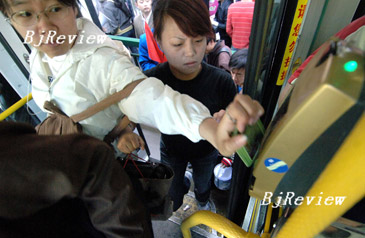
To motivate more citizens to use public transport, the city decided to offer a 60 percent discount for bus riders who have a public transport IC card starting from January 1, 2007, which means most bus riders can take buses wherever they want at a mere cost of 0.4 yuan, setting a record for the lowest bus fee in the country.
As a result, many private car owners have begun to give up driving to work and resort to buses. "I now choose to take a bus to work as it takes 20 minutes less to take a bus than to drive my car to work because the bus drives in the exclusive bus lane during the rush hour, plus, it's much cheaper," said a Beijing resident surnamed Liu.
"Such a bus fee reform is aimed not only at the Olympics, but more importantly, it helps citizens develop the awareness and habit of using more public transport," said Ren Hai, Executive Director of the Olympic Studies Center under the General Administration of Sport. "Thus, both the traffic and living conditions in Beijing will be improved in the long run."
Greater pressure
The Beijing Traffic Management Bureau (BTMB) released figures in January showing that the city witnessed an increase of 374,000 motor vehicles in 2006, with the total reaching 2.88 million.
According to Song Jianguo, Director of the BTMB, the largest daily increase in vehicles was an unprecedented 2,400 on one day in January, and the total number is projected to reach 3.3 million by the time of the 2008 Olympic Games.
"The core of the traffic problem in Beijing is that the growth in road construction is out of step with the increase in vehicles. The number of vehicles can increase by the thousands on just one day but we cannot build a new road in the same time," said Cheng Xianghui, a member of the Beijing Committee of the Chinese People's Political Consultative Conference (CPPCC).
"The city's vehicles are increasing by an average of 1,000 each day," noted Liu Xiaoming, Deputy Director of the Traffic and Transportation Administration Committee of Beijing Municipality. However, statistics from the BTMB show that the average growth rate of road construction in Beijing has been around 3 percent in recent years, far less than the increase in vehicles, which stands at 15 percent.
Traffic congestion, according to Liu Xiaoping, an engineer with the Beijing Railway Bureau, is an inevitable problem at a certain point not only for Beijing but also for other metropolises in the world. In this sense, dealing with the traffic problem is a common issue for large cities both at home and abroad.
The traffic bottleneck has a lot to do with the city's layout as well. "The traffic problem reflects the fact that the city's planning model doesn't fit its economic development when the economy advances to a certain level," he said.
|