|
 |
|
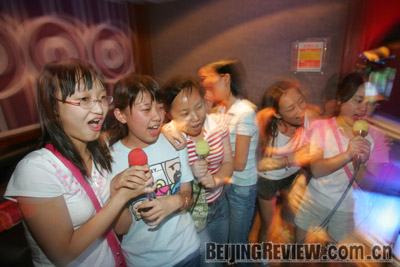
ENJOY KARAOKE: A consumer is singing in a karaoke room in Beijing |
A rise in karaoke club copyright charges could cause major ripples in China's booming KTV industry.
In early August 2008, China Audio-Video Copyright Association (CAVCA) publicized new karaoke charges across China, with Shanghai topping the charge rates at 11.1 yuan ($1.6) per day for each karaoke room.
Inflation has caused a drop in the number of karaoke customers since the beginning of the year. How to both ensure profits and remain competitive is a key problem facing many operators. The higher karaoke copyright charge could force some operators to the brink of bankruptcy, leading to a reshuffle in the industry. Karaoke customers could also see rising prices as operators pass the charge on to them.
The association said in an announcement on August 6 that the karaoke charge should be shouldered by operators and not passed on to their customers. Wang Huapeng, Vice Director of CAVCA, said in an interview that relevant bureaus had considered the karaoke charge carefully before setting it and that it represented only around three percent of operation costs.
In April 2008, karaoke operating company Partytime paid 12 million yuan ($1.7 million) for two years use of copyrights at its 16 chain stores in Beijing, Shanghai, Guangzhou, Shenzhen and Hangzhou. It was the largest copyright fee received by the association to date. Managers of Partytime said the charge was acceptable and pledged not to pass the cost on to customers.
However, past experience suggests costs have been passed on. After the first karaoke copyright charge announcement by the State Copyright Bureau was released in 2006, the price at Partytime venues rose from 59 yuan ($8.6) per hour to 96 yuan ($14) per hour. Partytime headquarters in Shanghai claimed the rise had nothing to do with the copyright charge.
According to CAVCA officials, karaoke charges could be adjusted in the future and will be released each year. Currently, there are two organizations managing audio-video copyright in China. One is CAVCA, and the other, the Music Copyright Society Of China (MCSC). CAVCA is in charge of protecting the producers of sound recordings, videos, and music, and MCSC protects the interests of lyric writers and composers. The karaoke charge will be collected by CAVCA and distributed between the two organizations.
A long way
China has about 100,000 karaoke enterprises, among which 80 percent adopt Video On Demand (VOD) systems to provide music accompaniment services. VOD system providers rarely get authority from relevant copyright holders, so, in order to protect the copyrights of audio-video works, on December 23, 2005, with the approval of the State Copyright Bureau, China Audio-Video Association (the predecessor of CAVCA) began to develop.
On November 9, 2006, the State Copyright Bureau released a karaoke charge standard to be implemented by the association, which at that time was still being built.
On July 22, the association received approval to manage audio and video program-related issues such as the right of performance, broadcasting, leasing, Internet broadcasting, duplication and distribution, and karaoke copyright royalty collection in an effort to protect intellectual property rights in audio and video sectors.
In order to better encourage karaoke operators to pay copyright charges, CAVCA gives operators who pay on their own initiative preferential treatment. KTV operators in Zhengzhou, capital city of central China's Henan Province, receive a 30-percent discount if they pay the charge nine months at a time. For those who refuse to pay the charge, CAVCA has vowed to pursue them through legal channels.
According to Ma Jichao, an official at CAVCA, many operators have already paid the karaoke charge. |