 |
|
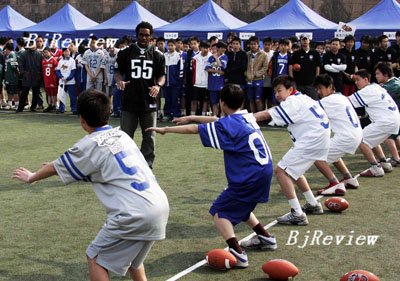
CULTURAL EXPORT: NFL Eagles linebacker Dhani Jones gives technical instruction to Chinese students taking part in a flag football contest in Beijing in 2005. The NFL has launched flag football programs for students aged 8 to 14 in Beijing, Shanghai and Guangzhou (XINHUA) |
The whistle blows, the crowd roars, and 22 armored athletes crash into each other with such force that players have broken bones, been knocked unconscious, paralyzed or even killed during gameplay. This is football, American style, but China is going to have to wait a little longer to see it in action.
The U.S. National Football League (NFL) in early April said it would shelve a planned exhibition game between two top American teams scheduled for Beijing this summer. The game, called the "China Bowl," is now scheduled for 2009. The problem, say organizers, is that American-style football is still relatively unknown in China and preparing the market has proven to be more difficult than first thought.
With 1.3 billion potential Chinese consumers, U.S. professional sports organizations are rushing to capitalize on the sports frenzy building in China around the 2008 Olympic Games. Basketball, which has produced Chinese stars like Yao Ming, and baseball, which has found a ready market in Asia, have been successful in their ventures. However, "American-style olive ball," as it is known in Mandarin, is a tougher challenge.
The China Bowl was also muscled out by a planned game in London scheduled for October, which will be the first regular season of NFL game to be played outside the United States. The game was announced after plans for China Bowl were released, but it will take precedence over the game in Beijing, NFL executives said.
Though the delay was a "disappointment," when evaluating the China Bowl the NFL wanted to ensure it had a large enough fan base in China that would be interested and knowledgeable about American football, said Mark Waller, Senior Vice President for NFL International. By delaying the game, the NFL hopes to build on the small steps it has already taken to market the sport.
"What you'll see in the next two years is a lot more emphasis on building and customizing some of our media content. At the moment, we have a broadcast arrangement with China Central Television (CCTV) and those games go out delayed but in their entirety. It's at pretty unsocial hours to be honest," Waller said.
The NFL may begin broadcasting highlights of recent American games, summary content or perhaps content that explains to the Chinese audience how the game is played, he said, all during more primetime hours. The NFL is also looking into partnerships with Chinese websites to publish game information online.
"It's important for us that we raise awareness and education of the game through the digital media capabilities that are now available," Waller said.
In its efforts to promote the sport in China, the NFL in 2003 launched a flag football program for students aged 8 to 14 in Beijing, Shanghai and Guangzhou. According to an NFL release, the program has reached 40,000 students at 80 schools so far and China was selected to host the sixth annual NFL Flag Football World Championship in 2005. Ten countries have NFL flag football programs. Beijing sports teacher Wang Jin told USA Today that many Chinese do not realize the sport is about brains as much as it is about brawn, and that the strategic nature of the game should appeal to the Chinese culture.
The flag football program over the past three years has been successful, Waller said, but the program is not used at its fullest potential yet.
"It probably needs to be A: expanded and B: deepened," Waller said, "so that we can do a better job of engaging those fans in our game and making sure that they truly are passionate and motivated about it. There will be more work that we can do locally and build some partnerships locally."
There are no current plans to expand the flag football program beyond the three core cities it reaches now, Waller said, but the NFL sees it as an important niche to carve out in the upcoming years. Compared to basketball, which he said was played by an estimated 300 million Chinese, the flag football program has a lot of room for growth.
"Success for us is that the people we connect with enjoy it, engage with it, and love it for what it is," Waller said. "I think it's very successful, but it's not scaled success. It's very focused, very targeted and it's important to those people who engage in it."
Partnerships with Chinese companies and organizations, especially long-term agreements, are something the NFL "must get much better at," Waller said. The NFL office in Beijing has been open only since March, later than expected, he said.
"We fell behind for lots of good reasons," he said. "One of the things that is important, particularly for our game, is whatever we do needs to be done very well. Speed is less important to us than doing it right."
In two years, the NFL has the potential to transform American football from a novelty sport to a more substantial game in China, but the NFL is looking long term.
"It's taken us 100 years to get where we are at in the States. We would have been no better off if we had done it in 98 years," Waller said. "Building sport in new cultures takes a long time and you're better off realizing that and working accordingly than trying to do things on an artificial timeline. I thought we would be well served coming in before the Olympics, but with the benefit of six to nine months of looking at that I'm not sure that was the right idea."
Chinese sports authorities and the city of Beijing are fully focused on Olympic preparations right now, and the NFL would have taken a backseat. By holding the game in 2009, Waller said the NFL is now in talks with Beijing officials to move the event to the new National Stadium. The game was originally to be played in the Beijing Workers' Stadium between the Seattle Seahawks and the New England Patriots. Both are among America's best football teams, as the Seahawks earned a trip to the Superbowl in 2006 and the Patriots won it in 2005. Both teams have expressed interest in participating in the 2009 exhibition game, Waller said.
The New England Patriots have prepared for years to play in the China Bowl. The team launched a Chinese-language website in 2004.
"We remain very interested in participating in the first China Bowl, whenever that is," Patriots' spokesman Stacey James told the Boston Herald. "If that's 2009, we'd be flattered to continue to be one of the teams asked to participate."
The NFL, like all major U.S. corporations, is obviously interested in China because of the country's rapid economic growth and huge potential market, Waller said. However, unlike some other American cultural exports, football resonates with the Chinese love of sports, strategy and physical achievement.
"The core of our game, which is a great combination of strategy and execution, is particularly relevant to the Chinese culture. Interestingly, there is an initial response to our game that it is too aggressive and not culturally appealing. Once people understand it, and realize how much of the game is strategic and pre-planned and incredibly trained and prepared for, it really does resonate."
China and the United States are two "incredibly great nations determined to do great things in the world," Waller said, and American-style olive ball taps into that drive for achievement.
(Reporting from New York)
Football, American Style
American-style football is the most popular sport in the United States, and the televised games draw more viewers than any other sport. The Superbowl, the championship game of the National Football League, is an unofficial national holiday. Fans love the sport for its combination of strategy and brute force.
However, to those outside the United States, the rules of the game are murky. Teams are given four chances to advance the ball 10 yards toward the opposing team's end zone. If they are successful they are given another four chances to advance, but if they are blocked they must turn over the ball to the opposing team. The chance to advance the ball, called a down, is over if the person carrying the ball falls or is knocked down or if the other team steals the ball.
To score a touchdown, worth six points, a team must carry or catch the ball in the opposing team's end zone. A touchdown also gives a team a chance to score an extra point by kicking the football through the opposing team's goalposts. Teams can also score three points by kicking the ball through the goalposts during regular gameplay or two points by forcing the offensive team into their own end zone. Games are divided into four quarters of 15 minutes each, and in the result of a tie the teams go into overtime known as sudden death, when the first team to score wins.
During a game, each team sends 11 players to the field, and each player has a specific offensive, defensive or special team role. There are also many game rules teams must abide by or they will be penalized by losing yards or possession of the ball. Teams develop playbooks full of strategies for combining passing, running and blocking to advance the ball, and the team's quarterback organizes each play like a military captain with his troops.
The U.S. National Football League was organized in 1920 in Canton, Ohio. There are 32 teams in the league, representing major American cities and regions. |