 |
|
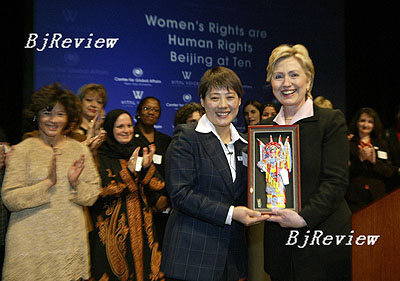
BEING RECOGNIZED: Guo Jianmei presents a gift to U.S. senator Hilary Clinton when they met at a global forum for female NGO leaders from across the world in March 2005 (COURTESY OF GUO JIANMEI) |
Advancing the cause of women's rights and legal justice, Guo Jianmei regards herself as a lonely idealist, but one who remains optimistic nonetheless. The past 12 years could not have been busier or more meaningful for Guo, the founder of China's first nongovernmental organization (NGO) to provide legal aid for women-the Center for Women's Law Studies & Legal Services of Peking University.
Over the 10 years between 1996 and 2006, the center has provided over 60,000 legal consultancies, covering a wide rang of topics on marriage, family, property rights and labor rights. The center has represented under-represented women for free in over 600 cases, among which over 100 have been reported by the media and greatly influenced law makers.
Guo's work has now been internationally recognized, when she was awarded the Global Leadership Award on March 14 in Washington, for her efforts to provide Chinese women with legal aid. The award organizer, the NGO Vital Voices, established the awards to encourage efforts to increase women's economic and political progress and safeguard human rights.
Taking action
Guo graduated from the Department of Law at Peking University in 1983 and began her career as a civil servant in the Ministry of Justice and then as a journalist in a government-owned law magazine. In 1989, Guo joined the drafting panel of China's historic Law on the Protection of Rights and Interests of Women. During the surveying and field research, she traveled to most parts of the country, extensively studying the living conditions of Chinese women.
In 1995 Guo participated in the Fourth World Conference on Women held in Beijing. At a forum on the protection of women's rights, Guo heard from a foreign legal professional for the first time that China had no legal aid organization for women. The news shocked her.
"It was a moment of revelation for me," she said, and it prompted her to found China's first non-profit legal aid program for women.
Her pioneering spirit and determination to make a difference soon led to Guo resigning from her stable government position to focus on her project full time. This was despite the fact that she was married with an eight-year-old girl and the family was not well-off.
"Quitting my job was quite a big thing at that time. Many people, including my parents, thought I had gone out of my mind and felt pessimistic about my new choice," recalled Guo.
December 1995 witnessed the inauguration of the Center for Women's Law Studies & Legal Services of Peking University, the country's first NGO focusing on legal aid for women. Working at two rented hotel basement rooms, the center, which became fully operational in March 1996, had seven employees, four of whom, along with Guo, were professional lawyers.
At that time, the legal aid system and NGO community were still in their infancy in China and getting operating funds topped the list of priorities. Through Guo's persistence, the Ford Foundation granted the center $40,000 as startup capital on the condition that it would process at least 50 legal aid cases every year.
Guo recalls that what surprised her most was not the difficulties in logistics and publicity in the early days, but the social backlash that came out of nowhere. Many of her peers thought she was either pursuing overnight fame or was too incompetent to find clients as other commercial lawyers did.
"Back then China didn't have any law or regulation on legal aid or NGOs, and government departments were suspicious of what we were doing," said Guo. "I felt puzzled at that stage."
Never give up
However, even at the lowest point of her career, she held firm to her belief that her nongovernmental legal aid organization for women would develop into something big one day. Although Chinese women enjoy equal status with men in the Constitution, in reality women, especially those with financial difficulties, formed a large under-represented group. Among this group of women were many trying to seek legal aid to protect their interests.
|