|
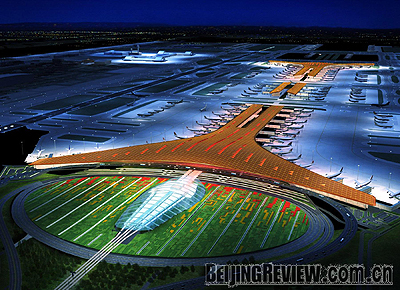
Sir Norman Foster's architecture firm, in conjunction with the Beijing Institute of Architectural Design and Research, recently finished the dazzling, ultra-modern Terminal 3 at the Beijing Capital International Airport. This structure certainly amazes and comforts weary travelers. Over the past 35 years, Foster, an English architect who promotes a "green agenda," has incorporated innovation with social responsibility, designing unusual museums, banks, airports, bridges, apartment buildings-and even a pyramid structure in Kazakhstan. His ideas have dramatically changed the character of cities around the world; Beijing is no exception.
Foster has a common philosophy that connects all of his work: He's interested in being socially responsive and making use of natural resources. He's taken on massive projects such as Terminal 3 and created the world's most advanced airport. Ever since the new terminal opened on March 26, 2008, it has awed Chinese and foreigners alike. Shaped like a dragon, the entire space has an aerodynamic feel that celebrates both the joy of flight and bequeaths a Chinese sense of place by utilizing traditional Chinese colors and symbols.
But Beijing holds many layers of Chinese structures that visitors walk by without ever realizing their significance to Chinese culture. In fact, Beijing has undergone many names and transformations ever since the Mongols established the Yuan Dynasty in 1271-with "Dadu" as their capital. The Mongol emperor Kublai Khan created the city plan by placing four gates to guard the four directions leading into his royal residence. When Ming troops overran it in 1368, they renamed the city Beiping (northern peace), keeping Nanjing (south capital) as their capital while building walls, reconstructing palace buildings and gardens in Beiping. In 1421 Beiping became Beijing-the northern Ming capital. Later, rulers of the Manchu's Qing Dynasty (1644-1911) added extensive gardens and the Summer Palace. After 1949, Chairman Mao Zedong altered the ancient architectural fabric of Beijing. Tiananmen Square is his creation. Under Mao's leadership, workers demolished almost all of the city's ancient walls and some centuries-old buildings, replacing them with massive structures such as the Great Hall of the People and the Museum of Chinese History.
In recent years even more demolition has taken place. Old hutongs (alleyway neighborhoods) have been torn down to give way to high rises. "I've lived in Beijing all my life," wheezed Mr. Wu, a frail grandfather tottering on a cane in Sanlitun, Beijing's bar district. "Everything's being
|