|
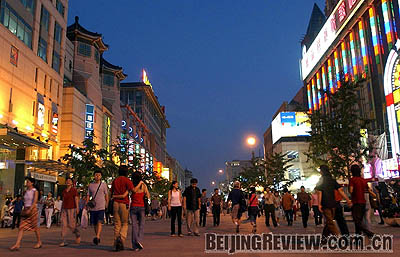
MORE NEEDED: Beijing is in dire need of more pedestrian-only streets to help improve city access, safety and business
Having just arrived in Beijing from crowded Seoul, I am impressed with the provision and variety given to public spaces here. From the large open areas around the rail station entrances to the green corridors that line the sides of some city boulevards, Beijing has incorporated open areas generously into a heavily populated metropolis that sees continued growth and construction.
In planning public spaces, the well-being and quality of life of people is always paramount in design thinking. Urban squares, or plazas, are ideal places of escape. They give communities a place to congregate and give people meaning in their lives socially that extends beyond work. Playgrounds are imperative places for children to learn and play, and encourage families to spend time together outdoors. Green spaces provide an oasis of calm where people can relax and exercise, and trees help to offset carbon emissions and smother noise. Traffic-free zones help to boost commerce and can improve safety and access around cities for pedestrians.
In all forms, public spaces give cities character and imaginative design can reflect national heritage as well as progressive modern thinking. Beijing succeeds in these points in architectural form, with its merger of ancient and new China, but where the city is growing skywards with new offices, I haven't seen many new public spaces opening at ground level.
This is a city that is novel in its utilization of public spaces. Clearly, public spaces are valued highly by the people. From outdoor practice of taiji, or people taking birdcages into parks, to the seemingly spontaneous and endearing dances of the elderly in random pedestrian areas, the population uses its open spaces in an inimitable Chinese manner: meditative, graceful and hushed. In what other major city in the world can you find crowds of people gazing to the skies, flying kites of different shapes and sizes?
La passeggiata is a social ritual in Italy that is also exercised here, around the lakes of Houhai particularly. After dinner, before dark, families, couples or friends take a short walk-the idea being of social coordination and harmony with the environment, as well as aiding digestion. In Paris, the concept of dérive means to drift around the city like a flâneur with no specific destination or direction, simply to discover the hidden city as you lose yourself in it. The sprawling medina of the hutongs compliments this notion perfectly. You can sense the history of China around you in Beijing, far more so than in Seoul where much of the landscape was constructed after the Korean War. Many times I have heard dismay at the development of the hutong areas. Landscape architects often argue the case for transformation, not demolition, to retain heritage and save resources. Such a point is evidently popular in the Houhai hutong area as tourists stream through the preserved alleyways.
|