|
 |
|
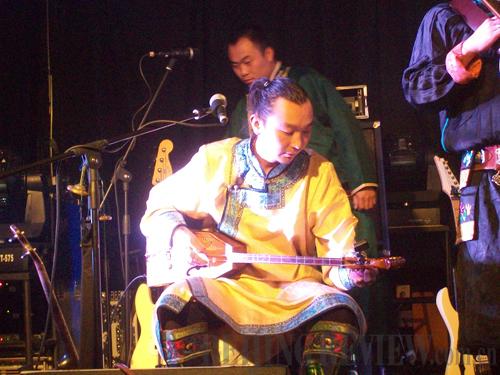
CLASSIC INSTRUMENT: Hanggai front man Ilchi plays an ancient Mongolian style lute during the band's performance at Yugong Yishan on November 24 (KYLE MULLIN) |
It was a galloping rhythm—not merely a bow on strings, but a sound that twisted and pulled like muscles on a strained leg. The members of Hanggai may be renowned for their revival of ancient Mongolian throat singing, but it was the band's horse-head fiddle player Batubagen who stole the show. He drew his bow across the strings with fiendish fervor, see-sawing it back and forth and twisting it at sharp angles so that it sliced at the strings' outer edges.
His playing drove the band's gentle folk melodies into a fevered sweat, setting the traditional song form ablaze with punky rawness. Batubagen is more suited for the band's anarchic leanings than its archaic roots—when the tempo slowed and his fiddle played ceased, he sang in a pitch so low and gravelly that it seemed subterranean. It was impressive for a beat or two, but soon started to drag into a grating monotone. Suddenly, in the same breath, the pitch of his voice leapt from those depths to a wondrously towering octave that cued the rest of Hanggai to join in. The audience soon followed suit, singing along to Mongolian lyrics that they likely couldn't understand.
The same can't quite be said about show openers Blackwater. Like Hanggai, they sang in a tongue that was foreign to most of the Chinese music buffs in the audience—but instead of Hanggai's Mongolian folk, Blackwater's lyrics were in English with strong Irish leanings.
Many reviewers have compared Hanggai's organic sound to Celtic music, but that's a stretch which became quite obvious at the end of the night, when the audience had time to compare both sets. Hanggai had little in common with their opening act—Blackwater front man Desmond McGarry, looking like Father Christmas with his frosty stubble and stocky frame, shuffled up to the mic to deliver a sweetly lilting brogue as his band's guitars and accordion swelled vintage melodies behind him.
When he gently goaded the fans to dance, "Once around the room and mind the dresser, as we say at home—we always have to watch out not to knock over the furniture," the audience smiled and nodded along. But their clapping was out of sync with McGarry, and despite further encouragement from the front man, they simply would not kick up their heels. Their applause was warm and enthused, both for the band's more rollicking numbers and for McGarry's a cappella ballad about leaving besieged old Ireland to discover the rest of the world.
 |
|
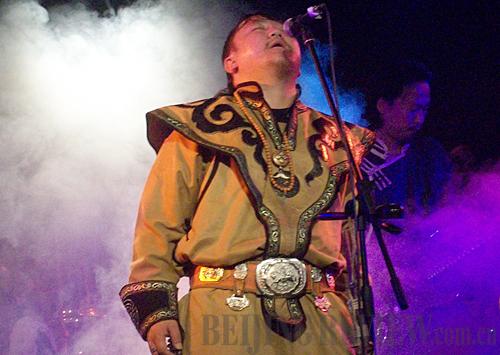
ENJOYING THE MUSIC: Hurcha showcases his stirring Mongolian throat singing technique at Yugong Yishan on November 24 (KYLE MULLIN) |
But the audience saved their raucousness for Hanggai—cheering at the sight of their vibrantly colored traditional Mongolian garb, clapping along with every song and pumping their fists as the band's popular tune Drinking Song reached a dizzying tempo. Their encore performance of that song was the show's plateau—a song that attained breakneck speed with each verse, leaving portly singer Hurcha soaked in sweat with his arms outstretched, as if he were about to embrace the whole room.
Even lute player Ilchi, who was subdued for most of the show, perked up for that climactic curtain call, bobbing back and forth in his chair as though he were about to be knocked clear out of the saddle. The tune made for a fitting conclusion to a night of drinking and dancing with one of Beijing's best folk-rock groups.
The author is a Canadian working in Beijing |