|
 |
|
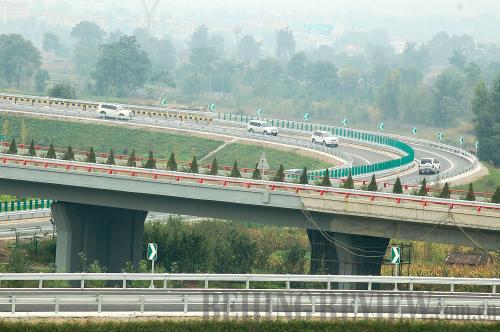
HIGHWAY DEVELOPMENT: A superhighway extends from west China's Shaanxi Province to Gansu Province, September 25, 2009. The superhighway in Gansu Province expanded from just 13 km in 1999 to 1,500 km in 2008 (ZHOU WENTAO) |
The Central Committee of the Communist Party of China (CPC) adopted a proposal for formulating China's five-year development program in October at the Fifth Plenum of the 17th CPC Central Committee. After the meeting, provinces and autonomous regions across the mainland began to roll out their own proposals for their own five-year plans spanning from 2011 to 2015; these plans were based on the Fifth Plenum.
Experts noted that China has put less emphasis on quantitative requirements for the growth of gross domestic product (GDP) in its Proposal on Formulating the 12th Five-year Program (2011-15) on National Economic and Social Development.
"Requirements in the proposal are focused on development direction and strategy, rather than a 'quantitative' target," Pan Shengzhou, deputy director of the Policy Research Office of the CPC Central Committee, said in an interview for the CPC's news website. Pan also helped to draft the proposal.
However, many provincial CPC committees have defined specific GDP growth targets in their next five-year plans. For instance, China's northeast Helongjiang Province said in its plan that the province would double its GDP and its local fiscal income based on figures from 2010. The province has vowed to create the most robust period of economic development seen in China since the reform and opening up of 1978.
The Guangxi Zhuang Autonomous Region's plan calls for more moderate economic growth. The region plans to continue increasing the amount of available jobs and keep commodity prices stable. The region also aims to double its GDP by the year 2015.
West China's Gansu Province is also shooting for a higher GDP growth rate. Its investments in fixed assets are predicted to grow steadily. The province also wishes to lower its rates of energy consumption and pollution emission. Gansu's plan is reflective of other provinces and regions in China in that it not only aims for economic growth, but also takes into account the life quality of its citizens.
Guizhou, another west China province, has guaranteed that its GDP will reach 800 billion yuan ($119 billion) over the next five years. The province also says that it will almost completely eliminate poverty in its rural areas by 2020.
The Tibet Autonomous Region designated some specific targets in its plan. The region plans to address drinking water safety issues in rural areas over the next three years; by 2015, the region is scheduled to have over 60 percent of its roads paved. Efforts will also be made to renovate the region's villages; the region wishes to provide at least 90 percent of its villages with access to post offices, electricity and telephone services.
|