|
 |
|
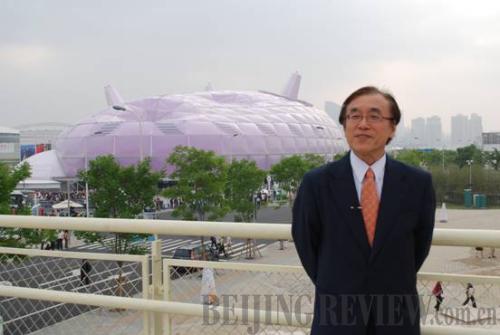
Director of the Japan Pavilion Noriyoshi Ehara (MIAO XIAOYANG) |
The opening of the 2010 World Expo in Shanghai in May has become an event of remarkable significance for China. Described as an "economic Olympics," the Expo in Shanghai has provided an important platform for countries to exhibit their achievements in economic development, technological innovation, cultural exchange and communications.
The Shanghai Expo is being held only two years after China hosted the 2008 Olympic Games in Beijing. Japan had a similar experience about 40 years ago. After Tokyo hosted the Olympic Games in 1964, another Japanese city, Osaka, hosted a World Expo. Back then, Japan's economy was on the path of fast growth and the Expo became a strong stimulus for Japan's economic takeoff and its full opening to the international community. What will the Shanghai Expo bring to the Chinese economy? Beijing Review reporter Miao Xiaoyang interviewed Noriyoshi Ehara, Director of the Japan Pavilion who has rich experience in promoting international trade.
Beijing Review: Some media organizations have said that China is in a similar state as Japan when it hosted the 1970 World Expo in Osaka. As an official with experience in promoting trade and investment relations, how do you think the Shanghai World Expo will affect the Chinese economy? Will the Expo become an economic stimulus for China?
Noriyoshi Ehara: When hosting the Osaka World Expo, Japan was experiencing fast economic growth, which was similar to what China is experiencing now. By implementing economic development-oriented policies, China has been able to accumulate considerable material wealth, but the development has also generated some social problems. Undoubtedly, China will surpass Japan in 2010 to become the world's second largest economy. Meanwhile, China's development has given rise to problems such as environmental degradation and overpopulated cities. This path also evokes Japan's history.
However, China is engaged in transforming its development mode and conducting economic restructuring, which I believe signifies a major policy change. From the perspective of people's daily life, this change means concepts of environmental protection and energy conservation should be put into practice. Many pavilions at the Shanghai Expo adopted environmental protection as their theme. I believe that creating an economic structure and transforming daily life based on energy conservation and environmental protection will significantly prevent economic bubbles from forming.
I believe the Shanghai World Expo reflects China's achievements in economic development. As the world becomes more interested in China, there will be a steady increase in foreign tourists to the country. In the medium and long run, China will further expand its technological and economic exchange with other countries. In the future, under the guidance of its economic development-oriented policies, China should further promote the construction of a "harmonious society" as an effective means to avoid economic bubbles.
How will this Expo affect the economic communication between China and Japan?
Many visitors to the Japan Pavilion are impressed by Japan's environmental and energy-saving technologies. I believe Japan and China will cooperate to tackle the global challenges of environmental protection together in the future. Meanwhile, new business links will be built between companies of the two countries and there will be rapid growth in two-way investment between the two countries. The Expo is also expected to significantly boost China's soft power and more companies, especially small and medium-sized ones, will become interested in China.
From the perspective of economic development, what is your interpretation of the "Better City, Better Life" theme of the Expo?
Economic growth will enable people to realize the dream of "Better City, Better Life," but economic growth alone cannot guarantee "a better life." I think the exhibitions of the China Pavilion and other national pavilions have illustrated to the world the connotations of the "Better Life" theme advocated by the Shanghai Expo. I think the deeper meaning of this theme is to highlight that the goal of economic development lies in protecting the environment on our planet. This is a topic of landmark significance.
As China is going through rapid urbanization, the "Better City, Better City" theme is closely related to the country's future.
At this Expo, the Japan Pavilion has built a futuristic "zero-emission town," a municipality set in 2020 that emits no carbon dioxide at all, as a practical example of a "Better City." We also put on display a "Life Wall," which gives a glimpse of what a living room in the future will look like. In such a room the wall doubles as a TV which people can control remotely by making gestures. We also exhibit robots that can help with housekeeping and play the violin. These are all instructive elements for building a "Better Life" in the future.
What are your expectations for the Chinese economy during and after the Expo?
I expect the Expo to boost the international community's understanding of China. The Osaka Expo increased the world's understanding of Japan. The globalization of the Chinese economy, especially the "going global" strategy of Chinese companies, is advancing rapidly. It would be difficult for the Chinese economy to achieve true globalization if the international community couldn't gain more knowledge of China.
As the largest ever Expo in history, the Shanghai World Expo has attracted a large number of tourists from various countries, who will go sightseeing around China as well as at the Expo site. Meanwhile, media organizations all over the world are reporting on events taking place in China. I believe this will help the international community to know China better. The Expo is as much an opportunity for the world to increase its understanding of China and the Chinese people through intensive reports on Shanghai over six months as it is an opportunity for China to show its economic development achievements to the world.
Moreover, the Expo also presents an excellent opportunity for China to enhance its soft power and make itself more likable to the international community.
Profile of Noriyoshi Ehara
Born in 1950, Noriyoshi Ehara graduated from the Faculty of Foreign Studies at the Tokyo University of Foreign Studies. He is a member of the Japan External Trade Organization (JETRO). He conducted a short-term study program at the University of Hong Kong. He worked at the Japan-China Economic Association and was appointed head of the association's Dalian office in 1993. He became an honorary citizen of Lushun District, Dalian City in 1998. In the same year, he was appointed head of the China and North Asia division of the Overseas Research Department of JETRO. Noriyoshi Ehara was appointed director of JETRO Beijing in 2001. In October 2005, he was appointed head of the China and North Asia division of the Planning Department of JETRO. He now works as a senior researcher in the Overseas Research Department of JETRO and serves as director of the Japan Pavilion at the Shanghai World Expo. |