|
 |
|
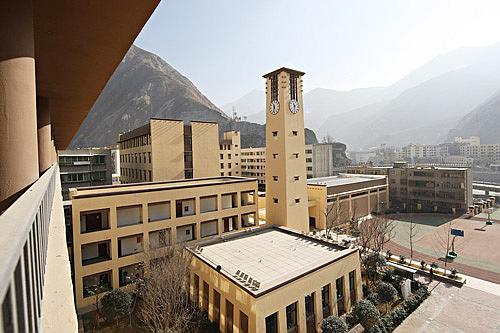
The newly-built Wenchuan No.2 Primary School (ZHAO XI) |
Reconstruction in Wenchuan, epicenter of the 8.0-magnitude earthquake that occurred on May 12, 2008, has paid special attention to disaster mitigation and safety precautions in order to protect residents during and after future earthquakes, officials say.
Located northeast of Wenchuan, Weizhou Town sits on the Longmenshan Fault, a thrust fault that runs along the base of the Longmenshan Mountains in west China's Sichuan Province. The 2008 Wenchuan earthquake occurred along this fault. In other words, the town faces a very high risk of earthquake at any moment.
Weizhou Town suffered devastating losses in the Wenchuan earthquake, which destroyed houses, infrastructure and public service facilities. Total economic losses for Weizhou are estimated at 16.11 billion yuan (about $2.4 billion).
According to reconstruction plans issued by the State Council, China's Cabinet, south China's Guangdong Province is responsible for reconstruction aid in Wenchuan County, with a total of 702 projects worth 8.2 billion yuan (about $1.2 billion).
Guangzhou, capital city of Guangdong Province, is in charge of reconstruction in Weizhou Town worth 2.8 billion yuan (about $409 million), accounting for 34.1 per cent of the total.
Measuring and planning
Xu Minggui, head of the Project Coordination Department of the Guangzhou Aid Working Group, said that when the working group arrived in Weizhou Town, the staff found that information on local topography and geographical features was unavailable, since the nearby geological observation stations were either damaged or shifted by the earthquake.
Therefore, the first task for the working group was to spend several months making an accurate landform measurement (scale 1:500) within the 20 square km around Weizhou Town.
"The data was very valuable for reconstruction and will be included in Sichuan's surveying and mapping data," Xu said.
The staff also inspected residential buildings in the town, noting their location, function, original structure and degree of damage.
In the process of reconstruction planning, a system of earthquake precautions and disaster mitigation was given first priority.
Xu said that before the earthquake, local building density was too high. Residents had to flee to the mountains when the earthquake hit. The staff decided to make every effort to establish three big squares for disaster prevention within such a small, crowded town. One of the squares across from the office building of the county government covers nearly 20,000 square meters.
The squares could otherwise function as resort and leisure places, which would help promote tourism.
Advanced technology
Xu said that all the schools the Guangzhou aid group has rebuilt can withstand earthquakes up to 8.0 in magnitude. For example, Wenchuan No.2 Primary School is enwrapped in a rubber shock isolator.
This particular technique was researched and developed by the national key laboratory at Guangzhou University and headed by Zhou Fulin, an expert on shock isolation and an academician in the Chinese Academy of Engineering. Zhou was also an advisor to the Guangzhou aid group, taking charge of project implementation in Wenchuan County.
Xu explained that the rubber shock isolator ensures student safety by absorbing the shock wave from an earthquake. The isolator is alterable with a 50-year service life and 100-year design life.
"Theoretically, the technique could enable a building to withstand earthquakes several magnitudes higher than before," Xu said. "But considering the difficulties in construction, we think the school will resist earthquakes at least one magnitude higher than before."
Wenchuan No.2 Primary School is also outfitted with shock isolator transition boards between buildings. The transition boards separate buildings and lessen the shock wave from an earthquake.
The new Wenchuan No.2 Primary School is a modern structure built in the ethnic Qiang architectural style. Big glass windows allow students to view the shock isolator embedded in the building's structure, raising their awareness of earthquake preparedness.
In addition, considering the cost and difficulties of construction, the projects funded by Guangzhou utilize various advanced shock isolation techniques that maximize protection and minimize expense.
Energy-saving solutions
All projects are required not only to ensure safety but also to save energy in accordance with the Energy Conservation Law.
Wenchuan County is rich in sunshine but has poor living conditions, as it is surrounded by mountains and often hit by heavy sandstorms. As part of the reconstruction process, the external walls of most buildings are made of squeezed plastic foam boards and thermal mortar to make indoor temperatures more comfortable.
Other energy conservation techniques used in reconstruction include solar power and energy-saving fans. For instance, the air conditioning system at Wenchuan County Hospital uses water from the Minjiang River for refrigeration, reducing electricity consumption and the demand for air conditioning as well as extending the service life of the equipment.
Ecosystem recovery
Ecosystem recovery is another mission of Wenchuan's reconstruction, especially recovering the ecosystem of the surrounding mountains.
In Baoziguan, suburban Wenchuan, vegetation recovery and ecosystem [re]construction have been implemented using various techniques, such as aerial sowing and water intake. The coverage rate of vegetation in Baoziguan will reach 85 percent after the project finished.
An urban greening program is also planned for Wenchuan.
(Reporting from Weizhou, Sichuan Province) |