|
 |
|
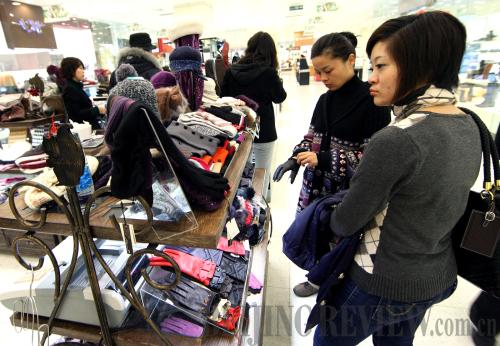
SPENDING SPREE: Consumers browse at a shopping center in Shanghai's Xujiahui District on January 2, 2010. Statistics from the Shanghai Municipal Commission of Commerce show that total sales volume for 100 large and medium-sized commercial businesses in Shanghai reached 1.5 billion yuan ($220 million) over the two-day promotion period from December 31, 2009 to January 1, 2010, a year-on-year rise of 37.6 percent (XINHUA) |
Statistics from the National Bureau of Statistics (NBS) indicate that the consumption rate of the Chinese people is growing more slowly than that of investment and exports. But Ye Tan, chief commentator at National Business Daily, is skeptical. She recently offered her insights in Economy & Nation Weekly. Edited excerpts follow:
In accordance with the logic that consumption in China is too slow, China is unable to expand domestic demand. The imperfect social security network is the first thing to be blamed, followed by the extraordinary thrift of the Chinese people.
This opinion is even echoed by the NBS. Peng Zhilong, head of the NBS Department of National Accounts, said on December 2, 2009 that China's household consumption accounts for only a small proportion of gross domestic product (GDP), and that its growth is fairly slow compared with the growth of investment and exports.
In 2008, China's household consumption accounted for 35.5 percent of GDP, compared with 70.1 percent in the United States and 54.7 percent in India. Nevertheless, India's per-capita GDP stood at $1,024, while the figure in China was three times higher at $3,266.
Is it true that the Chinese people cannot spend their money? The fact is China has become the second largest consumer of luxury goods following Japan, even surpassing the United States in recent years.
In early 2009, China cut the purchase tax on vehicles with engines of 1.6 liters or less from 10 percent to 5 percent. As a result, auto businesses in China weathered the global financial crisis relatively unscathed. Statistics from the China Association of Automobile Manufacturers showed that in the first 11 months of 2009, both industry sales and production exceeded 12 million, with the two numbers expected to break 13 million by the end of the year. China has become the world's largest vehicle producer and consumer.
Is China's household consumption rate too low? The data give food for thought. In 2008, the country's household consumption rate, allowing for the impact of price fluctuations, was 11 times higher than in 1978, with an average annual growth rate of 8.8 percent. Although the figure did not grow as fast as GDP, it is not low, and it is normal for an investment-type economy.
Actually, China's ultimate consumption rate "has remained high," according to Huang Hai, a member of the Chinese People's Political Consultative Conference (CPPCC), and former assistant minister of commerce.
China's annual ultimate consumption rate exceeded 60 percent from 1978 to 1992, with the figure peaking at 61.7 percent in 1981. Although the figure tended to fall from 1993 to 2005, especially in 2006 (50 percent) and 2007 (48.8 percent), the final consumption expenditure rate was rising. The consumption expenditure rate rose year on year by 12.4 percent, 13.1 percent and 16.1 percent, respectively, from 2004 to 2007.
China's consumption rate continued to rise in both 2008 and 2009 despite the impact from the global financial crisis. According to NBS statistics, total retail sales of consumer goods rose 21.6 percent year on year in 2008. The figure for the first three quarters of 2009 rose 17 percent allowing for price fluctuations.
China's consumption rate is undervalued, with the most obvious factor being housing consumption. Housing consumption is not included in the consumer price index (CPI). The NBS prefers to leave the practice of buying and selling houses, durable products that can increase in value, in the realm of investment, according to international practice. But even Peng acknowledged that rents are increasing along with housing prices.
The other factor should be expenditures on education and medical care. Song Yuezheng, head of the Department of Trade & External Economic Relations Statistics at the NBS, said in November 2009 that the government should recognize that "some consumption rates in terms of education, medical care and entertainment are not included in total retail sales of consumer goods."
Statistics on total retail sales of consumer goods are thus incomplete and fail to indicate the real situation of consumption among urban residents, rural residents and various businesses.
China's average household consumption rate would not be below that of India if expenditures on housing, education and medical treatment were included.
The statistical method China currently uses is already outdated, failing to reflect changes in either overall household consumption or market reality and people's livelihood.
Due to the fact that some expenditures on education, medical care and rent are not wholly included in the statistics, the Chinese people are considered "reluctant consumers." As a result, the current statistical method may mislead people trying to understand China's real economic structure. |