|
At present, the value of the yuan is faced with two major challenges. In the international market, it undergoes pressures of appreciation due to U.S. allegations. But domestically, the yuan is at risk of depreciating. The reasons are as follows.
First, China currently forbids a free exchange of foreign currencies in the country. Both the foreign exchange income of exporting companies and the foreign investment in foreign currencies must be sold to the government. The government will pay for those foreign currencies with the yuan. To date, the government has accumulated over $2.4 trillion worth of foreign currencies, which means it has issued an additional 15 trillion yuan accordingly.
Second, under the moderately loose monetary policy in recent years, skyrocketing loans—as much as 9.6 trillion yuan ($1.4 trillion) poured into the domestic market last year—have been unprecedented and placed enormous pressure on the market.
Third, tremendous bank deposits have formed a potentially huge purchasing power, but convincing people and companies to spend this money presents a challenge, despite excess productivity.
Theoretically, the yuan appreciation could help relieve domestic inflation pressures. But it is nearly impossible to appreciate the yuan in the international market, while keeping the yuan stable in the domestic market. Once a wave of vicious inflation sweeps the domestic market, the yuan will be dumped, which would in turn cut the yuan's value.
How unfair the trade?
 |
|
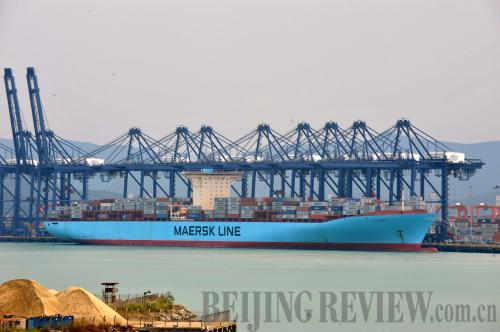
INCREASED SHIPPING: A cargo vessel full of goods stops at Yantian Port of Shenzhen in Guangdong Province. Ships entering and leaving the port have increased as the world economy recovers (CHEN YEHUA) |
The United States claims that China has been in a favorable position in their bilateral trade. In 2009, U.S. statistics showed China's trade surplus with it was $226.8 billion. (China Custom figure was $140 billion.) But not all the surplus has flowed into Chinese pockets.
Processing trade goods are China's major exported products. Among all those goods exported to America in 2009, about 73 percent were produced by foreign-owned and joint-venture companies in China. Also, among high value-added and hi-tech products exported by China, foreign companies took up more than 90 percent. The Chinese surplus generated by those companies should not be included.
More than 20 percent of "Made-in-China" products exported to the United States are from American companies invested in China. But the U.S. Government puts the trade surplus generated by those companies on China.
The U.S. calculation also includes those products labeled "Made-in-China" that are actually re-exported by other countries or regions.
Therefore, China is not responsible for causing the huge trade deficit with the United States. The long-term China-U.S. trade imbalance is actually a consequence of the discriminating trade policy adopted by the United States against China.
After adopting the reform and opening-up policy in 1978, China has always welcome U.S. products and investments. Against the backdrop of the global financial crisis, China organized a number of purchasing delegations to America in a bid to boost U.S. exports to China.
In a striking contrast, the U.S. Government strictly forbids exports of hi-tech products to China, and only allows exports of industrial goods and agricultural products. This is the true reason for the U.S. trade deficit with China.
The crux of China-U.S. trade relations is not "imbalance," but "unfairness." Among the annual average $400-billion trade volume between the two countries, China provides cheap, quality daily necessities for U.S. citizens at the cost of heavily polluting its environment and diminishing its natural resource reserves. And look what they have given in return—greenbacks whose actual value is much less than the market value, since the U.S. Government can always print more dollars to pay off its debts when necessary. After China exchanges goods for U.S. dollars, it lends the dollars back to help the United States cover up its huge fiscal deficit, which is expected to be $1.5 trillion in 2010. This allows the United States to avert bankruptcy, guarantee its public welfare expenditures, and save itself from undergoing a second round of financial turmoil.
To bring balance to China-U.S. trade, the U.S. Government must drop its current discriminatory trade policies against China, and get back on the right track of equal, fair, and mutually beneficial trade.
The author is a senior economist at the Chinese Academy of Social Sciences |