|
 |
|
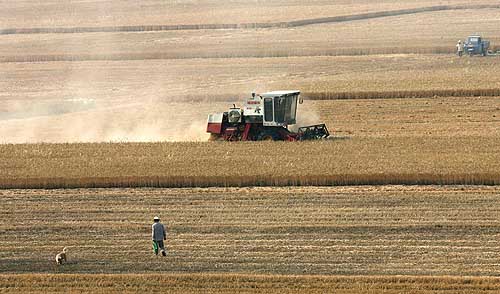
GRAIN BASE: Central China's Henan Province is the country's largest grain producer (CHEN XIAODONG) |
Figures for the Central Provinces (2008)
| |
Shanxi |
Henan |
Anhui |
Jiangxi |
Hubei |
Hunan |
| Population (million) |
34.1 |
99.18 |
67.41 |
44.0 |
57.11 |
68.45 |
| GDP (billion yuan) |
693.87 |
1,840.78 |
887.42 |
648.03 |
1,133 |
1,115.66 |
An old Chinese proverb says, "Those who control central China control China." The region that is comprised of Shanxi, Henan, Anhui, Jiangxi, Hubei and Hunan provinces covers an area of 1.03 million square km and has a population of 370 million, accounting for 10.7 percent and 28 percent of the country's total, respectively. It is the country's most important energy and grain base and a major transportation hub.
But the region's economy is comparatively weak. In 2008, the GDP of the six central provinces accounted for 21 percent of the country's total, while the GDP of the two most developed coastal provinces-Jiangsu and Guangdong-accounted for 21.9 percent.
The launch of the reform and opening-up policy some 30 years ago kicked off the rapid development of the eastern coastal region. The government also issued a large-scale development strategy for the west in 1999 and a revitalization plan for the northeast in 2003. But it was not until 2006 that the government developed a strategy to bolster the central.
"Although all the provinces of central China have been affected [by the financial crisis] to various degrees, they have continued on their development path," Vice Premier Wang Qishan said in April at Expo Central China 2009 in Hefei, capital city of Anhui Province.
Powerful Advantages
Central China's provinces are even more confident than before as they face down the sweeping financial crisis.
"With the world economic crisis and China's consumption stimulus in the background, both the country and the world have paid more attention to the region. I like to call it confidence in central China, which is more precious than gold," said Wang Sanyun, Governor of Anhui Province.
Landlocked central China's economy is much less dependent on overseas demand. In 2008, the region's export constituted only 4.1 percent of the country's total. The area's past shortcoming has become an advantage to it.
"The financial crisis took a less heavy toll on central China's economy compared to the coastal area," said Luo Qingquan, Secretary of the CPC Hubei Provincial Committee. "The crisis will accelerate the industrial and capital accumulation in central China."
A population of 370 million provides a vast market for economic development. "To stimulate the demands of central China is the same as creating a market almost as big as the European and American markets," said Liu Fuyuan, a researcher from the Academy of Macroeconomic Research under the National Development and Reform Commission.
Central China's agricultural population accounts for 70 percent of its total and 40 percent of the country's overall population of farmers. With income growth among the agricultural population, urbanization will also be accelerated. This is another driving force to the rise of central China, Liu said.
Connecting east to west and north to south, central China is positioned to be a convenient transportation hub second to none. National transportation arteries including railways, highways and the Yangtze River waterway all pass through central China.
|