|
| Xinjiang Today |
| From preservation to promotion | |
|
|
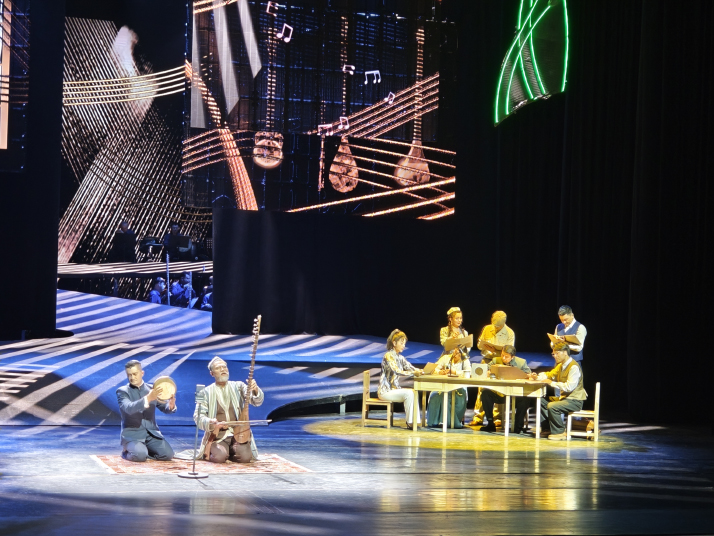 The Love of Muqam: Wan Tongshu is staged on the opening day of the Fourth Xinjiang Culture and Arts Festival in Urumqi on March 19 (ZHU CHENGXIAO)
Muqam, meaning "classical music" in Uygur, is a comprehensive art form created by the Uygurs, integrating songs, dances and literature, and hailed as the encyclopedia of their history and social life. Muqam has a wide variety of genres and in the 16th and 19th centuries, two major compilations of Muqam pieces were made. The most quintessential and refined 12 from these became known as the "Twelve Muqam." However, in the 1950s, the Twelve Muqam was on the verge of extinction as oral traditions began to disappear. Then musicologist Wan Tongshu and his wife Lian Xiaomei stepped in to record, transcribe and preserve this unique grassroots art. In 1951, Wan was a researcher at the Central Conservatory of Music in Beijing when the Central Government assigned him to go to Xinjiang to preserve the Twelve Muqam musical culture. There were numerous challenges. Wan could not find a single recording device in Xinjiang. The power supply was erratic, adding to the difficulties in recording veteran Muqam practitioners like famed folk artist Turdi Ahon, whose repertoire included hundreds of songs. And he had to endure the loss of his infant son due to pneumonia. But he doggedly continued with his mission. Thanks to the tireless efforts of Wan and many other people, Muqam has been revived and won UNESCO's recognition in 2005 as a Masterpiece of the Oral and Intangible Heritage of Humanity. Wan passed away in 2023. As a tribute to his dedicated work, an opera based on his mission, The Love of Muqam: Wan Tongshu, was staged on the opening day of the Fourth Xinjiang Culture and Arts Festival in Urumqi on March 19. It also shone a light on how artists are recording music from folk artists and passing on intangible cultural heritage. Muqam's signature rhythms fused perfectly with the Western singing style of opera, showing how music transcends borders and unites cultures. Wang Shaohui, a Xinjiang actor who plays Wan in the drama, told Xinjiang Today that to authentically portray the character, he retraced Wan's footsteps through several field visits and researched his life. Wang called Wan a "guardian" of culture. Jia Qianqian, who portrays Lian, said she hopes to inspire the audiences' love for China's cultural heritage through the role, while sharing with them the splendor of the Muqam and the story behind the preservation of this art form. Unlike the challenging past, Xinjiang is increasing support for artistic creations. In recent years, events such as the arts festival have enriched the cultural lives of local people and provided Xinjiang artists with high-level platforms for exchange and performance. These initiatives have elevated artistic creativity and injected fresh vitality into the region's cultural industry. 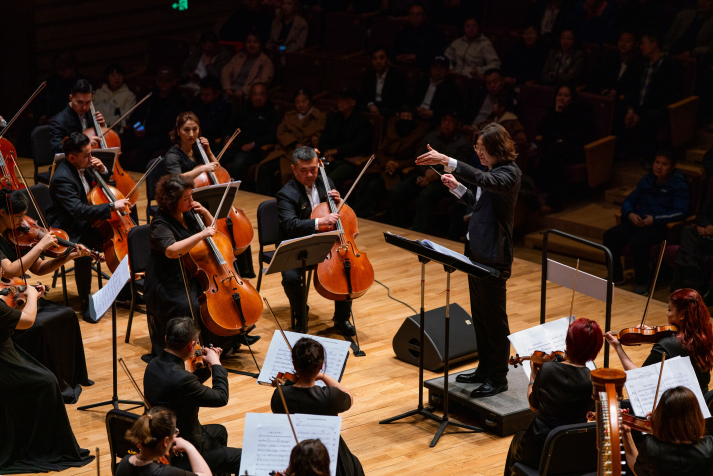 Singing Folk Songs in Xinjiang, a symphony concert of classic folk songs by Wang Luobin, in Urumqi on March 27. Wang was a musician who composed folk songs in standard Chinese based on the music of ethnic minorities in northwest China (CNSPHOTO)
Reaching all doorsteps This year's festival, featuring theater performances, fine art displays and heritage exhibitions, was held in a main venue in Urumqi, with sub-venues established across the region's prefectures, autonomous prefectures and cities. Whether in a bustling city or a tranquil county town, culture is reaching doorsteps. "The performances include new creations by local art troupes and renowned productions like the Suzhou Symphony Orchestra's Dream of the Red Chamber—Resonance concert, together building an artistic platform for cultural exchange and mutual inspiration," Zhao Yanyong, an official from the Department of Culture and Tourism of Xinjiang, told the media on the opening day. Dream of the Red Chamber, also known as The Story of the Stone, is one of China's Four Great Classical Novels. Written by Cao Xueqin in the 18th century, it depicts the rise and fall of a noble family and the complexities of love, society and fate, and the themes remain universal. The festival ensured it was affordable to the general public. Over 50 percent of tickets were priced at 80 yuan ($11) and 180 yuan ($26). Since its inception in 2023, the festival has successfully held three editions, showcasing 111 plays, over 3,800 artworks and more than 670 cultural activities. They have reached a combined online and offline audience exceeding 5 million, showcasing the vibrant vitality and contemporary charm of Xinjiang's culture and arts. 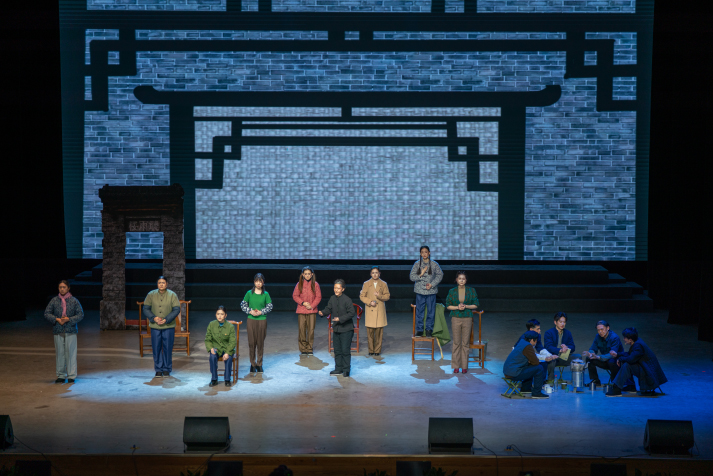 A scene from the drama Nine Daughters in My Family, staged during the Fourth Xinjiang Culture and Arts Festival in Urumqi on March 25 (CNSPHOTO)
Cultivating and promoting At the opening ceremony, Tong Liya, a renowned actress, dancer and singer hailing from Yili (Ili) Kazak Autonomous Prefecture in northwest Xinjiang, introduced the dance drama Here, and Beyond. It explores the themes of love, identity and personal growth while drawing on the cultural traditions of various ethnic groups in Xinjiang, including Kazak, Uygur, Xibe and Tajik. After its premiere in 2019 and an upgrade to version 2.0 in 2025, it will launch a nationwide tour covering 17 cities with 50 performances this year. Tong, the producer and lead performer, invited everyone to Xinjiang, saying, "Friends from all over the world are welcome to visit my hometown." Xinjiang, with a rich cultural heritage, abounds in cultural and tourism resources. One of China's provincial-level administrative divisions with the most diverse natural resources and breathtaking landscapes, it boasts six World Cultural Heritage sites, 133 key cultural relics sites under national-level protection and 779 cultural relics sites under the protection of the region. It is also home to three UNESCO-recognized intangible cultural heritage items, 141 items on the national representative list and 567 items on the list of the region. Currently, there are over 160 registered museums and memorials, more than 100 state-owned art troupes, and 69 performing arts theaters and centers in Xinjiang. 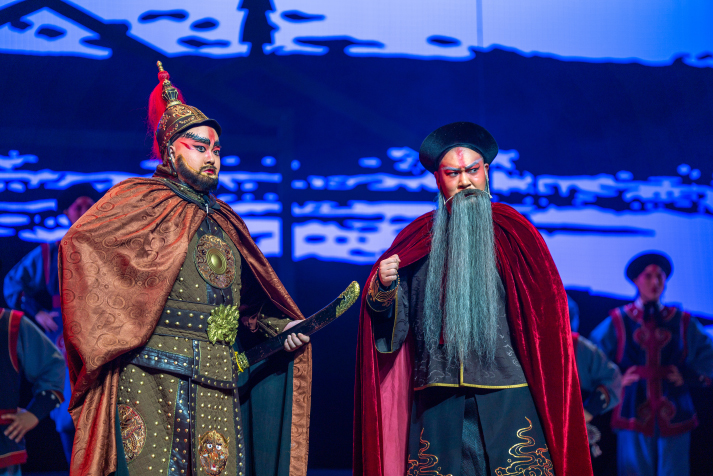 Return to the Homeland, a newly produced Peking Opera, premieres at the Urumqi Peking Opera Theater in Urumqi on March 24 as part of the Fourth Xinjiang Culture and Arts Festival (CNSPHOTO)
In recent years, the region has bolstered cultural confidence, strengthened cultural identity and bonds, and developed the Chinese culture, including its diverse ethnic cultures, with greater momentum and more robust measures. In addition to possessing abundant cultural resources and outstanding works, Xinjiang has also been actively promoting the integration of culture into the daily lives of its residents. By the end of 2024, Xinjiang had established 111 public libraries, 118 cultural centers, 1,126 cultural facilities in towns, townships and sub-districts, and 11,783 village cultural centers, according to a white paper released last year. The region has held the China Xinjiang Folk Art Season, Conference on Reading and village Spring Festival (Chinese New Year) galas that reach all villages and communities. Additionally, the establishment of the pomegranate seed art troupes has expanded access to literature and the arts in rural areas through regular performances. Comments to taoxing@cicgamericas.com |
|
||||||||||||||||||||||||||||
|