
|
| Xinjiang Today |
| Standard Chinese is a window to a wider world | |
|
|
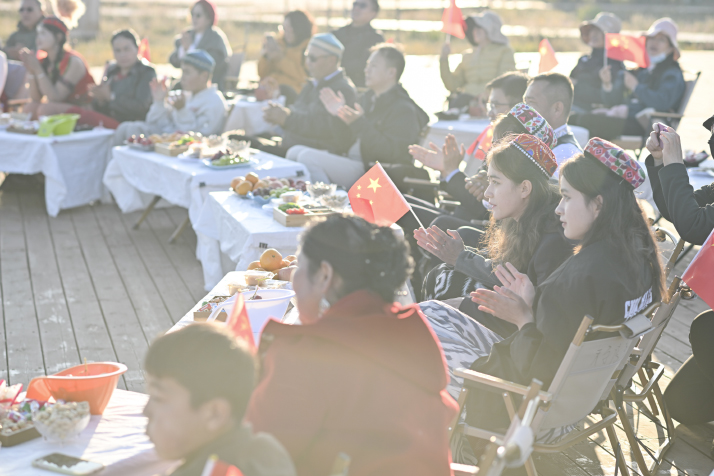 Members of a pairing assistance program to Xinjiang from Jiangsu Province and local people watch performances together in Zhaosu County, Yili (Ili) Kazak Autonomous Prefecture, on October 6, 2025 (XINHUA)
China is a mosaic of ethnicities and traditions. Its prosperity and development depend on integration and mutual understanding between different ethnic groups. On March 12, national lawmakers attending this year's National People's Congress voted to adopt the Ethnic Unity and Progress Promotion Law, a legislation that enhances the legal foundation for advancing common prosperity and development of all 56 ethnic groups in China. The law is a comprehensive statute governing ethnic affairs and fills a notable gap in China's existing legal framework. In doing so, it places China among the relatively small number of countries that seek to safeguard ethnic unity through formal legislation. It demonstrates the importance attached by the Chinese Central Government to guaranteeing legitimate rights of minority ethnic groups, ensuring equality and promoting joint prosperity. The law stipulates that schools and other educational institutions should use standard Chinese, the national common language, as the basic medium of instruction, as the promotion of standard Chinese is mandated by the Constitution and is also an important measure to foster a strong sense of community for the Chinese nation. To me, a native of Xinjiang Uygur Autonomous Region, the stipulation about promoting standard Chinese is deeply personal. While learning standard Chinese has been hard, it has unlocked a wider world for me.  College graduates at a job fair held in Urumqi, capital of Xinjiang, on March 11 (CNSPHOTO)
Promotion of standard Chinese I grew up in south Xinjiang, where only two primary schools and one junior high school offered courses in the national common language. By the time I finished middle school, I could not carry on even a simple conversation in it. When I later enrolled in a teacher-training program in 2009, I began making progress on standard Chinese and was later admitted to Fudan University in Shanghai. To improve my reading and expression abilities, I learned standard Chinese through reading newspapers in the morning, while many of my peers practiced foreign languages. Language, I came to understand, is not simply a tool of communication. It is a gateway to a better life. That insight has guided my work ever since. In 2018, while teaching in a rural village in Hetian (Hotan) County, I volunteered to teach standard Chinese to local residents. Many of my students were starting from zero—adults and children alike tracing Chinese characters stroke by stroke, repeating words until they took hold. Today, many individuals from minority groups in Xinjiang who have not yet learned standard Chinese face difficulties in the job market and in improving their earnings. In recent years, the Central Government and Xinjiang regional authorities have continuously increased investment in education and intensified efforts to promote standard Chinese. In 2024, China's total education expenditure was 6.89 trillion yuan ($999.7 billion), and state fiscal spending on education accounted for 4.02 percent of the GDP, maintaining a level above 4 percent for 13 consecutive years. In the same year, Xinjiang's education expenditure reached 127.73 billion yuan ($18.5 billion). Since 2012, fiscal spending on education in Xinjiang has, on average, accounted for 6.23 percent of the regional GDP, with a cumulative investment of 47.9 billion yuan ($6.9 billion) to improve conditions in primary and secondary schools. A total of 39,500 primary and secondary school and kindergarten teachers have been recruited, continuously enhancing teaching capacity. In 2024, Xinjiang had 332 senior high schools with 46,786 full-time teachers, 964 junior high schools with 94,519 full-time teachers, and 3,400 primary schools with 159,141 full-time teachers. This provides favorable conditions for promoting standard Chinese at all levels of schooling. 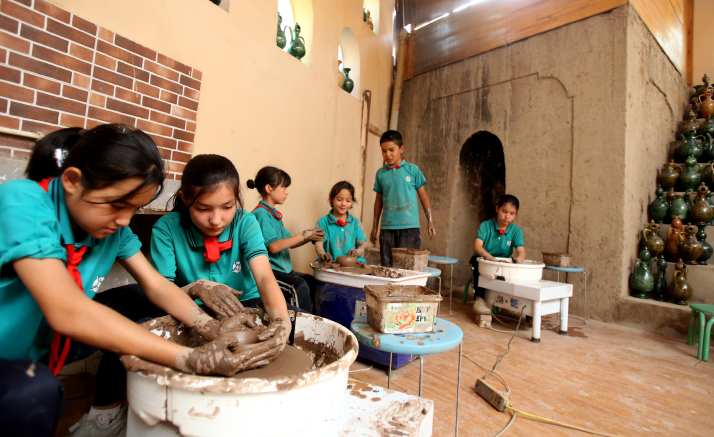 Students learn to make pottery, a local intangible cultural heritage, at Tutao Village in Kashi (Kashgar) Prefecture on September 11, 2025 (XINHUA)
Bridging the gap The law on ethnic unity and progress mandates the promotion of standard Chinese, which helps improve educational equality and enables young people from minority ethnic groups to better acquire knowledge and skills. At the same time, the law also guarantees the right of ethnic minorities to use their own languages, promotes the more standardized use of ethnic languages, and supports the preservation and research of ancient texts in minority languages. As of 2011, China had 229 periodicals in minority languages. Over 100 newspapers in minority languages had been published in 13 different scripts, covering 12 provinces and autonomous regions, accounting for 5 percent of the total number of newspapers nationwide. My own journey was made possible in large part by acquiring standard Chinese. With proficiency in standard Chinese, ethnic minorities can gain better access to higher education and more employment opportunities. In a country as diverse as China, unity must be built through the joint efforts of all ethnicities. Standard Chinese serves as a bridge that enables everyone to participate in the nation's modernization drive and share equally in the fruits of economic and social development. The author is an associate professor at the School of Journalism and Communication, Xinjiang University Comments to ffli@cicgamericas.com |
|
||||||||||||||||||||||||||||
|