
|
| Xinjiang Today |
| Paradise in four seasons | |
|
|
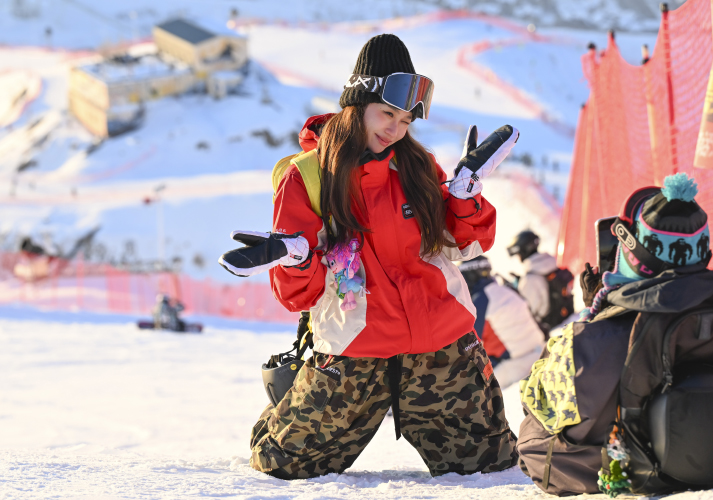 A ski enthusiast poses for photos at the Jiangjun Mountain International Ski Resort in Altay on February 25 (XINHUA)
In the Kazak language, Altay means "gold." Long ago, people came to Altay Prefecture in Xinjiang searching for gold buried in the mountains. Now, a different kind of gold rush is quietly unfolding in this most remote section of China's borderland. People now travel to Altay seeking something that has nearly disappeared from urban life: slow time, unobstructed starry skies and the freedom to dance in snow at 20 degrees below zero Celsius until the sun sets. Today, Altay is becoming one of the most unexpected laboratories for modernization on China's frontier. It is doing so through its beautiful landscape and welcoming people. 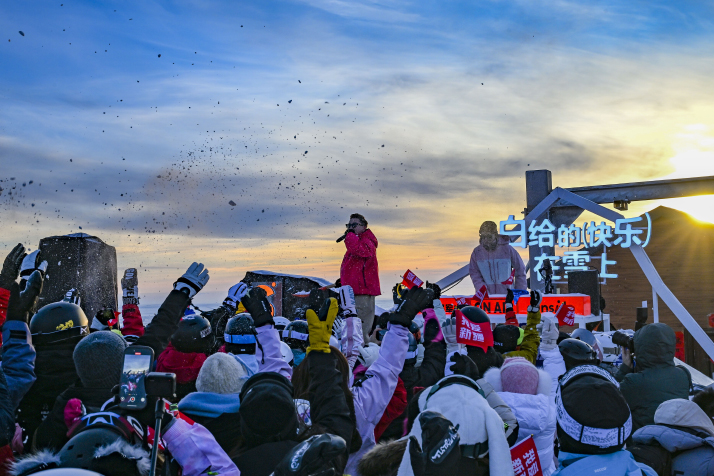 Skiers join a party at the Jiangjun Mountain International Ski Resort in Altay on January 28, 2025 (XINHUA)
Winter wonderland Altay has only become known as a destination for winter tourism and winter sports in recent decades, but the presence of skiers in the region stretches back millennia. Increasingly recognized as the birthplace of skiing, archaeological evidence suggests humans were skiing here over 10,000 years ago. From October to April, the region is blanketed in powdery snow, turning the Altai Mountains into a winter wonderland. Located at the northern end of the "golden latitude belt" for skiing—roughly 45 degrees north, around the same latitude as the French Alps and the Japanese island of Hokkaido—Altay receives an average annual snowfall of two to three meters. But what makes Altay's snow exceptional is its quality. The combination of cold, dry air from Siberia and the region's unique topography produces what skiers call "champagne powder": Snow so light and dry that it feels almost weightless underfoot. Unlike the heavy, wet snow found in many other ski destinations, Altay's powder allows for smooth, effortless turns, earning it a reputation among enthusiasts as one of the finest skiing surfaces on Earth. The Jiangjun Mountain International Ski Resort in Altay City, one of the top ski resorts in Xinjiang, set a record with 1.12 million visitors in 2025, up 30 percent from the previous year. It offers slopes for all skill levels, from beginners to professional athletes, and its world-class facilities play host to the 2025-26 National Cross-Country Skiing Championships in March. But what truly sets Jiangjun Mountain apart is not just its slopes—it is the Sunset Party. Every day at 6:00 p.m. during the ski season, as the sun dips behind the snow-capped peaks, skiers from across China and beyond gather on the mountaintop. A DJ mixes electronic beats with traditional Kazak dombra melodies, and for an hour and a half, in minus-20-degree-Celsius cold, strangers dance together as the mountain is painted in shades of pink and gold. 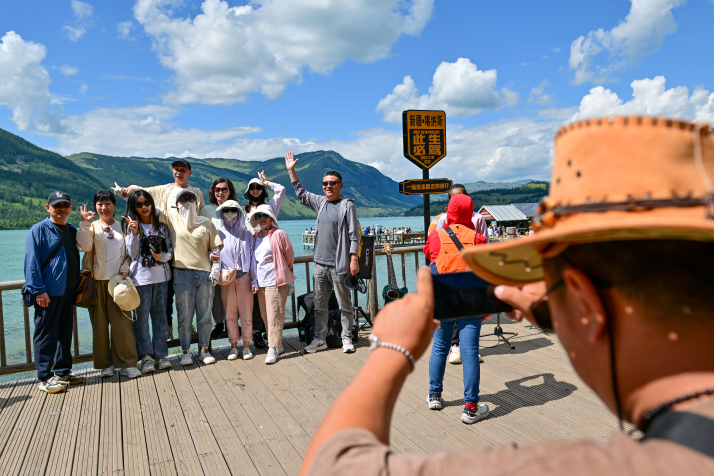 Tourists take a group photo at the Kanas Resort in Altay on July 22, 2024 (XINHUA)
A land of peace As the snow starts to melt in April, Altay awakens to a spring of vibrant contrasts. The once-frozen river thaws, its crystal-clear waters winding through birch forests that burst into green. This is the season of migration for Kazak herders, who move their flocks from lowland winter pastures to the alpine meadows, a practice that has shaped the region's ecology and culture for centuries. Spring in Altay is also a time of renewal for local communities: In villages like Xuedu Village in Aweitan Town, a key village for rural tourism, herders begin preparing traditional handicrafts—such as felt blankets and embroidered hats—to sell to visitors, turning their cultural heritage into a source of income. The mild spring weather, with temperatures ranging from 5 degrees Celsius to 15 degrees Celsius, is ideal for hiking along the river banks. Summer transforms Altay into a cool sanctuary from the heat of Central Asia, with average temperatures hovering around 20 degrees Celsius. This is the season in which the region's natural beauty is on full display: Kanas Lake, a turquoise gem nestled in the Altai Mountains, reflects the snow-capped peaks above, while Hemu Village offers panoramic views of alpine meadows dotted with wildflowers. The Altay-Hemu Highway, which links Altay City and Hemu Village and connects a number of tourist destinations, has attracted numerous self-driving tour enthusiasts since it opened in mid-2025. It is more than just a transportation route; it is an ecological tourism artery that has boosted local economies by connecting remote villages to the wider tourism network. Summer also brings cultural festivals, such as the Kazak Naadam Festival, where herders compete in horse racing, wrestling and eagle hunting, showcasing the vitality of the region's ethnic cultures. For visitors, summer in Altay is a chance to experience "glamping under the stars" at campgrounds or explore the Gebao Red Hemp Flower Sea Scenic Area, a popular spot for study tours that highlights the region's unique flora. Autumn paints Altay in hues of gold and amber, as the birch and larch forests across the mountains turn fiery red and golden yellow. This is the harvest season, when local communities gather crops like sea buckthorn and goji berries—both listed in China's national list of high-quality agricultural products—and prepare for the coming winter. Qiemuerqieke Town, one of Altay's featured rural tourism developments, comes alive with harvest celebrations, at which visitors can taste local delicacies like hand-made milk curd, staple of the region's diet. Autumn is also a prime time for wildlife watching: the Altai Mountains are home to rare species like the snow leopard and the Altay sheep, and protected areas offer guided tours that emphasize ecological conservation. For photographers and nature lovers, the autumn landscapes of Altay are unparalleled, with the contrast of golden forests, snow-capped peaks and clear blue skies creating a postcard-perfect scene. 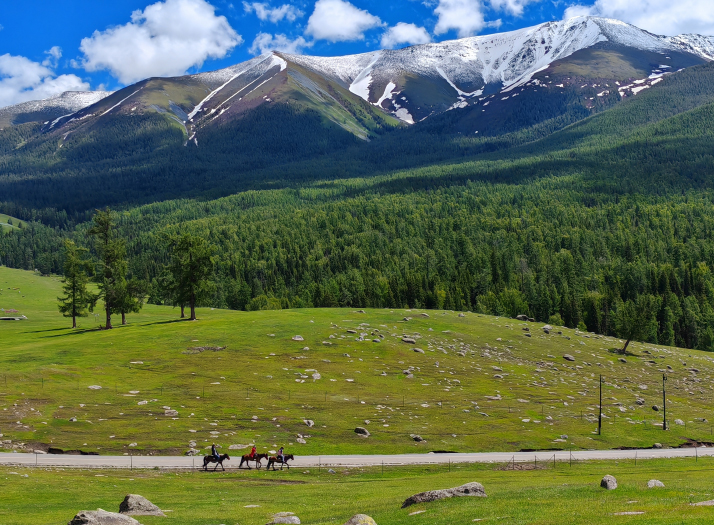 Tourists ride horses in Habahe County, Altay, on June 4, 2024 (XINHUA)
Infrastructure and jobs This seasonal rhythm, however, would not be accessible to most visitors without the transformation unfolding behind the scenes: the constant upgrading of Altay's transport infrastructure. The Altay-Hemu Highway involved a total investment of more than 1 billion yuan ($145 million). Altay Prefecture currently has 18 flight routes connecting to regions outside Xinjiang. In 2024, the prefecture's three airports—Altay Xuedu Airport, Buerjin (Burqin) Kanas Airport and Fuyun Keketuohai (Koktokay) Airport—handled nearly 900,000 passengers combined. According to official statistics, in the first half of 2025, the region operated 62 domestic and international air routes, with 7,511 aircraft takeoffs and landings and a passenger throughput of 565,900, representing year-on-year growth of 70.01 percent and 57.33 percent, respectively. From January to July 2025, Altay received over 6 million domestic tourists, a year-on-year increase of 13.9 percent. Total tourist expenditure exceeded 5.6 billion yuan ($814 million), a year-on-year increase of 15.8 percent. Local authorities recently revealed that in 2026, the region will focus on stabilizing growth, improving people's livelihoods and strengthening foundational infrastructure, with more than 500 fixed-asset investment projects, each valued at over 5 million yuan ($732,600), targeting an annual investment growth rate of approximately 8 percent. Tourist arrivals and tourism revenue have repeatedly hit new highs, bringing real changes to the lives of local residents. "Tourism projects like horse riding are popular with visitors, and our income has increased a lot," said Haiyinaer Baheti, a villager from popular tourism destination Saerwuleng Village. With the growth of the tourism industry, new jobs and opportunities have continued to emerge across sectors such as transportation, hospitality and entertainment, including cable car operators, ski equipment repair technicians, ski photographers and slope maintenance workers. "The village looks more beautiful every day. Our lives are getting better and better," Haiyinaer concluded. Comments to luyan@cicgamericas.com |
|
||||||||||||||||||||||||||||
|