|
| Xinjiang Today |
| Tacheng: a place with vibrant rhythm | |
|
|
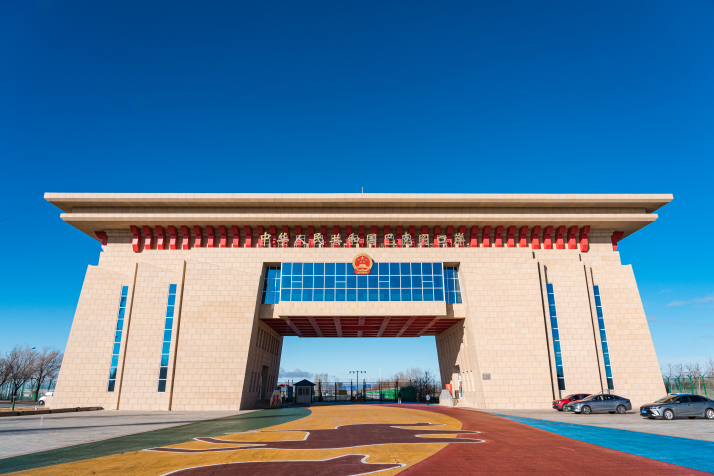 The entrance to the Baktu Port in Tacheng City (VCG)
Situated in northern Xinjiang along the border with Kazakhstan, the Baktu Port in Tacheng City, capital of Tacheng Prefecture, boasts a history of over 260 years as a gateway for trade. Now, as a national first-class land port in the prefecture, it is crucial for Tacheng's economic development, cultural integration, and improvement of people's livelihoods. It is also the key to understanding this border prefecture on the south of the Tarbagatai Mountains.
A green channel Every day, high-quality fruits and vegetables from major producing regions across China, like Henan in the north and Fujian in the southeast, as well as Xinjiang, arrive at the port, to be transported farther from there. The efficient and smooth customs clearance there ensures a steady flow of products ranging from pomelos, mangoes, grapes and pears to zucchini and bell peppers to Kazakhstan and other Central Asian countries, and even Russia, enriching the dining tables in these distant lands. The rapid clearance is enabled by a green channel opened in 2013, the first such channel in China for agricultural products. This has added logistical efficiency to the port's geographical advantages, with discernible results. Tacheng Yongli Trading Co. Ltd., a major fruit and vegetable exporter in the prefecture, has witnessed the efficient customs clearance firsthand. "Since the Spring Festival travel season began, we have seen a notable increase in orders coming in," said He Yuanyuan, a staffer of the company. "Thanks to the efficient and supportive measures, our fruit and vegetable exports are not delayed even during the Spring Festival holiday. The vehicles (carrying the shipments) are inspected as soon as they arrive and cleared quickly. Every shipment is delivered in time, and our customers are very satisfied." Improved customs clearance efficiency has greatly boosted foreign trade in Tacheng. According to official data, in the first three quarters of 2025, the port facilitated the import and export of 520,000 tons of goods, and 136,600 entries and exits of personnel—a year-on-year increase of 73.92 percent. The volume of fruits and vegetables exported through this port has ranked among the top of Xinjiang's highway ports for years. Quicker cross-border fruit and vegetable transportation is just the starting point for the transformation of Tacheng's open economy. In 2020, the State Council approved the establishment of the Xinjiang Tacheng Key Development and Opening-Up Pilot Zone, the first national-level zone of its kind in the border area of northwest China. This pilot zone has completely transformed the Baktu Port, moving it beyond its former role as a mere transit and cargo passage to a core engine driving industrial upgrading throughout the region. The benefits brought by the port percolate to border residents. "Border residents' mutual trade + on-site processing" is an innovative model in Tacheng. It has boosted China-Kazakhstan trade between residents on both sides of the border. Kazakh goods enter a special customs-supervised zone, where they are processed by local enterprises and then sold. This saves costs and increases efficiency. As of November 2025, this model had directly created 1,350 jobs and brought more than 3,000 border residents into the industrial chain, increasing their incomes. From January to November 2025, border residents' mutual trade at the port amounted to 159,200 tons, covering 68 types of goods from five neighboring countries, with a total value of 747 million yuan ($108.3 million). 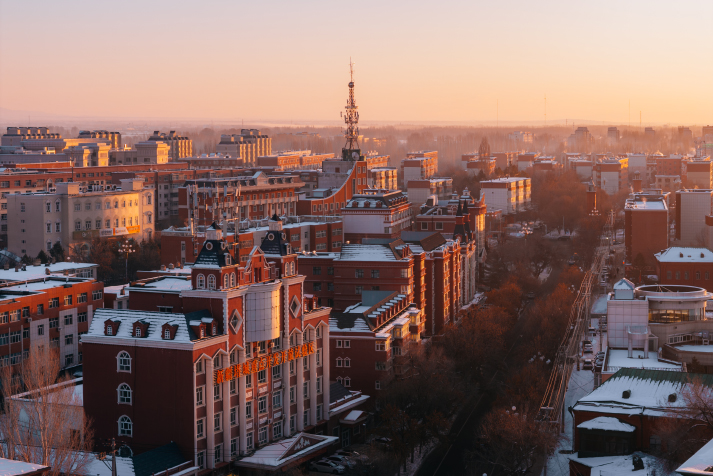 The cityscape of Tacheng City, Tacheng Prefecture, on January 1 (VCG)
Changing life Every acceleration in customs clearance at the port, every increase in foreign trade, and every industrial project ultimately translates into tangible income growth for the local people, upgrades in public services, and an improved quality of life. This is the most fundamental significance of opening up along the border. Residents living around the port for generations are the first to feel these changes. "In the past, whenever we had to see a doctor, we needed our children to take us to the hospital," said Zhang Linmei, a senior citizen who lives in Yumin, a county in Tacheng. "But now, doctors usually come to our home to check our blood pressure and blood sugar levels. It's more convenient." Such in-home medical services have become a normal part of life. The prefecture has over 930 family doctor teams and their contract service covers 78 percent of the permanent population. Thanks to the revenue from the port, Tacheng is able to subsidize public services. The per-capita subsidy for basic public health services increased from 74 yuan ($10.7) in 2020 to 99 yuan ($14.35) in 2025. Measures have been introduced to save medical expenses. During the 14th Five-Year Plan period (2021-25), 4,700 low-rent apartments were built for middle- and low-income families, and over 3,000 more for primarily new urban residents and young people with housing difficulties, up by 39.4 percent and 100 percent respectively over the numbers in the 13th Five-Year Plan (2016-20). Shantytowns and old residential communities have been renovated, benefiting over 29,000 households. Additionally, winter shelters have been built for herders and earthquake-resistant renovations were made in a large number of rural homes. 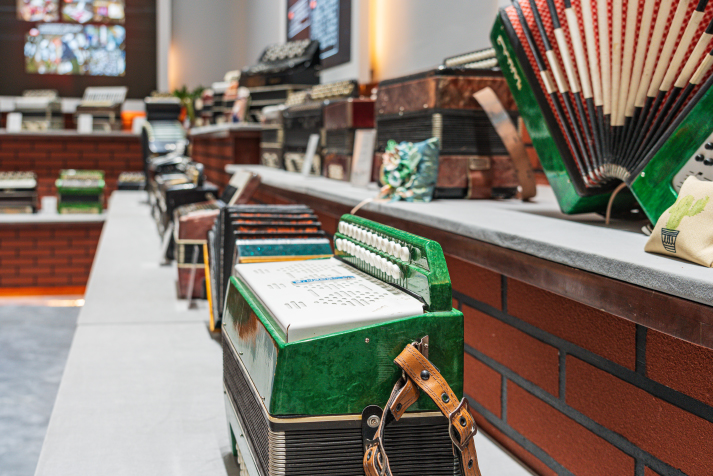 The Accordion Museum in Tacheng City (VCG)
The sound of music Freight vehicles shuttling back and forth embody the economic pulse of the Baktu Port, while the sound of accordions drifting in its streets is a characteristic cultural heartbeat of Tacheng. In 2023, Tacheng City was officially accorded the title China's Accordion City by the Chinese Musicians Association. The origin of this cultural namecard can be traced back to the accordions brought in through the port along the Silk Road trade routes. Dawuran Dvxakan is a Kazak collector of the musical instrument, having devoted more than four decades to this passion. When he was a young teen, Dawuran was fascinated by the music played on an accordion by a street player. He yearned for an accordion and eventually, his father bought him one by trading a cow for it. Thus began Dawuran's lifelong bond with the instrument. After graduation, he became a music teacher and learned the structure of the accordion like the back of his hand. Then he began mending old and broken instruments, "reviving" them. Subsequently, he began collecting vintage accordions. Around 2013, the city government decided to construct an accordion museum and commissioned Dawuran to acquire interesting models from neighboring countries. He brought hundreds of exquisite accordions and today, more than 1,200 are on display at the accordion museum. Accordions have long been part of the campus culture in Tacheng City. All primary and high schools offer accordion courses and have accordion clubs. Lu Hong, a teacher at Tacheng City No.6 Primary School, combines education on ethnic unity with music. Her classes are held in the museum. Lu uses the accordion to enhance friendship among various ethnic groups through melody. In 2016, when Tacheng held its first art festival, she organized a record-setting ensemble of over 1,500 people playing the accordion. In August 2025, the Fifth Tacheng International Accordion Culture and Art Festival brought together accordion artists and enthusiasts from 22 countries and regions. Mirco Patarini, President of the Confédération Internationale des Accordéonistes, called it a vivid example of interactions, exchanges, and integration among different ethnic groups. At the festival, over 5,000 accordion players played together to set a new Guinness World Record for the largest accordion ensemble. Lu and her students were among them. This achievement is not only a source of pride for Tacheng but also an honor for China, setting a new benchmark for the development of accordion culture around the globe. The story of Tacheng begins at the Baktu Port, yet extends far beyond it. The port endows this prefecture with openness, but what truly brings the place to life is the resonance across ethnicities and national borders found in the sound of accordions, and the stable livelihoods of ordinary people buoyed by rising income. It is not just a distant place on a map but a prefecture full of warmth, vitality, and amazing stories. Comments to shangzhouhao@cicgamericas.com |
|
||||||||||||||||||||||||||||
|