
|
| Xinjiang Today |
| Swan guardians | |
|
|
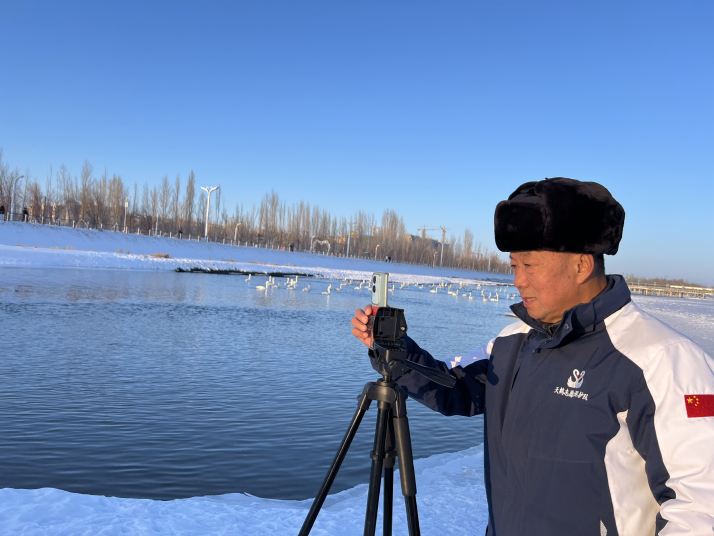 Wu Liping livestreams the swans on the Emin River in December 2024 (COURTESY PHOTO)
A remote county in northwest Xinjiang is writing a remarkable conservation success story. Emin County in Tacheng Prefecture, once a stopover point for migrating birds, has been transformed into a permanent winter home for hundreds of swans, thanks to the dedication of grassroot conservationists, digital outreach, and government action.
This dedication recently won recognition. Known as the "White Feather Guardians," the initiative, led by Wu Liping, a 61-year-old retiree, received the Gold Award at the 2025 Xinjiang Volunteer Service Project Competition. 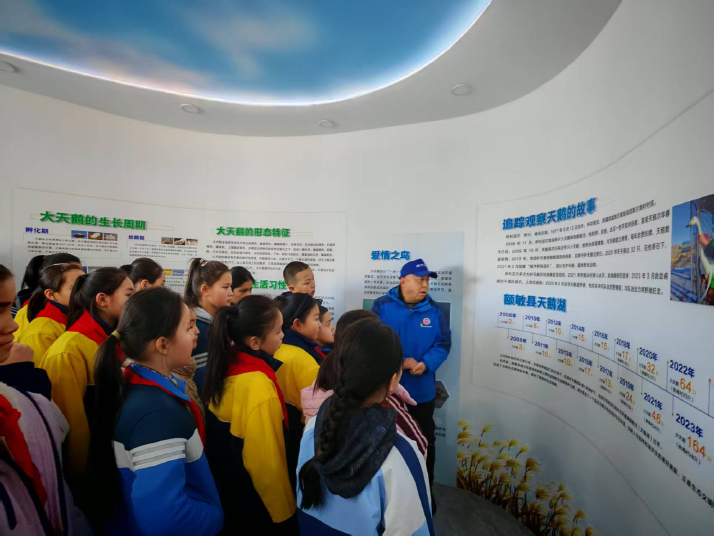 A volunteer gives a guided tour for visiting teachers and students at the Swan Science Popularization Center in Emin County on January 4 (COURTESY PHOTO)
From stopover to permanent home Emin is a critical juncture on the West Asia-East Africa Flyway, one of the nine major bird flyways worldwide. Bird flyways are the routes migratory birds follow during their seasonal journeys between breeding and wintering grounds. In the past, each October, vast flocks passed through the county but did not stay as food was scarce, human activity caused disturbance, and the threat of stray dogs loomed large. Things began to change when residents started shooing away stray dogs, stopped photographers from disturbing the birds for better shots, and provided food and care for injured swans. The swans responded and began to linger. The local government recognized this opportunity and stepped in to organize dedicated volunteer teams and improve the ecosystem. As a result, the wintering swan population has risen from the initial two birds to over 180 today.  Swans, mergansers and other migratory birds at the Riverside Park in Emin in December 2025 (FANG JINZHI)
The digital catalyst Wu, who moved to Emin after retirement to look after his parents, began documenting the swans in late 2020. Using the pseudonym "Gang Pao," he posted videos almost daily, and then switched to livestreaming at the suggestion of his growing audience. He shared details of the swans' lives—their diets, travel patterns, and the environmental challenges they face. His audience expanded rapidly, reaching 70,000 followers. His videos have drawn many tourists to the riverbanks. Crucially, his broadcasts mobilized locals from diverse ethnic groups—Uygurs, Daurs, and Kazaks—to join the conservation work. In 2022, Emin began renovating its Riverside Park, a prominent, large public park, and Wu was a consultant for the newly designated swan ecological protection zone in the park. He suggested building artificial, hill-shaped feeding platforms in the river to ensure winter food access for the birds, and advised to discontinue the tradition of placing red lanterns by the river. He also suggested relocating the red riverbank sculptures as swans are sensitive to the color. In 2023, the Emin County People's Procuratorate established a swan patrol volunteer service team with Wu as the lead coordinator. The team is entrusted with round-the-clock patrols, emergency feeding, rescues, and educational outreach. 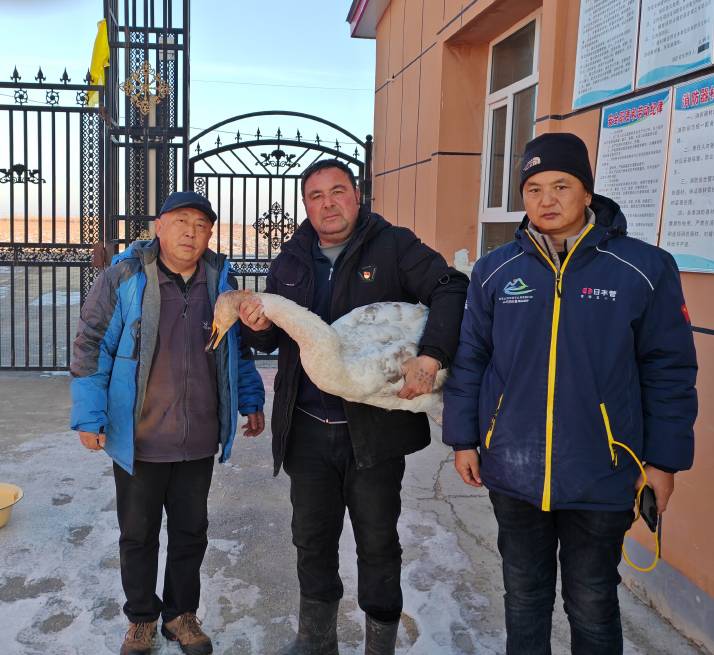 Illyar Ily (middle) and two other volunteers with an injured swan at a rescue center in January 2024 (COURTESY PHOTO) An ecological classroom The commitment extends beyond the riverbanks. On the first workday of 2026, more than 40 primary school teachers and students visited Illyar Ily, a 55-year-old Uygur, at his home. The Swan Science Popularization Center operates from his courtyard. Opened in 2025, the center has a steady stream of visitors, who are given a deeper understanding of avian biology and their ecological responsibility. Illyar's neighborhood is home to 32 households across nine ethnic groups. Most of them raise pigeons and they use their pigeon-raising experience to protect the swans. "It's the same as raising pigeons," Illyar remarked. "The swans are very smart. If you treat them well, they trust you." In 2024, Illyar and others formed the Emin County Wildlife Protection Volunteer Service Team. They conduct regular patrols, clean up the Emin River, and educate the community. They have rescued over 40 injured swans, including one with a severe wing injury that had to be transported to a local rescue center for specialized care. Illyar, who previously spoke limited standard Chinese, now speaks it fluently, thanks to studying with his teammates to communicate more effectively during the educational talks. 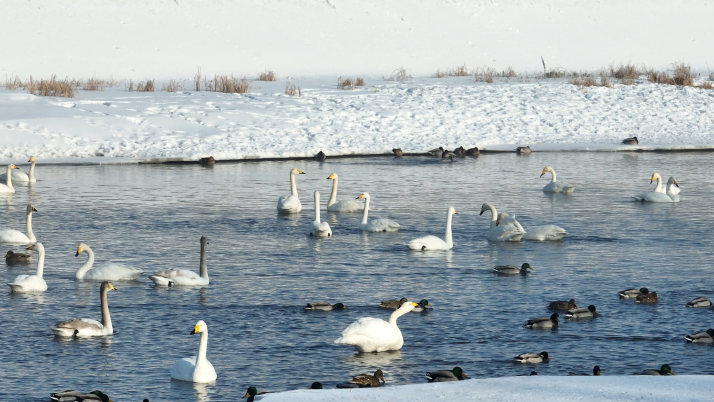 Swans swim in the Emin River in December 2025 (COURTESY PHOTO)
Government stewardship In the late 1990s, the 46-km Emin River was severely impacted by the polluting factories and sand quarries on its bank as well as people dumping waste. In April 2009, the government shut down all the polluting factories and quarries, as well as the riverside slaughterhouses. The river was dredged extensively and received water supplementation. Hundreds of trees were planted to create a green landscape and revitalize the once-stagnant waterway. Within three years, water quality improved dramatically and fish returned after years of absence. The arrival of the swans provided impetus for further environmental refinement. The Riverside Park was upgraded by 2023 and the water areas were expanded. The river chief system, in which officials are put in charge of the rivers, was implemented to ensure regular monitoring and prompt removal of debris. The government also invited public participation. In 2024, the Emin County Charity Association recruited volunteers for patrols and educational outreach to ensure comfortable wintering for the swans. 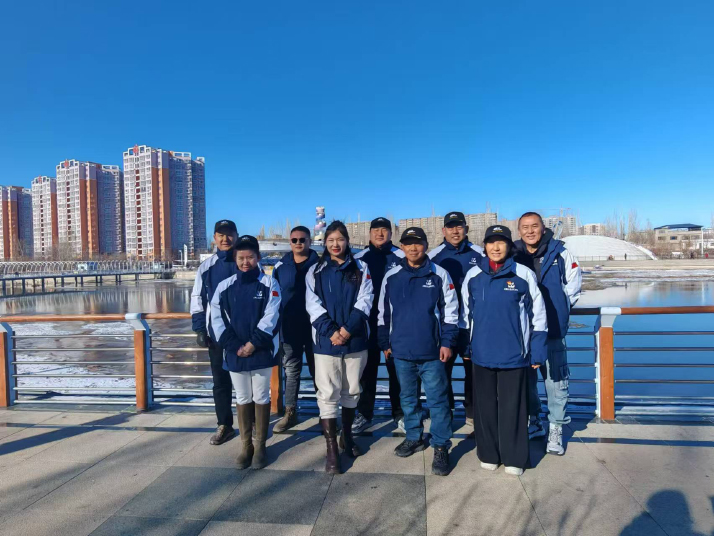 The Swan Patrol Volunteer Service Team in Emin (COURTESY PHOTO)
A model for sustainable development The Emin swan conservation effort is a compelling case study of the concept that "lucid waters and lush mountains are invaluable assets." It has simultaneously driven ecological improvement, boosted local tourism, and ensured stable income growth for residents. It also exemplifies local action in fulfilling international responsibility. By safeguarding this crucial migratory corridor from Siberia to the south, Emin contributes to global biodiversity preservation. Qian Zhen is a retired teacher who has worked in Xinjiang and spent nine years researching Xinjiang-related issues. Quan Huihui is deputy head of the Party School of the Communist Party of China Emin County Committee Comments to jijing@cicgamericas.com |
|
||||||||||||||||||||||||||||
|