|
| World |
| Bridging continents through the shared magic of literature and culture | |
|
|
|
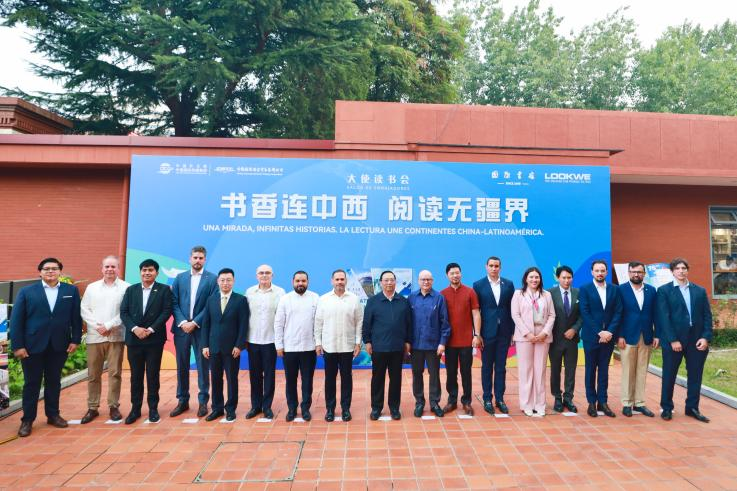
Guests pose for a group photo at the One Glance, Infinite Stories--Reading Unites Continents: ChinaLatin America Ambassador Book Club event held at the Beijing International Bookstore on August 20 In Beijing, the August heat still shimmered off the asphalt, yet a subtle hint of autumn stirred in the morning breeze.
Inside a corner of the Beijing International Bookstore, the air was heavy with a distinct, comforting blend of scents--the fresh, crisp ink of newly printed pages, the faint, herbal aroma of mate and a breath of distant Caribbean breezes carried among the gathering crowd. On August 20, the One Glance, Infinite Stories--Reading Unites Continents: ChinaLatin America Ambassador Book Club event was held here.
Hosted by China International Book Trading Corp. (CIBTC) under China International Communications Group (CICG), the event brought together more than 100 representatives, including diplomatic envoys and officials from over a dozen Spanish-speaking countries, alongside domestic figures from the cultural, academic, educational, media and corporate sectors, in this space known as an international cultural living room.
Interlacing glances The event opened in a relaxed and welcoming atmosphere.
Chang Bo, President of CICG, took the podium. In his opening remarks, he noted that “reading is a vital pathway for humanity to acquire knowledge, foster wisdom and enhance morality.” Behind him, the giant screen flickered with imagery showcasing cultural exchanges between China and Latin America.
Expounding on the philosophy of understanding the world through books and recognizing different civilizations through interactions, Chang said CICG intends to continually strengthen communication with Spanish-speaking countries across media, publishing, think tanks and cultural institutions. He highlighted the organization’s commitment to presenting the vivid practices and fruitful results of China and Spanish-speaking nations in jointly building a community with a shared future for humanity.
Eriberto Gomes, Ambassador of Panama to China, took the floor as the representative of the Spanish-speaking diplomatic corps. Looking out over the audience, his tone was calm yet resolute. In his view, the Ambassador Book Club vividly demonstrates the brotherly bonds of mutual support between China and Latin America, while reflecting their deeply resonant historical echoes. Gomes invited everyone present to turn the pages and explore the spiritual and cultural core of the Latin American land.
During the event, the Latin America-themed special edition of LOOKWE magazine (Chinese-Spanish bilingual version), jointly compiled by over a dozen Spanish-speaking embassies in China, was officially released. As the fresh copies were handed out, guests immediately began flipping through the pages, immersing themselves in the narratives of Latin American culture.
Eladio Jiménez, First Secretary of the Venezuelan Embassy in China, told Beijing Review about the profound connections underlying the written word. “Both Chinese and Latin American nations hold a deep affection for family, and this commonality is vividly reflected in our literature,” he said, adding that Chinese and Latin American peoples share a strong emotional foundation for mutual understanding and communication. “We look forward to more opportunities for cultural exchange and mutual learning in the future.”
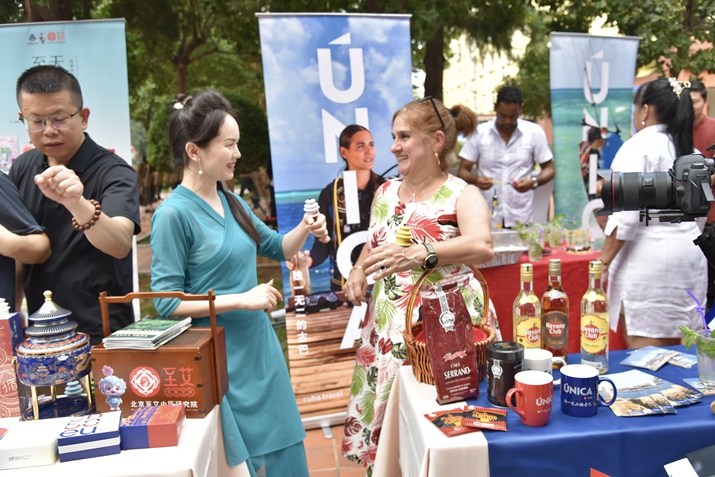
This shared sensibility concerning family, land and emotion forms the foundational code by which Latin American literature and Chinese culture clasp hands across the Pacific. A Chinese representative talks with staff of the Cuban Embassy booth at the One Glance, Infinite Stories--Reading Unites Continents: ChinaLatin America Ambassador Book Club event on August 20(COURTESY PHOTO) Behind the pages Tracing the written interactions between China and Latin America, this transhemispheric gaze did not emerge from a vacuum.
In the grand tapestry of international communication, true foundations of mutual trust are often pieced together from countless micro-fragments. As early as the 1960s, ordinary families in Latin America quietly built their initial imaginations of China through Chinese- or Spanish-language periodicals that traversed the seas. Those yellowed pages and bound volumes of magazines, surviving earthquakes and relocation, formed the most unpretentious bedrock of people-to-people connections.
Yet, times move forward. For contemporary cultural communicators, a practical and concrete challenge remains: How to resonate with Latin American youth who have never read Chinese periodicals, and how to find the common denominator between vastly different cultures. In recent years, widespread attention generated in Latin American media outlets--such as Chile’s Radio Cooperativa--regarding topics like giant panda conservation demonstrates that cross-cultural communication long ago ceased to rely solely on historical friendships. Instead, it must align with local societies' real concerns regarding ecological wellbeing, sustainable development and pragmatic economic and trade cooperation.
From supply chain transformations in agricultural trade to the familial affections flowing through literary works, the connection between China and Latin America is transitioning from mere storytelling to articulating the underlying logic that binds them.
Interweaving Beyond the main venue, the book and culture exhibition area presented a multidimensional landscape with booths representing more than 10 countries, including Nicaragua, Venezuela, Peru, the Dominican Republic, Honduras, Costa Rica, Argentina, Bolivia, Colombia, Cuba, El Salvador, Chile and Uruguay. The Peruvian booth featured historical readings of the Andean civilization; the Argentine booth displayed classic works by poet and essayist Jorge Luis Borges; and the Cuban booth employed vibrant colors and literary works to recount the historical trajectory of the Caribbean island nation.
The Spanish-speaking book and culture exhibition zones were distributed throughout the bookstore, with each country's booth showcasing its own classical literary masterpieces, historical readings, art albums, and cultural artifacts. Indeed, from Colombian novelist Gabriel García Márquez’s One Hundred Years of Solitude to Borges’ poetry collections, and from albums of the Inca civilization to contemporary Latin American art catalogs--stacked together, these books formed a miniature version of Latin America itself.
Just steps away, in the immersive cultural experience market, the exotic charm of Latin America collided warmly with the flavors of everyday Beijing life.
The organizers collaborated with iconic Beijing landmarks and time-honored national brands like Bainian Yili, which showcased traditional Beijing-style pastries at the counters. Concurrently, distinct cultural intellectual properties (IPs)--such as the Beijing International Bookstore's tin toy special exhibition, Chinese New Year paintings, traditional fabric art, Shanghai-style frog buttons (pankou) and ancient, mystical masks of Nuoxi, a folk opera popular in southwest China--were tastefully arranged throughout the marketplace.
Several diplomats paused before a booth showcasing Shanghai-style pankou. Captivated by the intricate geometric knots formed by winding silk threads, one of them lingered as an inheritor of the intangible cultural heritage demonstrated the twisting and pulling techniques. Wanting to try her hand at the craft, she soon had an exquisite pankou taking shape at her fingertips. Holding it up to her companions, a radiant smile bloomed across her face..
This micro-level interaction shattered the sense of distance often brought by grand narratives. Static books and dynamic craftsmanship intertwined at that moment, enabling symbols of diverse civilizations to complete a most intuitive dialogue under the very same roof.
As the agenda drew to a close, the bustle within the Beijing International Bookstore gradually subsided.
In this space, though the crowds had dispersed, the invisible bonds extended by the written word remained unbroken. From the Spanish-Chinese side-by-side lines of the LOOKWE special edition to the lingering warmth left in the cultural experience market, the mutual observation and gazing between different cultures were transforming into countless details of everyday exchange.
For the diplomats, scholars and readers immersed in the experience, this transhemispheric dialogue of civilizations was never a fleeting ceremony, but rather a long journey of understanding and listening forged in the quiet depth of nights spent turning pages.
Copyedited by Elsbeth van Paridon Comments to taozihui@cicgamericas.com Printed edition title:Two Shores, On the Same Page
|
|
||||||||||||||||||||||||||||
|