
|
| World |
| How China's 15th Five-Year Plan is opening doors for Latin America and the Caribbean | |
|
|
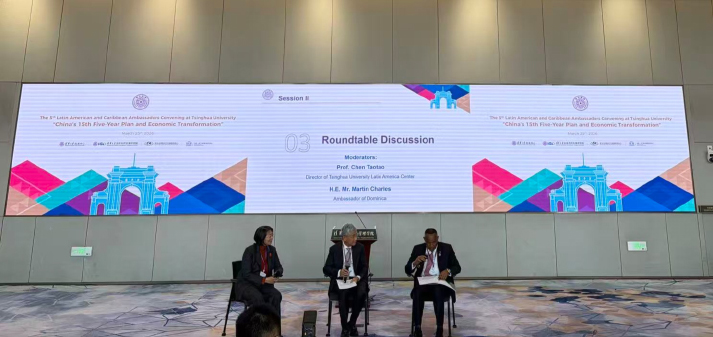 Chen Taotao (left), Bai Chong-en (center) and Martin Charles engage in a roundtable discussion session at the fifth Latin American and Caribbean Ambassadors Convening, held at Tsinghua University in Beijing on March 25 (ZHANG YAGE)
'China's 15th Five-Year Plan (2026-30) invites us to look to the future with determination," said Martin Charles, Ambassador of Dominica to China. "It reminds us that economic transformation is a path that can be traveled together." That message came at the fifth Latin American and Caribbean Ambassadors Convening, held at Tsinghua University in Beijing on March 25, where diplomats, scholars and policymakers gathered to discuss what China's next development chapter means for a region half a world away. The outline of the 15th Five-Year Plan for national economic and social development, adopted this March at the annual session of China's top legislature, sets a slew of goals, with high-quality development high on the agenda. "China's 15th Five-Year Plan has built a valuable roadmap," Charles said. "For many, China is not only a reference point for development and innovation among developing nations, but also a global actor that facilitates stability, peace and resilient and sustainable development." Future blueprint The call for cooperation between China and Latin American and Caribbean (LAC) countries found its anchor in the keynote speech delivered by Professor Bai Chong-en, Dean of Tsinghua's School of Economics and Management and a member of the 15th Five-Year Plan National Development Planning Expert Committee. According to Bai, the plan's emphasis on high-quality development and total factor productivity reflects a deeper transformation. "Even though we don't set a specific GDP growth number," Bai said at the event, "the goal of doubling the size of the economy in the year 2020 by 2035 implies an average annual growth rate of around 4.7 to 4.8 percent. Therefore, the quality of that growth matters more than ever." That quality hinges on innovation and on China's ability to achieve technological self-reliance in key areas. He addressed the skepticism he often encounters from international colleagues who question why China pursues self-sufficiency. "If you are standing in the shoes of a person whose supply chain has been abruptly cut, you understand the risk," he said. "That external pressure has actually become a very strong incentive for China's innovation capabilities." Yet Bai was equally candid about the challenges that accompany transformation. China's economy is navigating a difficult shift from investment-led growth to one driven by domestic consumption. The real estate sector, once a major driver, is contracting, and household spending has not yet filled the gap. "We need to strengthen the social safety net so that people feel secure enough to consume," he said, "for example, by enhancing pension benefits and coverage." Chen Taotao, Director of the Latin American Center at Tsinghua University, told Beijing Review that she believes the drivers of China-LAC cooperation during the 15th Five-Year Plan period lie in green transformation and digital economy. "Green transition will certainly be a major area of growth. Chinese companies already have a solid foundation in the region, given Latin America's rich green resources and China's mature capabilities in this sector. There is also strong interest from both sides in digital economy and technological innovation, but these areas face constraints—regulatory frameworks and differing national policies. Technological innovation, especially, requires careful matching between local conditions and the types of technology China can offer." "The foundation for deeper cooperation has already been laid, and over a decade of rapid trade growth has given both sides a clear understanding of their complementary strengths," Chen added. "With Chinese firms operating in the region for a longer period and gaining greater familiarity with local environments, the conditions for more substantive, mutually beneficial cooperation are stronger than ever." Broader partnership The speech delivered by Bai inspired LAC ambassadors to reflect on the partnership between China and LAC countries. Charles traced cooperation over the past decade, pointing to infrastructure projects that have enhanced logistics and market connectivity, industrial parks that have brought technology transfer, and renewable energy initiatives that have helped Caribbean nations reduce their dependence on fossil fuels. But he also looked forward. "China's 15th Five-Year Plan and economic transformation provides a framework we can leverage to address challenges, reinforce economic openness, promote international cooperation, and continue consolidating relations between China and LAC," he said. Charles also placed emphasis on the human dimension of cooperation. "More young people have gained access to quality jobs and have been integrated into local development projects, thanks to the opportunities offered by China, both through joint initiatives and through training programs, experience sharing and government scholarships," Charles added. "Shared innovation must become an essential asset of cooperation." That sentiment was reinforced by Zhang Run, Director General of the Department of Latin American and Caribbean Affairs at China's Ministry of Foreign Affairs, who offered a broader geopolitical framing. Zhang emphasized that China-Latin America cooperation is fundamentally a form of South-South collaboration. "China firmly believes that the paths Latin American countries choose should be decided by Latin Americans themselves, and that whom they befriend should also be their own decision," Zhang said. "No matter how the international situation evolves, China will continue to advance its cooperation with LAC countries." He identified three areas where the 15th Five-Year Plan could deepen the partnership: expanding market integration through free trade agreements, advancing energy transition and industrial upgrading, and strengthening multilateral coordination to safeguard the interests of developing nations. "We are ready to work with Latin American countries to implement the 15th Five-Year Plan as an important opportunity to jointly promote China-LAC comprehensive cooperative partnerships to better benefit the peoples of both sides," Zhang added. "China's 15th Five-Year Plan and economic transformation invite us to look to the future with determination," Charles said. "It reminds us that economic transformation is a path that can be traveled together and not something exclusive to a few countries. Fostering trust, shared vision and the willingness to learn from one another will continue to underpin cooperation between China and LAC." Shared learning Opportunities are not just about trade volumes or infrastructure construction. They are about people. Chen placed particular emphasis on the human dimension of cooperation, an area where the 15th Five-Year Plan's focus on social development opens new doors for Latin America. Poverty knows no borders. In Latin America and the Caribbean, poverty remains one of the most stubborn challenges. In China in the past decade, nearly 100 million people moved out of extreme poverty, a feat that has drawn global attention with developing countries seeking to understand how it was done. Now, young people from both sides of the Pacific come together to tackle poverty under the China-Latin America Youth Responding to Global Challenges initiative. Launched through Tsinghua University's Latin America Center, the initiative brings together students from China and three LAC countries to conduct fieldwork, identify the root causes of poverty, and propose solutions grounded in local realities. "We aim to inspire a generation of young leaders to join hands in addressing global challenges. Through this challenge program, we encourage Tsinghua students to form multinational teams with students from Latin American countries. Through this collaboration, they can explore the specific realities of poverty in one country, and can learn from diverse national experiences to jointly explore and design poverty alleviation solutions," Chen said. The initiative is part of a broader effort to deepen mutual understanding between China and LAC. Since Tsinghua established its Latin America Center in Santiago, Chile in 2018, the university has sent multiple student delegations to the region. In 2023, nine groups of Tsinghua students visited LAC countries, engaging with local communities, universities and government institutions. The exchange is increasingly becoming a two-way street. Students from Latin American universities have also traveled to China to study poverty alleviation strategies firsthand, including industrial development and inclusive education. "China's experience in increasing education accessibility and accelerating industrial transformation will be helpful for many LAC countries." Chen said. "Many Chinese enterprises operating in LAC countries are actively implementing wellbeing improvement programs there, helping local people with training programs and shouldering their social responsibilities, which I believe will benefit their development in the long run." "Our future plan includes expanding the scale of this program by inviting LAC regional institutions, government departments and enterprises from both sides to get on board with us, to work out a way to turn our visions and plans into concrete actions," Chen said. Copyedited by G.P. Wilson Comments to zhangyage@cicgamericas.com |
|
||||||||||||||||||||||||||||
|