|
| Voice |
| Davos: World order at an inflection point | |
|
|
|
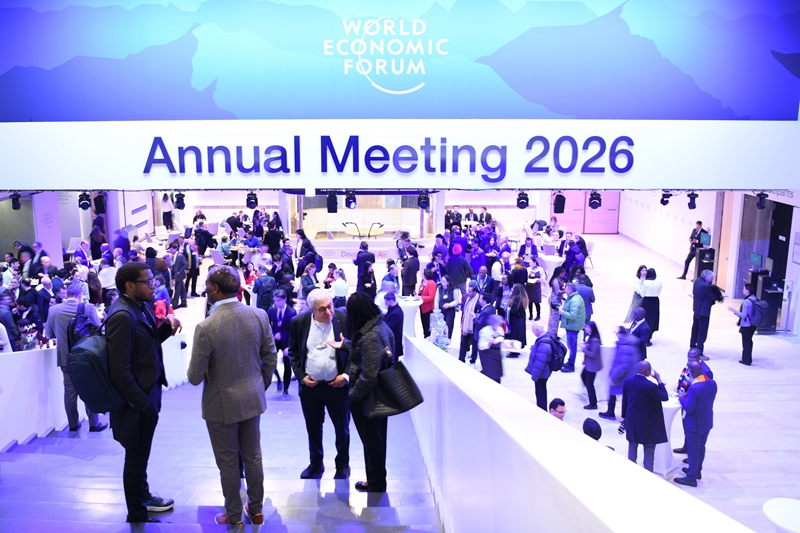
The welcome reception at the 2026 annual meeting of the World Economic Forum in Davos, Switzerland, on January 19 (XINHUA) The recently concluded 2026 annual meeting of the World Economic Forum in Davos will leave enduring imprints on the global economic order. Three speeches presented three visions of reality and charted three diverging paths forward, offering a prisms through which to view and understand the complex world we now inhabit. China's multilateral vision Chinese Vice Premier He Lifeng reiterated China's commitment to multilateralism, emphasizing that China's development stems from reform, opening, and innovation—and that this development provides opportunities to the world. The numbers tell a compelling story. Since China's reform and opening in the 1980s, per-capita GDP (adjusted for inflation and measured in 2010 dollars) rose from approximately $437 in 1980 to over $2,406 by 2001. China's WTO accession in 2001 ushered in another high-growth period, with per-capita GDP reaching $13,122 by 2024. In nominal terms (not adjusted for inflation), their increase is even more striking: according to Chinese statistics, per-capita GDP rose from $69 in 1980 to $1,303 in 2001 and further to $14,134 in 2024—a more than 200-fold expansion over four decades that underscores the transformative scale and speed of China's economic rise. As China pivots from high-speed growth to high-quality development, innovation and productivity growth continue to propel its economy forward, lifting living standards domestically while creating opportunities globally. China has contributed 30 percent of global growth in recent years. Its exports provide not only affordable consumer goods but indispensable intermediate goods for industrial production worldwide. Chinese markets generate enormous revenues for foreign enterprises—an estimated 7 percent of S&P 500 revenues, translating to over $1 trillion. China provided approximately $1.3 trillion in development finance between 2000 and 2021, according to data from William & Mary's AidData research lab. Outward direct investment has grown rapidly as Chinese enterprises such as Huawei, Tencent, BYD, and CATL invest abroad, create jobs, and train local workers. Over 50,000 Chinese enterprises now operate in 190 countries, representing cumulative investment of $1.7 trillion and creating an average of 2 million jobs annually. China's approach to multilateralism, encapsulated in its Global Development Initiative, Global Security Initiative, Global Civilizations Initiative, and Global Governance Initiative, rests on principles of equality, mutual respect, consultation, and win-win cooperation. Recent trade agreements with the EU and Canada, along with 15 official agreements with South Korea, demonstrate China's commitment to resolving disagreements through consultation and negotiation. Against the chaos created by the Trump administration, China's consistent support of multilateralism instills a sense of stability and certainty. Trump's rupture Trump delivered a disturbing 70-minute speech at the meeting. Against a backdrop of domestic grievances and self-congratulations about "success" in reducing inflation and making American cities safer, Trump insisted on U.S. acquisition of Greenland. "You can say yes and we will be very appreciative," he declared, "or you can say no and we will remember." While Trump retreated from earlier pronouncement that he wouldn't rule out using force to acquire Greenland, he nevertheless accused European leaders of being unable to defend Arctic security and threatened to impose an additional 10-percent tariff on eight European countries should they prove uncooperative. European leaders in the audience were visibly stunned, confused, and angered by this blatant disregard for sovereignty, alliance commitments, and basic diplomatic respect. By evening, Trump had reversed course again, clawing back from his tariff threat after reaching a "framework" on Greenland with the NATO Secretary General. Yet the damage was done. The rift deepened irreparably. Trump's assault on the international "rules-based order" and the transatlantic alliance marks the beginning of the end of Pax Americana.
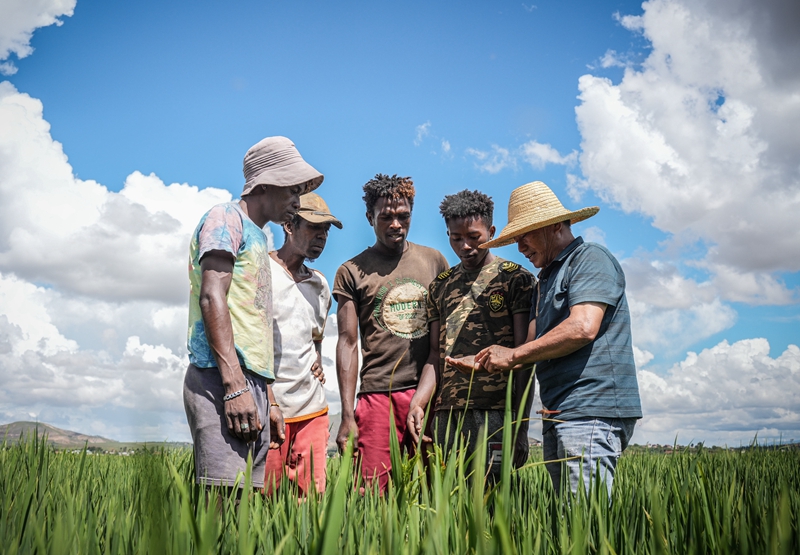
Chinese agricultural expert Hu Yuefang (first right) inspects the growth of hybrid rice with local farmers in Mahitsy, Madagascar, on March 25, 2025 (XINHUA) Carney's call for middle power unity Trump’s version of reality is precisely what Canadian Prime Minister Mark Carney characterized as a "rupture" in his speech delivered prior to Trump's arrival. He spoke decisively: "It seems that every day we're reminded that we live in an era of great power rivalry, that the rules-based order is fading, that the strong can do what they can, and the weak must suffer what they must." It is both revealing and sobering that the veil has finally been lifted from the “rules-based” order. Carney is correct about the rupture, the weaponization of integration, the exhaustion of the “rules-based” international order, and the end of comforting fictions. But the reality is starker: the "rules-based international order" has never existed outside the Western circle. One need only ask Latin America, the Middle East, and Africa whether "rules" prevented interference from America and other "great powers." What's different now is how the U.S. treats its traditional allies and accomplices. Carney called for middle powers to unite and act collectively in counteracting U.S. coercion—a call that seems to be resonated with many European leaders. This again heralds the beginning of the end of the U.S.-centric world order. A choice before us Three speeches, three worldviews. He Lifeng's envisions a multilateral system where global integration and sustainable development are built on principles of equality, respect, and win-win cooperation. Trump's marks the demolition of the neoliberal order that has governed the world since World War II, replacing it with jungle law and naked imperialism. Carney's unveils the delusion of the "rules-based" international order while calling for collective efforts to restore a rules-based system that, while still hierarchical, would at least be predictable. History is being made. Every country now faces a choice: Which world should we make, and how? The author is a professor of economics at Willamette University in the United States. Comments to ffli@cicgamericas.com |
|
||||||||||||||||||||||||||||||
|