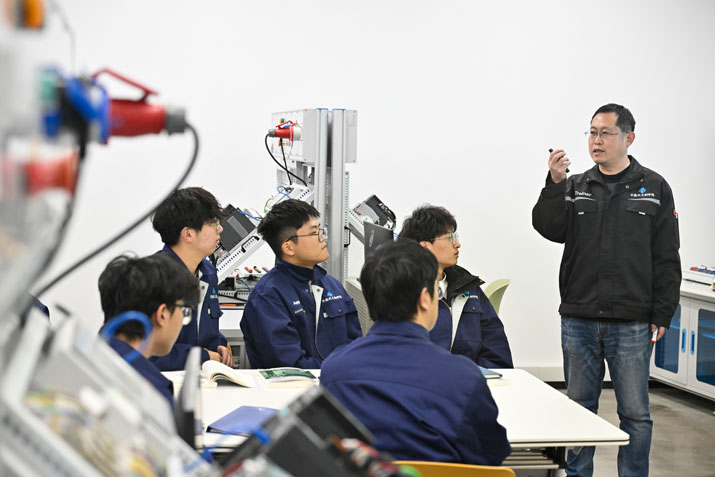
A lecture on programming and control at a vocational college in Suzhou, Jiangsu Province, on March 24 (XINHUA)
For many decades, China's education system has been perceived, externally and internally, as overly reliant on teaching to the test and rote memorization at the expense of creativity. But as the needs of China's society and economy are changing, so too are its educational policies and practices. As they do so, education in China is becoming more well-rounded and more conducive to building an innovation-driven country. In a recent interview with Beijing Review, Josef Gregory Mahoney, a professor of politics with the School of Politics and International Relations at East China Normal University, shared his observations on the ongoing reforms in the country's education sector. Edited excerpts of the conversation follow:
Beijing Review: How do China's education reforms fit into its long-term development strategy?
Josef Gregory Mahoney: Let's consider some of the reform needs the government has raised and addressed through the years. I'll refer here to a number of major reforms dating back to the late 1990s, as well as the 2024-35 master plan on building China into a leading country in education.
Generally, there's been a longstanding need to reduce student burdens while improving quality and access. Consequently, in primary and secondary education, we've seen initiatives like the "double reduction" policy (2021), which aims to limit excessive homework and better regulate off-campus tutoring for first to ninth graders. At the same time, schools have been pushed to adopt more holistic approaches, not simply being fixated on test scores, to promote overall wellbeing and educational development. This has required improving instruction methods, insomuch as the old rote models are more passé now, to make learning more effective, efficient and empathetic. To complement these developments, we've also seen schools offering mental health education and establishing mental health monitoring systems.
Altogether, these efforts have produced mixed but positive results. What most Chinese care most about is whether the system is fair, and most believe the zhongkao and gaokao exams, which determine access to senior high schools (10th to 12th grades) and universities, respectively, are fair. The results from these exams are also still the most important criteria for determining access to the best programs. However, the exams themselves have been reformed to make them less severe, and while elite (senior high school and university) programs have been reinforced, the overall quality of lesser programs has been improved and equalized, including in both public and private institutions.
In the meantime, students do spend less time preparing for exams and instead are encouraged to experience other forms of learning, like visiting exhibitions or attending musical performances, and then writing essays about these experiences.
Additionally, in order to overcome the limits of rote learning associated with science education and thereby lay new foundations for innovation, we've seen the introduction of the Wotu Plan for primary and high school students, and Tuoying Plan for senior high schoolers. These are new models for cultivating top-tier scientific literacy conducive to contributing to innovation in strategically urgent and emerging fields.
In higher education, we've seen reforms like the Double First-Class Initiative, launched in 2015, which have employed a strategy similar to the Centers of Excellence model in the U.S., one that, in China's case, invested in universities with the greatest potential for breaking through as elite institutions globally. These efforts have met with considerable success, and while these institutions now play a leading role in generating and disseminating knowledge and have recognized global reputations, they're also serving as role models for other Chinese universities, thereby improving quality and access nationally.
Additionally, there's a major push for reforming vocational education. In the late 1990s, China implemented major higher education reforms that dramatically improved quality and access to university degrees. While this was a tremendous step forward, it predictably saw students choosing universities over vocational and technical colleges, associating the former with white collar social statuses and higher pay, and doing so under the old rubric that distinguished these two types of institutions. In other words, we saw an increasing number of university students without sufficient vocational skills, and insufficient number of vocational students.
To address these problems, universities are working with industries to ensure graduates have better vocational skills, and also working with students directly to help them cultivate the sort of vocational skills necessary for developing their own companies. At the same time, there are also efforts underway to improve vocational and technical schools, to ensure they provide stronger general education, not only to enrich the intellectual lives of vocational students but also to help improve the overall quality of the workforce. In short, university students are learning how to get their hands dirty, while vocational colleges are becoming more intellectually respectable.
Recent reforms have also addressed issues like lifelong education. Here we see efforts to develop educational resource platforms and public services that open up learning opportunities for everyone, regardless of age or background. These include fostering "open universities," providing people with opportunities for personal growth and career development, including the opportunity to acquire new skills to meet new market conditions.
In the meantime, a longstanding concern has been promoting equitable access to quality education across different parts of China. On the one hand, we've seen tremendous progress in bringing higher-quality primary and secondary education to areas where it was previously insufficient. We've also seen continued migrations from rural areas to cities. By addressing migrants' concerns over their children's school access arising from the hukou (household registration) system, the government is encouraging them to settle down and build productive lives.
In pursuing these reform goals, what shifts have you seen in how policymakers view the purpose of education and the best ways to teach?
Crafting education policies and reforms might be the most difficult task policymakers face.
In some respects, China has reached a point in its national development where its older industrial model of education is too constraining in terms of how it identifies and cultivates high-level talents. At the same time, the older industrial model, centered on standardized exams, is still making major contributions to social progress. Consequently, we see the dialectic of the old and the new coexisting simultaneously.
Consequently, while there can be individual disappointment or confusion in specific circumstances, including when it comes to education policies and practices, there's a broader faith that China's leaders are committed to putting the people first and helping them realize better lives for themselves and their children, with some of the best schools, most innovative minds, and cutting-edge science, technology, arts and humanities competing neck-and-neck with the best in the world.
What further reforms do you think are likely to follow the current ones?
As we all know, we live in a new era of paradigm-shifting technologies and great power competition in tech innovation. It's understandable that policymakers would choose to emphasize STEM (science, technology, engineering and mathematics)-related programs at the expense of those in the arts and humanities and to a lesser extent, the social sciences, above all as we face economic headwinds and budgets become tighter. That said, we must do our best to sustain a healthy balance.
However, we already see new efforts now to bring the humanities and social sciences into STEM fields by promoting interdisciplinarity. Additionally, this trend toward interdisciplinarity aims to spur innovation and applicability, i.e., to ensure findings are not limited to a particular discipline but shared across different subject areas and likewise capable of better serving society and policymaking. It's also the case that China, as a major power, now needs a more robust understanding of the world, and so we're also seeing the rapid development of area studies programs.
Finally, there's a movement toward more university autonomy, with the government giving universities more freedom in academic and financial matters, in tandem with new models of assessment that emphasize long-term impacts over short-term results.