




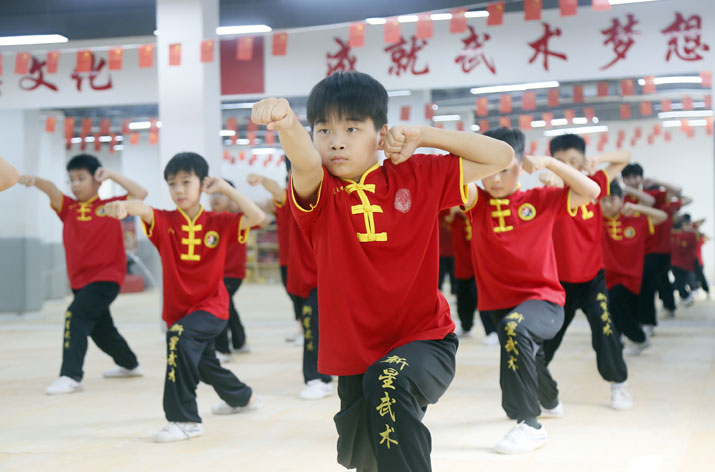
Young trainees practice martial arts at an art education school in Luoyang, Henan Province, on August 18 (XINHUA)
In Zhenjiang City, Jiangsu Province, every primary, middle and high school student has a mentor, who frequently communicates with them. This mentorship program all began with an education reform that's been in full swing for 13 years.
Back in 2013, some schools were struggling with weak classroom management, a gap between teaching and administration, and a rise in student mental health issues. So Runzhou District in Zhenjiang decided to try something new: They put small teams of two or three teachers in charge of each class, working closely with parents and students. Instead of one homeroom teacher going it alone, it became a group effort. That small experiment slowly took root and grew, thanks to the dedication of Zhenjiang's educators.
In June 2022, the city's education bureau made it official, rolling out a mentorship program across all schools. Each mentor plays two key roles, serving as both a trusted guide for students and a bridge between school and home. Their main tasks are simple: visit the families, have heart-to-heart talks with students and track their progress. Today, all 479 schools in Zhenjiang are on board with the program, with nearly 30,000 mentors looking after close to 370,000 students.
"We've been searching for the right answer for a long time," Huang Kewen, Director of the Zhenjiang Municipal Education Bureau, told China Education News newspaper. "And we found it in this mentorship system. Mentors are the ones to make sure every student feels seen, heard and supported."
Zhenjiang's story is just one example of a broader, nationwide shift. China, which has built one of the world's largest and strongest basic education systems, spanning preschool through senior high, is moving to take the sector to a new level that will place greater emphasis on well-rounded student development.
At a national meeting held in Beijing on July 22, priorities for the next phase of basic education were laid out, with an emphasis on moral development, a health-first approach, better allocation of educational resources and closer coordination among schools, families and society.
In an instruction conveyed at the meeting, Chinese President Xi Jinping, also General Secretary of the Communist Party of China (CPC) Central Committee, said China has treated basic education as a cornerstone of its larger education strategy, laying a solid foundation for its goal of becoming a leading country in education.
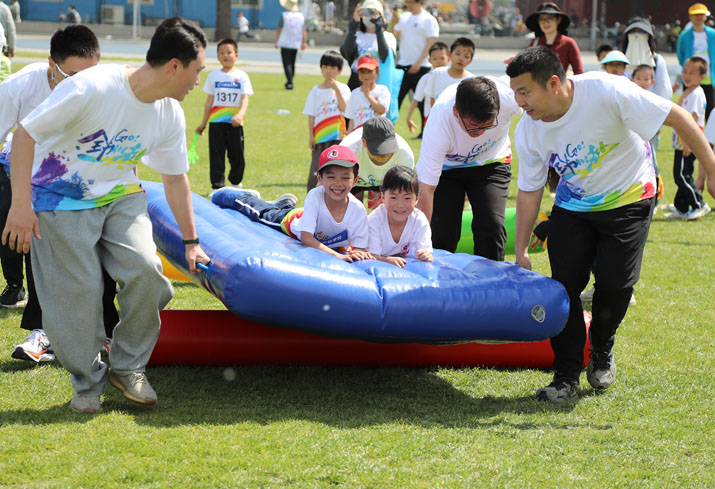
Students and parents take part in a parent-child activity at a school in Beijing's Xicheng District on April 29, 2025 (XINHUA)
Stronger system, steady progress
China now has around 430,000 primary and secondary schools and kindergartens, enrolling 220 million students and employing 15.77 million teachers, according to official statistics.
"To be able to maintain order and ensure quality on such a massive scale is itself the greatest testament to China's educational miracle and a powerful reflection of the country's institutional strengths," Li Zhengtao, Vice President of the Chinese Society of Education and a professor of education at East China Normal University, told news portal China Comment.
According to the Ministry of Education, in 2025, preschool enrollment reached 92.9 percent, covering nearly every 5-year-old. In compulsory education, 157 million students are enrolled.
This March, Education Minister Huai Jinpeng said China's basic education coverage and key indicators had surpassed the average levels of upper-middle-income countries, with preschool and compulsory education reaching the averages of high-income countries.
In the Programme for International Student Assessment, or PISA, a worldwide study by the Organization for Economic Co-operation and Development that evaluates educational systems by measuring the knowledge and skills of 15-year-old students, Chinese students have consistently ranked among the world's top performers, particularly in mathematics, reading and science.
A global education index developed by the China National Academy of Educational Sciences ranks countries based on internationally comparable data. The index looks at multiple dimensions, including educational equity, quality, service capacity and sustainable development potential. It shows that China jumped from 49th place in 2012 to 21st place worldwide in 2024, the fastest climb of any country. In terms of education quality, China now ranks eighth globally.
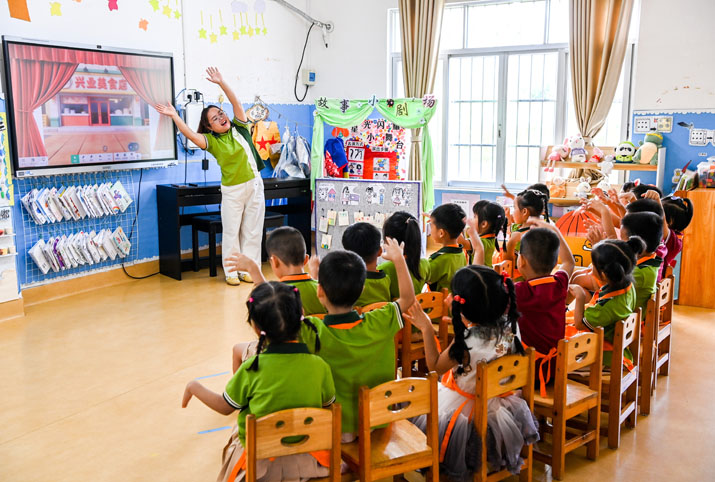
A teacher plays games with children at a kindergarten in Yulin City, Guangxi Zhuang Autonomous Region, on July 1 (XINHUA)
Finding one's fit
In the fall of 2025, Tianning District in Changzhou, Jiangsu, began piloting smaller class sizes, reducing them from 45 to 35 students. "In the past, after a lesson, I could only remember the few kids who were always raising their hands," Huang Xintian, a Chinese language teacher at Jiefanglu Primary School, told China Education News. "Now, I can tell you exactly who's keeping up, who's falling behind and who's just too shy to speak up."
Shanghai is making similar moves. In 2025, the city launched a pilot program for small-class teaching, with one district going all in and nearly 40 schools across the city joining the exploration. At Gongnongxincun Primary School in Yangpu District, a first-grade classroom of 24 students no longer sits in tidy rows. Instead, they're split into small groups around six tables, with plenty of open space between them. "This seating arrangement makes it much easier to read each child's expressions, gestures and overall state," said Ju Zhenyin, the school's principal.
The changes go beyond the classroom. Hallways now have reading nooks, display walls, drawing boards and activity areas. "This warm, inviting space feels a lot like a kindergarten," Ju added. "For first-graders, that sense of comfort and security matters."
Still, cutting class sizes is just the start. The real question is how to make sure every student, no matter their level or pace, finds their place in the same room.
At Xingda School, a small rural school in Jingyu County, Jilin Province, the answer lies in a teaching philosophy called "leveraging differences." It's built on four ideas: respect differences, understand gaps, narrow disparities and embrace diversity. In practice, teachers design layered assignments: basic work for students who need more time to grasp core concepts, and deeper challenges for those ready to move ahead.
In Ordos, Inner Mongolia Autonomous Region, the city has rolled out a "three-dimensional diagnosis" system. Schools use digital portfolios to track each student's grades, interests and activities outside class, then use that information to shape instruction. They've also built a tiered resource bank, with teaching materials divided into three levels, namely foundational, intermediate and advanced, so teachers can easily match work to student needs.
Body and mind
Yet even as the system delivers strong outcomes, the major concern remains that an overemphasis on grades and test performance may be contributing to considerable academic stress among students.
Public concern, according to Li, centers on a handful of pressing questions: Are students actually carrying less homework? Are after-school programs delivering what families need? Are mental health services keeping up with demand? And are vulnerable students being left behind? "These are precisely the issues driving basic education reform today," he said.
At the meeting on July 22, Xi stressed a health-first approach and efforts to improve students' physical and mental wellbeing.
This emphasis on a health-centered approach to education shows a clear shift away from an exam-score-driven mindset toward a more balanced view of student development, according to experts.
For schools, the policy shift means strengthening physical and arts education, practical skills training and mental health support, helping students build physical strength and develop resilience, they noted.
"We've seen schools across the country expand their programs in sports, the arts, hands-on learning and psychological counseling," Zhang Lili, an art teacher at a primary school in Changchun, Jilin, who has been teaching for more than a decade, told Beijing Review. "All of this is about giving students the tools they need to become stronger, not just physically, but mentally as well."
The numbers tell a mixed story. On the one hand, students are seeing better physical health outcomes. For example, the myopia rate has fallen for four years in a row from 2021 to 2024, hitting 50.3 percent in 2024, a 3.3-percentage-point improvement from 2018. On the other hand, mental health is emerging as a more urgent concern. A 2025 report from the Chinese Academy of Sciences' Institute of Psychology found that up to a quarter of adolescents exhibit depressive symptoms, with the risks of depression, loneliness and smartphone addiction climbing steadily with each advancing grade.
In response, schools are ramping up mental health services. Counseling centers are being expanded, and more schools are hiring full-time psychologists. Some districts have introduced regular mental health screenings and established referral systems for students who need professional help.
Zhenjiang offers a closer look at how these efforts play out on the ground. Beyond the mentorship program itself, the city has built a robust training infrastructure to support its mentors. The local education bureau has developed a system that helps mentors build what they call the "four skills"—observing, assessing, counseling and supporting students effectively. "Whatever our mentors need, we provide training for," Wang Jian, Deputy Director of the Zhenjiang Municipal Education Bureau, told China Education News.
The city has offered mental health certification programs for 11 consecutive years, training about 800 educators annually. Today, nearly a quarter of Zhenjiang's teachers hold this certification.
At the national level, the Ministry of Education has issued guidelines to reduce homework and testing, limit smartphone use and require at least one hour of physical activity per school day.
"The seeds are being planted now," Zhang said. "In 10 or 20 years, I hope to see a generation of young people who are not just smart, but more confident, kinder and more resilient, because that's what our education system will have helped them become."



