
|
| China |
| How Beijing's Songlin Park became a model of shared stewardship | |
| Innovative practice in Beijing's Songlin Park | |
|
|
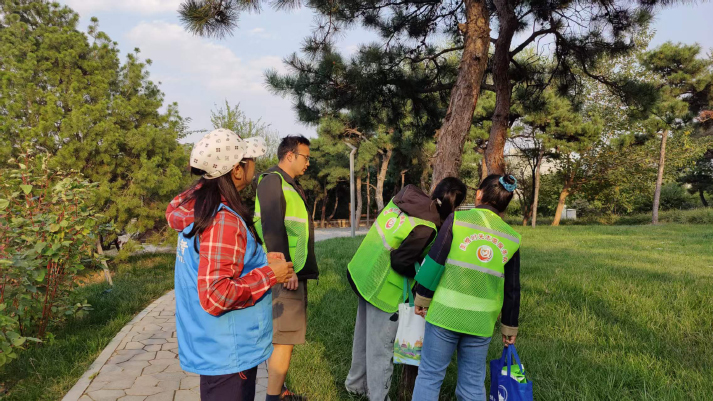 Citizen Park Stewards and Junior Rangers conduct forest patrols at Songlin Park on October 3(COURTESY PHOTO)
Over the past year, aside from school, 12-year-old Chen Ziqian has spent more time at Songlin Park in western Beijing than anywhere else. He does not go there simply to play. He goes to patrol the forest. Chen is one of the park's Junior Rangers and his mother, Yan Jing, serves as a Citizen Park Steward. Nineteen kilometers west of Tiananmen Square along Chang'an Avenue lies Songlin Park, a key part of the urban forest park corridor stretching across western Beijing. The park covers 22.5 hectares, with roughly 80 percent of its land shaded by native Chinese pines. Tucked beneath the trees are reading rooms, covered walkways and fitness spaces. From the observation deck, visitors can see the distant Xishan Mountains rise against the skyline, while Shijingshan Amusement Park and the surrounding neighborhood unfold below—a striking mix of nature and urban life. From warehouse to urban forest It is difficult to imagine now, but this green expanse was once largely an abandoned warehouse site belonging to Shougang Group, Beijing's largest steelmaker. In 2019, amid Beijing's large-scale afforestation campaign, the park entered a new phase, transforming from an industrial site into an urban forest park. The transformation continued. In September 2024, the Shijingshan District Landscaping and Greening Bureau launched another round of upgrades designed around the idea of an all-age-friendly park. The park focused on improving paths and the way visitors travel through the park and reorganizing public spaces, before reopening fully to visitors in October 2025. The renovation replaced aging permeable bricks and damaged stone pathways throughout the park, improving both accessibility and drainage performance. Permeable paving and newly added rain gardens increased stormwater runoff control capacity by 40 percent, contributing to Beijing's broader "sponge city" initiative. Sponge cities are cities that follow a model of urban planning that uses green spaces and permeable surfaces to decrease both flooding and water shortages and to regulate temperature. New walking paths also linked woodland areas and activity zones, creating a fully connected 4.06-km community greenway. The redesign emphasized shared use across generations. Along the greenway, shaded seating areas, rest stops and viewing platforms serve all visitors. Children's play zones feature sand pits and climbing nets designed to encourage interaction with nature. Under the pine canopy, fitness spaces equipped with senior-friendly exercise facilities provide gathering places for elderly residents. Low-carbon technologies were integrated throughout the reconstruction process. Solar-powered lighting now lines the park's pathways, while rainwater collection and infiltration systems help recycle water resources on site. The park's 18 hectares of native pine forest have been preserved, supplemented by additional native plant species known for strong carbon sequestration capacity. Biochar-treated soil has further improved ecological performance, helping the park achieve an estimated annual carbon sequestration of 367.5 tons. In 2025, Songlin Park was recognized as one of Beijing's representative climate-friendly development projects. 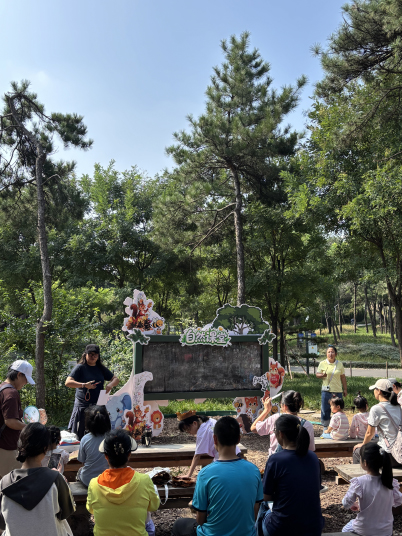 A Nature Classroom event takes place at Songlin Park in Beijing’s Shijingshan District on September 26 (COURTESY PHOTO)
Shared governance The park's physical transformation raised another question: How should the space itself be managed? For years, Songlin Park followed a conventional management model. Administrators maintained the grounds while visitors simply used them. Public feedback moved slowly, and residents had little role in the park's day-to-day stewardship. That model has since shifted toward something more participatory. In 2025, the district introduced a professional operations team from Yisheng Yishi (Beijing) Technology Co. Ltd., a company with rich experience in managing urban public spaces. Working under a framework described as "government-led, professionally operated and public-benefit-oriented," the team sought to turn the park into a more active civic space. Using China's traditional 24 solar terms as a cultural framework, the team developed a year-round series of public programs: spring flower festivals, summer nature carnivals, autumn garden fairs and winter cultural events. The aim was not simply to animate the park seasonally, but to weave it more deeply into everyday community life. At the same time, the park introduced mechanisms centered on public participation. Programs such as Citizen Park Stewards, Junior Rangers, and Songlin Coins reward system encourage residents to take part directly in ecological protection and park maintenance. Participants can earn Songlin Coins through activities such as environmental patrols and recycling contributions, then exchange them for ecological workshops or cultural products. Yan said the difference is noticeable. "In the past, maintenance was handled entirely by staff," she told Beijing Review. "Now residents participate in an organized way. People are no longer just observers. They've become part of the park's governance." One of the clearest expressions of that philosophy is the Songlin Reading Room, which has evolved into a central hub for community activities. Plant clinics, nature education classes and parent-child workshops are held there regularly, transforming what might once have been one-off public events into recurring parts of neighborhood life. Li Jian, a 67-year-old retiree who lives 4 km away, visits often. "The activities here are genuinely engaging," she told Beijing Review. "Adults and children both learn about ecology, and people feel closer to nature." "We wanted to create an integrated space that combines ecology, culture and shared governance," Liu Haiou, manager of the Songlin Reading Room, told Beijing Review, "and encourage residents to participate more actively in environmental protection." Today, Songlin Park functions as more than a conventional urban green space. It has become what many residents describe as an "ecological living room," a place where public governance, environmental awareness and community life intersect. "There are more ways to enjoy the park now," Li said. "People care more about ecology, neighbors participate together, and there's a stronger sense of happiness in the community." Better green The year 2026 is the first full year to see the implementation of China's 15th Five-Year Plan (2026-30). Among the country's environmental goals are simultaneous increases in both forest coverage and forest stock volume, with national forest coverage targeted at 25.8 percent and forest stock volume expected to reach 22.4 billion cubic meters. The shift reflects a broader transition in China's environmental agenda: from expanding green space to improving its quality and long-term ecological value. Songlin Park is an example of that transition. A child's forest patrol diary. A community nature class. A virtual Songlin Coin. Together, they form a picture of how urban environmental governance is being reshaped at the neighborhood level through government guidance, professional management and community engagement. BR ( Print Edition title: A Shared "Living Room") Copyedited by G.P. Wilson Comments to linan@cicgamericas.com |
|
||||||||||||||||||||||||||||
|