
|
| Voice |
| Driving New Dynamics | |
|
|
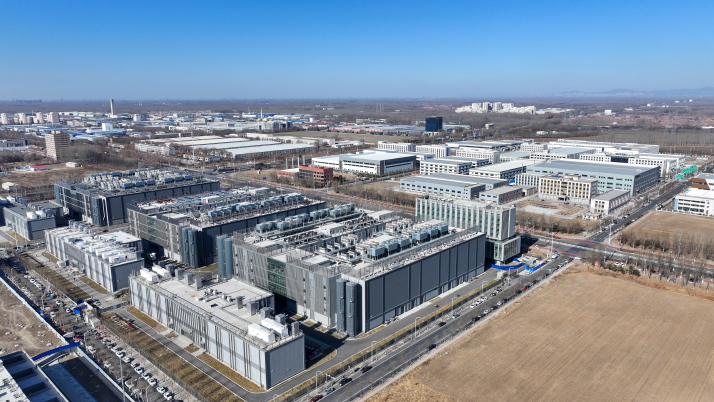 The Beijing-Tianjin Zhongguancun Tech Town in Baodi District, Tianjin, on January 23 (XINHUA)
The capital metropolitan area is the most densely populated, innovation-rich, and economically powerful part of the Beijing-Tianjin-Hebei region. Stretching approximately 100 km from the center of Beijing, this 42,000-square-km land encompasses Beijing, Tianjin and several cities in Hebei Province including the Xiongan New Area, Langfang, Baoding and Zhangjiakou. It serves as the primary engine for building a world-class city cluster. The area is now committed to the transformation and upgrading of traditional industries, the expansion of emerging industrial clusters, and the forward-looking deployment of future industries to better cultivate new quality productive forces featuring new economic models, new businesses and new industries. Complementary strengths The capital metropolitan area is home to over 90 percent of the automobile manufacturing enterprises in the Beijing-Tianjin-Hebei region. In 2025, the scale of its new-energy and intelligent connected vehicle industries exceeded 1 trillion yuan ($150 billion), with new-energy vehicle (NEV) production surpassing 1 million units, accounting for over one third of total vehicle output in the region. In the realm of emerging and future industries, the area accounts for approximately half of China's core AI industrial scale and AI enterprise count. Its number of national-level hi-tech enterprises and "little giants"—a designation of top-tier small and medium-sized enterprises (SMEs) with high growth potential, advanced technology and strong market competitive edge—leads the country. Beijing has also built the country's only national-level advanced manufacturing cluster in the AI field. In addition, the output of new products such as robots and integrated circuits has grown rapidly. Integrated circuit production in 2025 increased by over 50 percent compared with 2020, while industrial robot output also multiplied. The Beijing Innovation Center of Humanoid Robotics released the open-source initiative to build a multi-use humanoid robot known as Tien Kung in 2024, and it is expected that by the end of 2026, the center's annual robot production will reach 5,000 units. The area has robust sci-tech innovation capabilities and a strong industrial foundation. It has established an innovation ecosystem featuring original innovation in Beijing, research and development (R&D) and commercialization in Tianjin, and promotion and application in Hebei, along with a synergistic and complementary industrial division of labor. Beijing is home to China's top universities and research institutes, key laboratories and high-caliber sci-tech innovation talent, focusing on basic research and cutting-edge, original R&D. Tianjin possesses a nationally leading specialized pilot-scale testing system and a complete industrial system, supporting the formation of emerging industrial chains for Beijing's robotics, biomedicine and other sectors. For instance, AgiBot, China's highest-valued embodied intelligence startup, has established humanoid and industrial robot component supply, assembly and scenario demonstration operations in the Beijing-Tianjin Industrial New City in Wuqing District of Tianjin. Established in 2017, Xiongan New Area is already home to multiple headquarters of Chinese centrally administered state-owned enterprises (SOEs), hundreds of their branches, as well as sci-tech innovation platforms, becoming a core testing ground and commercialization hub for Beijing's cutting-edge technological achievements in fields such as aerospace information, satellite Internet and AI. Many cities in Hebei also leverage their own industrial strengths to serve as commercialization and supporting bases for NEVs, intelligent connected vehicles and aviation-related industries in both Beijing and Tianjin. Chinese tech giant Xiaomi has formed industrial clusters in electric vehicles (EVs) with a clear division of labor within the capital metropolitan area and the broader Beijing-Tianjin-Hebei region. Xiaomi's EV R&D and design and assembly operations are located in Beijing, with core component suppliers mainly clustered in the Wuqing Automobile Industrial Park in Tianjin, alongside other auto parts processing enterprises in cities in Hebei, including Baoding. Future deployment Currently, the capital metropolitan area is accelerating the deployment of future industries and continuously improving industrial chains in cutting-edge fields such as AI and computing networks, commercial aerospace and satellite Internet, synthetic biology and biomanufacturing, as well as humanoid robots. Leveraging Beijing's advantages in large model development, Wuqing's computing power infrastructure and Xiongan's application scenarios, the area is building a comprehensive industrial ecosystem. Similarly, an end-to-end industrial chain encompassing satellite development, constellation deployment and commercial aerospace applications is gaining robust momentum, anchored by Beijing's original innovation capabilities in satellite design, core chip R&D and aerospace software, together with the state-of-the-art intelligent satellite mass-production base in Xiongan. At the same time, relying on two development corridors, the spatial layout of future industries is being continuously optimized. The Beijing-Tianjin corridor will prioritize the large-scale development of future industries, leveraging spatial carriers such as the Beijing Economic-Technological Development Area and the Tianjin Binhai New Area and amplifying the platform advantages of cooperative parks such as the Binhai-Zhongguancun Science Park. From 2021 to 2025, the Tianjin Binhai New Area absorbed a cumulative total of 278 major projects from Beijing, with a total investment of 273.4 billion yuan ($40.38 billion), while the Binhai-Zhongguancun Science Park has registered over 6,000 enterprises, continuously benefiting from the spillover of Beijing's sci-tech innovation resources and the transformation of its scientific and technological breakthroughs. The corridor will concentrate on industrialization projects in AI computing, biopharmaceuticals and advanced new materials, speeding up the clustering of innovative enterprises and the revitalization of underutilized industrial resources. The Beijing-Xiongan corridor, on the other hand, will focus on future industry incubation and application scenario innovation. This corridor has achieved initial milestones in clustering innovation and industrial resources. As of February 2026, Xiongan was home to 10 national-level "little giants" and nearly 700 national hi-tech enterprises, drawing high-quality enterprises in fields such as aerospace and satellite-related industries. Over 260 technology-oriented enterprises have established operations in the Zhongguancun Science Park in Xiongan, bringing together leading industry players such as cybersecurity enterprise Topsec and LED display manufacturer Leyard. Powered by the Xiongan Zhongguancun Science Park and Daxing Airport Economic Zone, the Beijing-Xiongan corridor will champion forward-looking sectors such as space information and satellite Internet, and new-energy storage. It will open up a vast number of real-world scenarios, providing experimental space for the iteration of cutting-edge technologies, the trial use of new products and the implementation of new models. The development of new quality productive forces in the capital metropolitan area is a long-term project, particularly the forward-looking deployment of future industries, which requires strong sci-tech innovation and deep integration of innovation and industrial chains. Therefore, it is imperative to reinforce the functions of Beijing as a source of original innovation. Efforts must also be made to continuously enhance key core technology R&D capabilities in emerging and especially future industries and promote the deep integration of innovation, industrial, capital and talent chains. A priority must also be placed on continuously optimizing the spatial layout of new quality productive forces, particularly by focusing on the two development corridors, improving industrial functional nodes, cultivating emerging and future industries, upgrading advanced manufacturing clusters, and promoting the coordinated deployment of integrated industrial chains. BR Li Guoping is dean of the Beijing Development Institute at Peking University, and Wei Hui is a research assistant with the institute Copyedited by G.P. Wilson Comments to dingying@cicgamericas.com |
|
||||||||||||||||||||||||||||||
|