
|
| China |
| Challenges in the recycling of large items | |
|
|
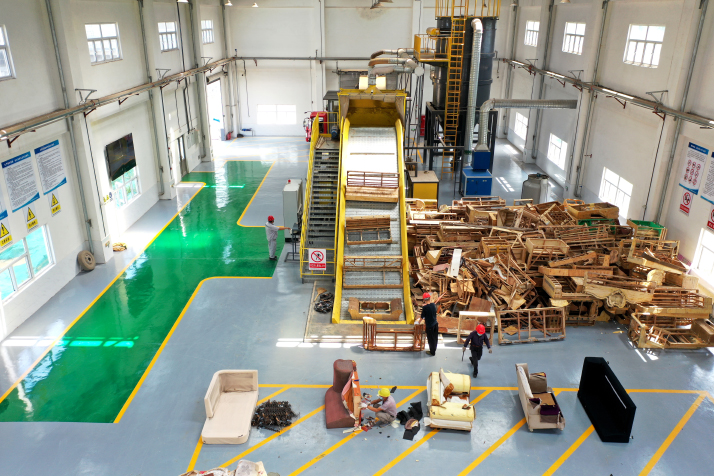 A processing site for bulky waste, household trash too large or heavy for regular collection, in Meishan, Sichuan Province, on May 22, 2022 (VCG)
In the first half of this year, a Beijing resident surnamed Liu found himself in a perplexing predicament. His attempt to declutter by parting with a seldom-used spinning bike, despite its functional state and his apartment building having elevator access, was met with a frustrating series of rejections. The manufacturer offered no take-back service. Online secondhand platforms yielded no result for months. Ultimately, Liu was forced to pay a scrap collector 80 yuan ($12) simply to have the sizable piece of equipment removed from his home. Like Liu, many households in China are grappling with a nagging problem: Acquiring new large items has become relatively effortless, yet disposing of old ones, even if perfectly functional, has become an unexpectedly arduous and often costly endeavor. This conundrum highlights a disconnect in the current system. On one side, the accumulation of large, underutilized items in homes is escalating. On the other, the pathways for their effective recycling, trading and reuse remain incomplete. The challenge of transforming these "idle burdens" into "circular resources" has emerged as a pressing new concern, demanding innovative solutions. Significant hurdles Liu's predicament is far from isolated. Many regions lack established, official recycling mechanisms for large used items, forcing residents to spend significant time and money to dispose of them. While some cities have implemented drop-off points or collection platforms for bulky waste, household trash too large or heavy for regular collection, a persistent lack of effective public awareness campaigns leaves many residents unaware of their existence or of how to utilize them. Also, attempts to facilitate the circulation of these items through secondhand sales reveal a process that is far from smooth. Perusing online secondhand trading platforms highlights that buyers' primary concerns for large furniture listings are often not price, but rather logistical factors: "Where are you located?", "Is there an elevator?" and "Can you help with moving?" For inter-city transactions, transportation costs emerge as an unavoidable hurdle. Even within the same city, moving large used items necessitates specialized equipment and the coordinated effort of multiple individuals. These ancillary expenses can easily eclipse the inherent value of the item, rendering these sales impractical. The challenges of disposing of large used items are not solely an individual burden; businesses in the recycling sector also grapple with significant obstacles. Industry insiders reveal that for recycling companies, acquiring a large used item does not guarantee immediate value realization. During the period of waiting for resale, dismantling or reuse, ongoing costs for storage, transportation and labor continue to accrue, significantly impacting profitability. Deng Qihua, head of Brand and Sustainable Development of Feimayi, an online platform that initially focused on recycling used clothing and has since expanded to include appliances and furniture, told Beijing-based Legal Daily newspaper that the handling, transportation and disposal of large used items are the significant pain points in the industry. "The costs associated with recycling large used items are mainly comprised of labor, moving, transportation and disposal," Deng explained. "For large items like furniture, both moving and transportation incur fees, and when these two costs are combined, the overall cost becomes higher. If the warehouse is far from the collection point, the costs will continue to increase, which is a major reason why large used items have difficulty circulating efficiently." A manager of a recycling market in Chongqing Municipality told Legal Daily that after collecting old furniture from a home and transporting it over 10 km, factoring in labor and vehicle expenses, the revenue generated from selling the dismantled recyclable materials amounts to only around 200 yuan ($30). Furthermore, many recycling merchants operate as individual businesses, lacking the capacity for scaled and standardized operations, which inherently limits the development of the large item recycling industry. Shang Yongjun, General Manager of Sichuan Senruihang Logistics and Supply Chain Management Co. Ltd., told Legal Daily that in the absence of a well-developed recycling and utilization channel, a large volume of large used items ultimately ends up in the final disposal stage. Some usable materials are buried or incinerated. Treating large used items as garbage rather than renewable resources fails to fully exploit their potential economic value. "If recycling processes can be integrated with furniture delivery and installation services, costs can be significantly reduced," Shang suggested. In the case of his company, as it has a well-developed furniture warehousing, distribution and installation system in place, it has the capacity to remove old items at the same time it delivers new ones, thereby reducing the labor and logistics costs associated with separate collection visits. After collected furniture is sorted and dismantled, the wood can be sent to processing enterprises for reuse. The utilization rate of renewable resources can exceed 80 percent. Emerging solutions Despite the challenges, a clear demand exists on the consumption side for large used items. Young consumers setting up new homes are often eager to purchase secondhand furniture at more affordable prices. Chang Dalei, Executive Vice President and Secretary General of the China Resale Goods Trading Association, noted at a Green Consumption and Renewable Resources Recycling Industry Development event in April that China's used goods circulation market is steadily expanding. The used goods transaction volume in 2024 reached 1.69 trillion yuan ($253 billion), a year-on-year increase of 28 percent. While online platforms primarily focus on easily transportable items like mobile phones and luxury goods, offline markets remain dominated by large items such as used home appliances and furniture. Recognizing this potential, the state has been actively promoting the development of recycling networks for discarded items and the circulation of used goods. In 2024, a joint notice from nine government departments, including the Ministry of Commerce, called for improvements to the recycling system for resources like discarded household appliances and furniture. This initiative emphasizes enhancing recycling facilities, such as community collection points and district or county sorting centers, and delivering professional recycling services. In line with national directives, local authorities are proactively pioneering new methods for bulky waste collection and disposal. Shanghai, for instance, has implemented new regulations, effective on October 1, aimed at streamlining the management of approximately 210,000 tons of bulky waste generated annually. These regulations abolish collection and disposal fees for residents, and designate "collection days" for bulky waste deposits at specified points or for on-site collection. For residents requiring assistance with shipping heavy items, transparent "short-haul fees" are now clearly listed by the Shanghai Trade Association of City Appearance and Sanitation. An improved recycling system for large used items necessitates convenient community-level collection points, professional collection and processing by enterprises, and platforms that facilitate the circulation of used goods. Simultaneously, corresponding testing standards, quality assessments and accountability mechanisms need to be established. (Print Edition Title: The Paradox of Usability) Copyedited by G.P. Wilson Comments to jijing@cicgamericas.com |
|
||||||||||||||||||||||||||||
|