
|
| China |
| A Chinese company offers a smart solution for the textile recycling industry | |
|
|
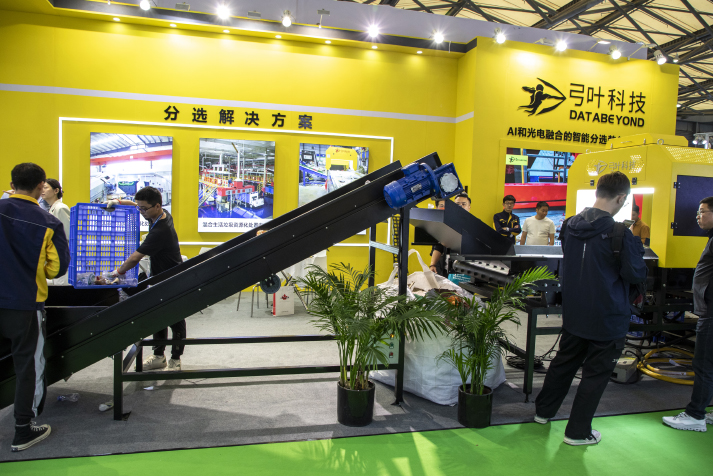 The booth of Databeyond Technology at the IE Expo China, an environmental protection expo, in Shanghai on April 20, 2023 (VCG)
In a textile recycling workshop in Zhangjiagang, Jiangsu Province, a production line that once required 30 workers to toil for eight hours to process 15 tons of used clothing now operates with only two staff members. Behind this transformation is an automated textile sorting line quietly at work. Developed by Databeyond Technology, this system integrates AI and hyperspectral imaging technology to identify the material and color of waste textiles, precisely identify blend ratios, and automatically sort out components such as cotton, polyester and nylon. Hyperspectral imaging is an advanced sensing modality that captures spatial and spectral information simultaneously, enabling non-invasive and label-free characterization of material, chemical and biological properties. Last October, this technology was named one of the Best Inventions of 2025 by Time magazine. Databeyond Technology is the only Chinese hi-tech enterprise to receive this honor in the recycling category, drawing global attention to China's advancements in intelligent sorting. By improving both sorting accuracy and efficiency, the technology has significantly boosted resource utilization and catalyzed an upgrade across the entire industrial chain, providing the technical foundation for the textile industry's transition toward a circular economy. The bottlenecks of textile recycling Headquartered in Hangzhou, Zhejiang Province, Databeyond Technology is an AI-driven innovator in the solid waste sorting sector. While explaining why the company focuses on the niche of textile sorting, founder Mo Zhuoya recalled a scene she witnessed during her research: At a waste recycling station in Guangdong Province, mountains of discarded clothing emitted a complex, pungent odor. Workers stood hunched over, manually sifting through piles of trash mixed with cotton, linen, wool, buttons and zippers. By the end of the day, despite the grueling labor, the sorting efficiency and accuracy remained lackluster. "This is not an isolated case; it is a 'common disease' in the textile recycling industry," Mo told China Environment News newspaper. Having spent years in the recycling sector, she realized that sorting is the critical, often overlooked link that determines the industry's efficiency. In 2024, China generated approximately 36.4 million tons of textile waste, accounting for about 26 percent of the global total, yet only 5.15 million tons were recycled. "The core issue lies in the 'sorting' stage," Mo explained. Currently, over 80 percent of sorting in the traditional textile recycling industry still relies on manual labor. A skilled worker can only sort about 100 kg of used clothing per hour and labor costs account for over 40 percent of total operating expenses. Low efficiency and high costs have become the primary bottlenecks for large-scale industrial development. Moreover, clothing composition is becoming increasingly complex. "Blended fabrics and various chemical dyes are harder to identify than almost any other industrial raw material. Traditional sorting methods struggle to achieve precise separation, making it difficult to meet the demand of downstream recyclers for high-purity materials," Mo added. It was these persistent industry bottlenecks that convinced her that textile recycling had to transition toward intelligence. The "eye, brain and hand" collaboration How does the AI-driven hyperspectral optical sorter work? "It functions like an intelligent sorter with collaborative 'eyes, brains and hands,' completing identification and sorting while objects move at high speed," Liu Jiahua, Market Manager at Databeyond Technology, told China Environment News. The system's "sharp eyes" utilize a vision system with multiple sensors. As materials move along a conveyor belt at 4 meters per second, the system—combining hyperspectral and laser sensors—captures the shape, color and material characteristics of each textile piece in real-time. "Hyperspectral imaging technology is particularly adept at distinguishing unique spectral characteristics of different fibers, essentially creating a 'spectral fingerprint' for each material," Liu noted. "For instance, it can identify a garment as a blend of 90 percent polyester, 8 percent cotton and 2 percent spandex." Behind these eyes is an ever-evolving "smart brain." "Spectrum identification alone cannot support complex industrial scenarios or meet requirements for accuracy, stability and scalability. Therefore, we built a massive spectral database of solid waste materials and integrated AI algorithms to perform real-time analysis," Liu added. The "dexterous hands" rely on a high-speed, precise execution system. A major challenge was the lightweight nature of materials like garment trimmings and shredded fabric, which easily shift or float due to airflow at high speeds. To solve this, the team introduced an innovative aerodynamic design. "We added a positive pressure system (a type of ventilation system that maintains a higher air pressure inside a building or enclosure than the surrounding atmosphere) above the conveyor belt. The airflow produced by the system acts like an invisible, steady hand that keeps light, thin materials flat and stable," Liu explained. Once identified, the system issues a sorting command in milliseconds, and high-pressure air nozzles eject the target material from the belt with over 98 percent accuracy. Environmental benefits The environmental benefits of the sorter are significant. Lin Xianping, Executive Deputy Secretary General of the China Urban Expert Think Tank Committee, told China Environment News, "As textile production relies heavily on resources such as cotton and petroleum, recycling reduces the pressure on raw material extraction. Given that the textile industry is a major consumer of water and energy, recycling significantly reduces carbon emissions, water pollution and landfill volume. Furthermore, because incinerating textiles generates greenhouse gases and placing them in landfill occupies land, recycling serves to mitigate environmental pressure at the end-of-life stage." According to the UN Environment Programme, for every ton of old clothing recycled, 3.6 tons of carbon dioxide emissions are prevented, while 0.5 tons of crude oil and 20 tons of water are saved. Currently, Databeyond's overseas market has expanded beyond Japan, the Republic of Korea and Southeast Asian countries to include India, Mexico, Brazil, Uganda and countries in Central Asia. The global demand for this kind of intelligent equipment is growing increasingly robust. Mo said that in the future, Databeyond will continue to deepen the integration of AI and intelligent sorting, expanding its technology to more recycling scenarios—such as waste plastics, film and construction waste—accelerating the intelligent era for the global recycling industry. Copyedited by G.P. Wilson Comments to jijing@cicgamericas.com |
|
||||||||||||||||||||||||||||
|