
|
| China |
| Pioneering artist wins Hans Christian Andersen Award | |
|
|
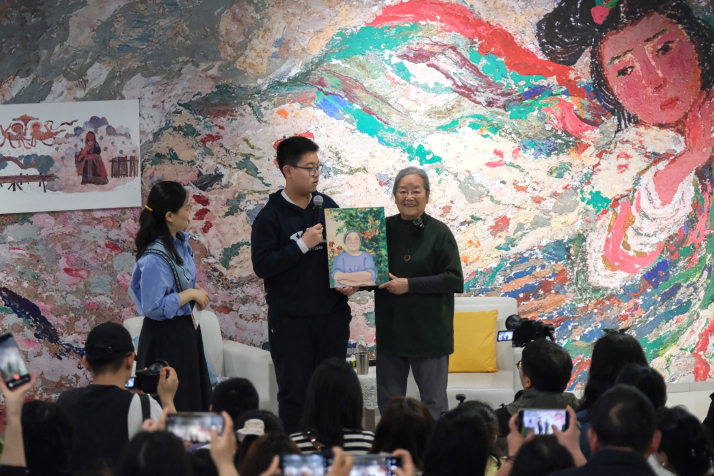 Cai Gao (right), China's first winner of the Hans Christian Andersen Award for illustration, at her first book-signing event in Changsha on April 18 (VCG)
On August 8 in Ottawa, Canada, in a ceremony that will live on in the annals of children's literature, 80-year-old Chinese illustrator Cai Gao accepted the 2026 Hans Christian Andersen Award. Born in Changsha, Hunan Province, Cai is the first Chinese artist to receive the prestigious honor.
Awarded biennially by the International Board on Books for Young People, the Hans Christian Andersen Award recognizes lifetime contributions made by authors and illustrators and is widely regarded as the highest international distinction in children's literature. The jury praised Cai for a body of work that demonstrates "outstanding artistic quality" and a distinctive visual language that expands the possibilities of illustration for children. Her illustrations, it noted, move between tradition and modernity, combining technical mastery with creativity, sensitivity and innovation. For Cai, this was a career-defining zenith. For the Chinese picture book industry, it was a long-awaited international spotlight. Born in 1946, Cai first began illustrating picture books when she was 36, and she did not achieve major international recognition until she was 47. She has never attended a formal art academy and she often jokes about her "slow-blooming" nature. Instead of seeking formal institutions, she nurtured her talent in the quiet margins of life, keeping herself grounded in the soil. Her story is a testament to the idea that true artistic greatness comes from a lifelong, humble devotion to one's craft. 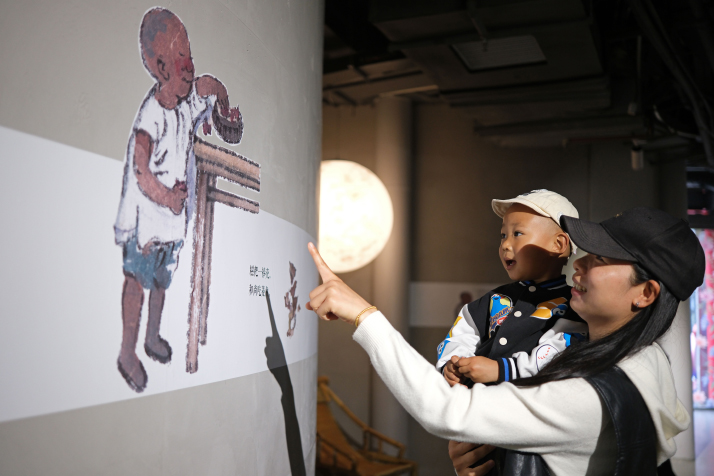 A young child is delighted by one of the illustrations at an exhibition of Cai Gao's work in Changsha, Hunan Province, on April 14 (VCG)
The wellspring of the soil To understand Cai's art, one must look toward her roots. Her path to the Andersen Award began in the muddy paddies of Taihu, a small village in Hunan. At 23, Cai began a six-year tenure as a teacher there. Xie Dangrong, a 67-year-old villager who grew up under her tutelage, still remembers Cai teaching him English and drawing. During the grueling harvest seasons, she was never merely an educator; she waded into the paddies, helping farmers transplant rice seedlings. Those six years left an indelible mark on her. She spent her days with her head bowed over students' homework, her back bent alongside the villagers during the labor-intensive harvest cycles, and her hands poised with a brush, capturing the soul of village life in sketches. The unadorned village life became the bedrock of her creative universe. This is best exemplified in The Land of the Peach Blossom, created in collaboration with Japanese author Tadashi Matsui. Adapted from The Peach Blossom Spring Record (the preface to the poem The Peach Blossom Spring) by poet Tao Yuanming of the Eastern Jin Dynasty (317-420), the book follows a fisherman who stumbles upon an enchanting utopia—a world of peace and beauty that vanishes as soon as he leaves. Cai integrated her rural memories into these illustrations. When she painted the fisherman meeting an old man on a bridge near a thatched pavilion, she was painting the exact pavilion she passed every day on her way to school in Taihu. It was a place built by farmers to offer passersby a drink of tea. Yet, her search for this "fountainhead" was not limited to the physical landscape of the village; it was equally rooted in her childhood. "I've spent my whole life revisiting my childhood," she told newspaper Hunan Daily, "drawing my sustenance from it." Her grandmother, who hummed folk songs while stitching shoe soles and pickling vegetables, was the primary source of her inspiration. Those rhymes became the foundation for books like Going With the Moon, in which Cai recreates the imagery of the nursery rhymes that once filled her home. The tapestry of tradition Cai soon realized that the same innocence she found in her grandmother's stories was echoed throughout the ancient visual heritage of her culture. In 1982, as an editor at the Hunan Juvenile and Children's Publishing House, Cai became a pioneer of original Chinese picture books. She immersed herself in the traditional visual language of papercut, New Year painting and intricate embroidery. She was captivated by the folk palette—vibrant, bold and brimming with raw sincerity. "That kind of innocence in folk art is incredibly close to the heart of a child," she told Hunan Daily. This realization shifted her style from strict realism to the more expressive, free-spirited xieyi (freehand) approach. Xieyi is a central concept in Chinese art, aiming to capture the spirit and essence of an object rather than a photographic reproduction. This approach allowed her to convey the inner world of her characters through sparse, powerful brushwork. This transformation led to her 1993 masterpiece, Bao'er, which won the Golden Apple Award at the Biennial of Illustrations Bratislava, one of the world's most prestigious awards in children's literature, held under the auspices of UNESCO with the support of the Ministry of Culture of Slovakia. At 47, Cai became the first Chinese illustrator to receive this international accolade. The book, based on a tale from the Qing Dynasty (1644-1911) short story collection Strange Tales From a Chinese Studio, tells the story of a child who outwits a fox to save his mother. She may refer to herself as a "late bloomer," but Cai's journey in search of these "fountainheads" shows that every step was essential. Whether in the quiet countryside, the nostalgia of childhood or the rich heritage of folk art, Cai has remained down to earth, drawing from these three inexhaustible springs to nourish her art. At the turn of the millennium, Cai and her husband, Xiao Peicang, created a Peach Blossom Spring garden on the rooftop of their urban high-rise in Changsha. By hauling bags of soil up to the rooftop, they built a garden that breathes life into her work. In this sky-bound sanctuary, Cai talks to insects, tends to her fig trees and watches the seasons cycle. It is there that her art and her life became one. "Life itself is the greatest art," she said. Even at the height of her international acclaim, she remains an artist rooted in the soil, finding beauty in the small, the low and the quiet wonders of the world. (Print Edition Title: Magic in the Soil) Copyedited by G.P. Wilson Comments to jijing@cicgamericas.com |
|
||||||||||||||||||||||||||||||
|