

|
| China |
| Huangmei Opera artist Han Zaifen dedicates her life to reviving a traditional art | |
|
|
|
|
|
On Chinese New Year's Eve, February 16, the sub-venue in Hefei, Anhui Province, of the 2026 Spring Festival TV Gala, staged and televised by China Media Group, glowed under a canopy of lights. At center stage stood Huangmei Opera master Han Zaifen, dressed in full costume, leading more than 100 performers portraying the heroine of Emperor's Female Son-in-Law.
As the familiar aria from Emperor's Female Son-in-Law rang out, the lilting, tender melodies of Huangmei Opera traveled across television screens nationwide, stirring audiences from living rooms to city squares. One of China's five major opera genres, Huangmei Opera, local to Anhui, traces its origins to the Qing Dynasty (1644-1911). In the 1950s, productions such as The Marriage of a Fairy Princess and Emperor's Female Son-in-Law brought the genre to national prominence on both stage and screen. In 2006, Huangmei Opera was inscribed on China's first list of national intangible cultural heritage. Few figures embody that legacy more fully than Han—both a guardian of tradition and an architect of reinvention. 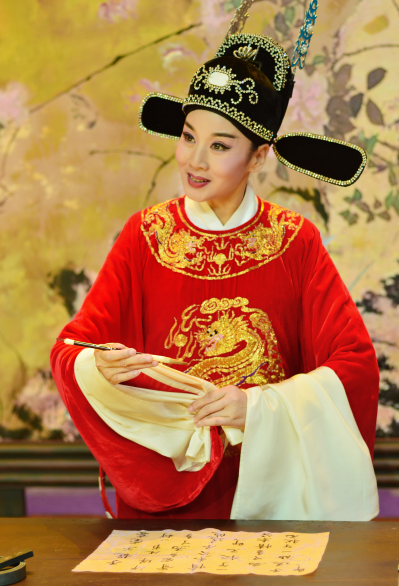 Han Zaifen in costume for Emperor’s Female Son-in-Law (COURTESY PHOTO)
Building the future Han grew up immersed in the art. The daughter of a Huangmei Opera performer, she made her stage debut at 10 years old in 1978. From that point on, her career has become inseparable from the genre's trajectory. "Meeting Huangmei Opera was a beautiful thing in my life," she told Beijing Review. "It nurtured me and gave our generation space to create and express ourselves." Gifted and rigorously trained, Han rose quickly. At 16, she gained national fame starring in the television series Zheng Xiaojiao. Over the years, she has headlined more than 50 stage and screen productions, including Emperor's Female Son-in-Law and The Lady From Huizhou. She has won China's highest theater honor, the Plum Blossom Award, twice—in 1999 and 2015—becoming Huangmei Opera's first two-time recipient of the honor. But Huangmei Opera's path has not been smooth. Like many traditional Chinese art forms, it has struggled against the pull of modern entertainment and digital media. Younger audiences drifted away. Meanwhile, low pay and limited career prospects drove performers elsewhere. Some productions failed to resonate with contemporary life. Han chose to stay. Determined to revitalize the art form, she devoted herself to strengthening its foundation. Under her leadership, the city of Anqing in Anhui established a range of facilities dedicated to supporting the development of Huangmei Opera, including the Grand Theater of the Anqing Huangmei Opera, the Anqing Huangmei Opera Art Center and the Zaifen Huangmei Opera Art House. Yet infrastructure alone is not enough. "In 2010, I realized that without generations of newcomers, our mission could not continue," Han said. "But performer cultivation takes patience. It cannot be rushed." As academic dean of the Huangmei Opera Arts College at Anqing Normal University, she customizes training programs based on each student's strengths—whether vocal quality, physical presence or acting style—encouraging them to cultivate distinctive artistic identities while mastering the classical repertoire. Breaking with the opera world's long-standing hierarchy, where lead roles traditionally go to senior performers, Han introduced what she calls an "everyone can be the lead" model. She also built a tiered training system, enabling young performers to progress from short works to full-length productions. In some cases, she has even commissioned large productions specifically designed around individual students' talents. The cost was personal. Han said for nearly seven years after assuming the teaching post, she did not stage a new production for herself, focusing instead on curriculum building and mentorship. "The groundwork is crucial," she said. "Only with a solid foundation can you build something lasting. Now the younger generation has grown to become the backbone of Huangmei Opera. That gives me great comfort." Worldwide audience A deputy to the National People's Congress, China's top legislature, since 2003, Han has made the preservation of traditional opera genres and other forms of intangible cultural heritage her life's mission. For Han, opera's vitality lies with its audience. "China has more than 300 opera genres. Why has Huangmei Opera been popular?" she asked. "Because it is sincere, simple and full of authentic emotion. Through performance and interaction, it offers comfort and resonance. We must create works that speak to ordinary people and reflect life in our times." Her creative philosophy is rooted in tradition but open to evolution. She has expanded Huangmei Opera's themes beyond romantic tales to explore history, traditional culture and contemporary thought. From the original The Lady From Huizhou and The Past of Huizhou—to adaptations of works by renowned writer Lu Xun such as Kong Yiji, and Communist Party of China history-themed productions like Yannian and Qiaonian, Han has used Huangmei Opera's signature melodies to interpret stories across eras. Her ambitions extend beyond China. In 2010, Han's performing history and Huangmei Opera tradition she represents were recorded and permanently archived by the Library of Congress in the U.S. as part of its documentation of world cultures. She became the second Chinese opera artist included in the project, after the legendary Mei Lanfang, a pioneering 20th-century Peking Opera performer who introduced Chinese classical theater to global audiences. On July 3, 2025, Han led her troupe in a flash performance at Frankfurt's Römer Square in Germany. She sang excerpts from Emperor's Female Son-in-Law, while fellow performers demonstrated signature techniques such as flowing water sleeves and sword dances. Passersby stopped, captivated. "Foreign friends were adorable—completely focused," she recalled. "Some leaned out of windows, then rushed downstairs to tell us how beautiful it was. They were curious about everything—our costumes, our makeup, the art form itself." Through careful stewardship and bold innovation, Han has ensured that Huangmei Opera continues to shine in the modern era. 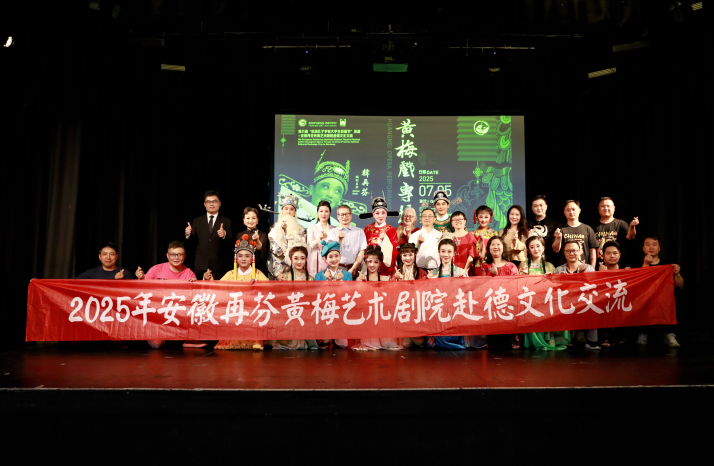 Members of Anhui Zaifen Huangmei Opera Art Theater pose during a cultural exchange program in Germany on July 5, 2025 (COURTESY PHOTO)
"It is not easy to find a lifelong passion," she said. "I was fortunate to find this calling, and I have never left it." Copyedited by G.P. Wilson Comments to wangruohan@cicgamericas.com |
|
||||||||||||||||||||||||||||
|