
|
| China |
| Turpan turns scorching heat into a new industrial track | |
|
|
 Vehicles undergo high-temperature testing in Turpan on June 25, 2023 (VCG)
As summer sweeps across Xinjiang Uygur Autonomous Region, Turpan is once again living up to its legendary reputation as a historical "land of fire." With daytime temperatures in some areas soaring above 50 degrees Celsius and surface temperatures frequently topping 70 degrees Celsius, this scorching heat has become a resource for China's rapidly advancing automotive and hi-tech manufacturing industries. While ordinary tourists seek refuge from the relentless heatwaves, a new breed of visitors is flocking to Turpan's blistering expanse: automotive engineers and drone operators. Here, under the shadow of the historic Flaming Mountains, a unique "hot-zone testing" economy is shifting into high gear, transforming extreme climate conditions into a thriving, high-value industrial cluster. 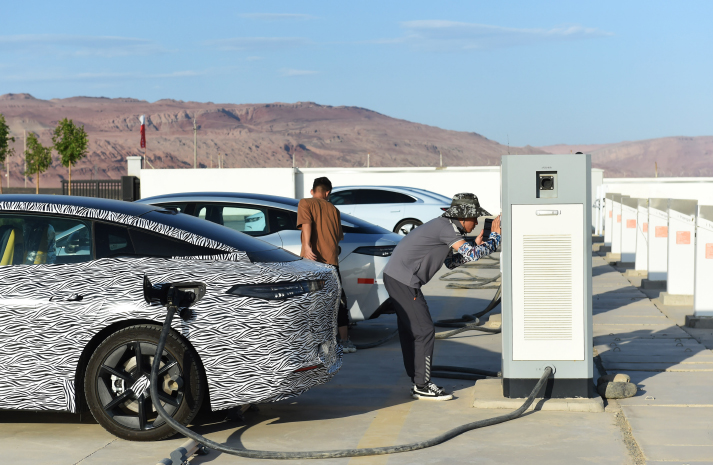 Vehicle charging performance undergoes testing at Flaming Mountain Automobile Testing Co. Ltd. under China Communications Construction Group in Turpan, Xinjiang Uygur Autonomous Region, on June 25, 2023 (VCG)
Forging quality Turpan's unmatched appeal to engineers lies in its unique composite dry-hot environment. Characterized by prolonged high temperatures, intense solar radiation, extremely low humidity and frequent strong winds, a key driver of the area's sandstorms and dust storms, the region offers a harsh testing ground that closely mirrors the real-world conditions of arid global markets in the Middle East and Central Asia. For decades, automakers have turned to extreme environments as the ultimate test of their vehicles. In the past, however, testing in Turpan was largely decentralized and informal, relying heavily on public roads and temporary spaces without professional oversight. Today, the city has evolved from offering mere "hot weather" into providing a sophisticated, systematic industrial ecosystem. Yu Shengli, Executive Deputy General Manager of Flaming Mountain Automobile Testing Co. Ltd. under China Communications Construction Group, told Securities Daily newspaper that the city's specialized testing grounds have grown exponentially. His company, the country's first third-party high-temperature dry-hot vehicle testing enterprise, has invested heavily in creating comprehensive testing infrastructure. During peak testing season, from June to September, roughly 1,400 vehicles, about half of them new-energy vehicles (NEVs), descend on Turpan for rigorous testing across a variety of specialized tracks. For NEVs, the desert acts as an unsparing crucible. Engineers test everything, from battery management to rapid charging efficiency. Ten days of blistering outdoor exposure can push car interiors past 70 degrees Celsius, with steering wheels and seats reaching up to 90 degrees and dashboards hitting 110 degrees, hot enough to melt plastic and burn skin on contact. "Outdoor solar exposure tests must be conducted during the hottest hours of the day for at least three hours per session," Zeng Wenbo, a test engineer at Flaming Mountain Automobile Testing Co. Ltd., told People's Daily newspaper. "The empirical data we collect help optimize the high-temperature resistance design of automotive components." Beyond cars Turpan's industrial ambitions, however, extend far beyond four wheels. Recognizing the potential of its climate, the region has systematically broadened its testing boundaries, turning its landscape into an open-air laboratory for a wide array of industrial products. In the burgeoning low-altitude economy (or aerial economic activities below 1,000 meters), drone developers are finding Turpan to be an ideal proving ground. Luo Hao, an engineer who frequently tests drones, told People's Daily that his team utilizes a recently approved low-altitude test zone of Flaming Mountain Automobile Testing Co. Ltd.—spanning a 5-km radius and reaching a height of 600 meters. Operating in such searing heat puts the drone's flight control systems, motor cooling and battery safety under extreme pressure. By running simultaneous static exposure and dynamic flight tests, developers can meticulously track how thermal stress affects structural components and battery output, ensuring that unmanned aerial vehicles can perform reliably in punishing environments. Meanwhile, at the Turpan Natural Environment Test Research Center, the landscape resembles an outdoor department store. Rows of air conditioner units hum under the blazing sun to test cooling performance, while nearby photovoltaic panels absorb solar radiation to test power generation efficiency. From building materials and plastic runways to agricultural plastic films, more than 42,000 products across 31 major categories have been tested here. Guo Chunyun, deputy head of the research center, told Securities Daily that this diversification, from seasonal car testing to year-round multi-product testing, has maximized resource utilization. It has shifted the local economy away from a reliance on brief seasonal spikes toward a hi-tech testing and certification service hub. Extending the industrial chain The influx of testing demand has become the core lever for Turpan to activate its "heat economy" and extend its industrial chain. The continuous arrival of testing teams and vehicles not only makes efficient use of local infrastructure but also drives the upgrading of urban services. Unlike short-term tourist traffic, automotive research and development (R&D) teams typically stay for extended periods of time. During peak testing season, engineers and support staff often reside in the city for weeks, or even months, providing hotels, restaurants and supermarkets with a steady stream of high-value customers. Reziwanguli, a staff member at the Mercure Turpan Huozhou Hotel, said the concentrated arrival of testing personnel has boosted occupancy rates, and the long-term nature of these stays ensures a stable customer base. The ripple effect extends along the entire chain of vehicle operation. Specialized needs, including vehicle maintenance, parts logistics and fire emergency services, have opened up new business opportunities. The sustained presence of R&D teams not only tests the professional capacity of local infrastructure but also forces local services to evolve from traditional hospitality to high-end R&D support. Turpan's success is not merely a product of luck, but of governance. Local authorities recently released the Turpan Hot-Weather Testing Service Management Measures (Draft for Comments) to solicit public feedback. The document proposes a multi-departmental coordination mechanism for testing services. It also emphasizes the upgrading of infrastructure, including charging stations and hydrogen refueling points, while standardizing supporting services like specialized vehicle repairs. By integrating institutional support with market-driven innovation, Turpan is closing the gaps in its industrial capacity. The goal is to move beyond simply renting out land and into the realm of standardized, high-value testing. As the city continues to refine its service standards, the brief peak season of vehicle traffic is slowly settling into a sustained flow of industrial activity, consumption and innovation. The heatwaves of the Gobi Desert are no longer just a climatic challenge; they have become the driving force for a high-quality regional development model. (Print Edition Title: A Hot Streak) Copyedited by Elsbeth van Paridon Comments to jijing@cicgamericas.com |
|
||||||||||||||||||||||||||||
|