|
| China |
| Ancient literature and the Long March legacy of unity | |
|
|
|
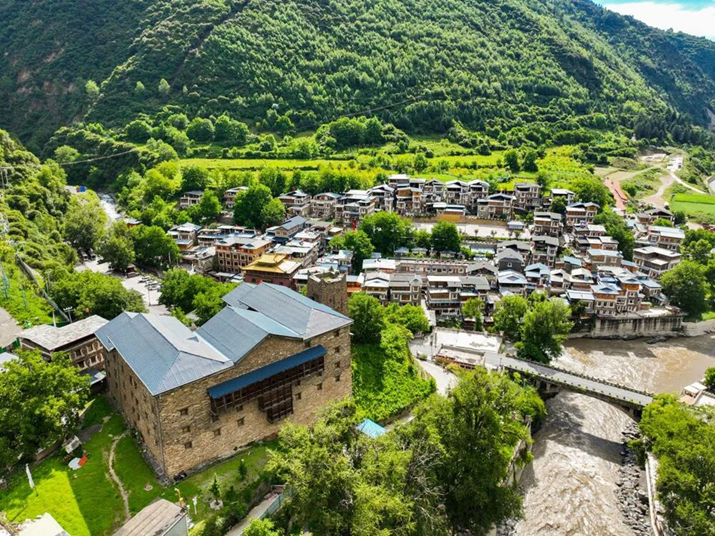
In ancient times there was Meiwu Fortress, Today there standsTusi Manor. Zhuokeji Tusi Manor in Xisuo Village of Aba Tibetan and Qiang Autonomous Prefecture in Sichuan Province was once compared by Mao Zedong to the Meiwu Fort of the Eastern Han Dynasty (25-220) because of its grandness.
The Zhuokeji Tusi Manor in Xisuo Village, Zhuokeji Township, Barkam City, Aba Tibetan and Qiang Autonomous Prefecture, Sichuan Province, on July 7 (WEI YAO) In July 1935, the Red Army halted and rested here for seven days during the Long March. Barkam City, in which the village is located was established based on the territories of four of the 18 original Jiarong Tibetan chieftains (Tusi) in northwest Sichuan area and so was also known as the Four Tusi Region in the Qing Dynasty (1644-1911). Today, however, a region onced held back by Tusi rule, geographical isolation and poverty, is now using its intangible cultural heritage and the opportunities presented by tourism to pursue common prosperity and enhance cultural integration. History tells The manor stands in the upper reaches of the Suomo River, halfway up a mountain above downtown Barkam. Integrating ethnic minority customs, revolutionary heritage and the Tusi culture, it was once hailed by Pulitzer Prize-winning writer Harrison Salisbury as a “pearl on the snow-covered plateau.” The manor functioned both as the Tusi’s administrative office and residential quarters for his family. “Many know the Red Army held meetings here, but few are aware of a study located in the manor that embodied the integration of cultures of Tibetan and Han ethnic groups,” Tashi, one of the manor’s curators, told a group of journalists from China International Communications Group (CICG)’s Together on the Long March project, as he led reporters into the study in the. The media initiative was launched to commemorate the 90th anniversary of the completion of the Long March. CICG is a leading media and publishing agency based in Beijing and the publisher of Beijing Review. Leaders of the Communist Party of China (CPC), including Mao Zedong, Zhou Enlai and Zhu De, stayed in the study and held a critical conference in it to literally and metaphorically chart the course for the Party and country, and many of Aba’s residents soon joined the Red Army as it continued toward Yan’an in Shaanxi Province. Chairman Mao, who had long lacked reading materials on the arduous march, lived in the study during this stay. The book collection back then fell into two distinct categories: a wealth of Tibetan volumes including Buddhist scriptures, Tibetan historical records and folk classics, and ancient Chinese stitch-bound books. Most prominent among them was a complete stitch-bound edition of Romance of the Three Kingdoms, one of the Four Great Classic Novels of Chinese literature, written in the 14th century. “Chairman Mao read it in his spare time and had not finished it when the army departed northward,” Tashi said, sharing a well-preserved local anecdote. “Fascinated by the book, he borrowed it specially, leaving a written note still preserved in the room.”
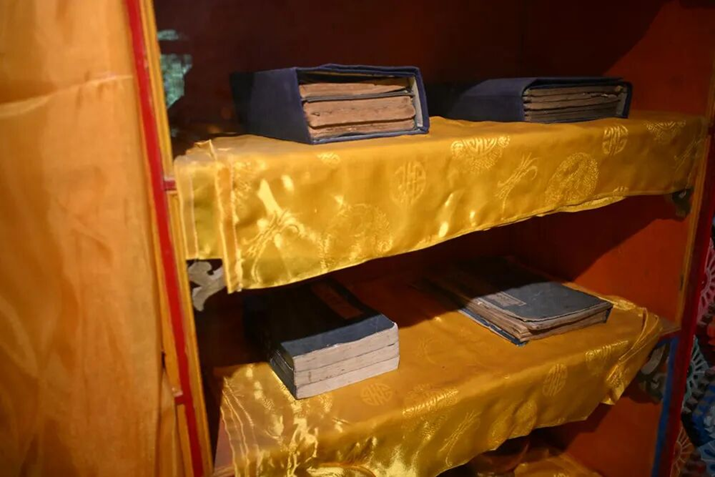
The stitch-bound edition of Romance of the Three Kingdoms borrowed by Mao Zedong, on display in Zhuokeji Tusi Manor in Xisuo Village, Zhuokeji Township, Barkam City, Aba Tibetan and Qiang Autonomous Prefecture, Sichuan Province, on July 7 (WEI YAO) For those seven days, the study’s lamp burned through the night. To engage with local people and learn about Tibetan customs, Mao enlisted help to translate and study Tibetan scriptures and historical documents. This is more than a literary anecdote; it is a story of revolutionary solidarity. Aba Prefecture is the only area inhabited by ethnic minorities that was traversed by the 100,000 main Red Army troops during the Long March, and where the troops stayed the longest, for a total of 16 months. During that period, people of Tibetan, Qiang, Hui, Han and other ethnic groups fully supported the Red Army, providing over 10 million kg of grain and more than 200,000 livestock, building a solid logistical foundation for those main Red Army troops. “After the founding of the People’s Republic of China in 1949, Chairman Mao remarked to Tianbao (Sanggyai Yexe), a Tibetan Red Army soldier from Barkam who later served as secretary of the CPC Xizang Autonomous Regional Committee and chairman of the People’s Government of Xizang Autonomous Region, that ‘your ethnic group stood by the Red Army during the nation’s most perilous hours’,” Tashi added. The story of this study reveals the contemporary global significance of the Long March spirit: A modern governance practice lies in understanding and embracing cultural diversity. The inclusive appreciation of diverse classics by lamplight over nine decades ago embodies the CPC’s governance philosophy of seeking common ground while placing differences aside and building a shared future. This respect for and integration of diverse indigenous cultures offers a valuable Eastern reference for countries around the world grappling with ethnic and cultural diversity challenges, demonstrating that culture is not a wall of estrangement, but a flame that illuminates all. Weaving dreams Across the Suomo River from the manor is the Xisuo Residential Complex. Offcicially listed as one of China’s traditional villages, the settlement is known for its well-preserved Jiarong Tibetan stone houses and bluestone alleys. Advancing with rural revitalization and cultural-tourism integration, Xisuo Village pursues development through preservation, embedding modern conveniences into ancient traditional architecture. Today, the tidy village is a well-known model village for ethnic unity and progress in the prefecture. The nostalgia of traditional Tibetan dwellings is combined with the comfort of modern life, creating harmonious coexistence rather than contradiction. By commercializing distinctive ethnic culture, local residents in the mountains gain the autonomy to change their destinies at their doorsteps. On the village’s scenic commercial street, Samlang Lhawor, a practitioner of Thangka painting, which is listed at the provincial level as a form of intangible cultural heritage, paints intricate designs on canvas at his studio.
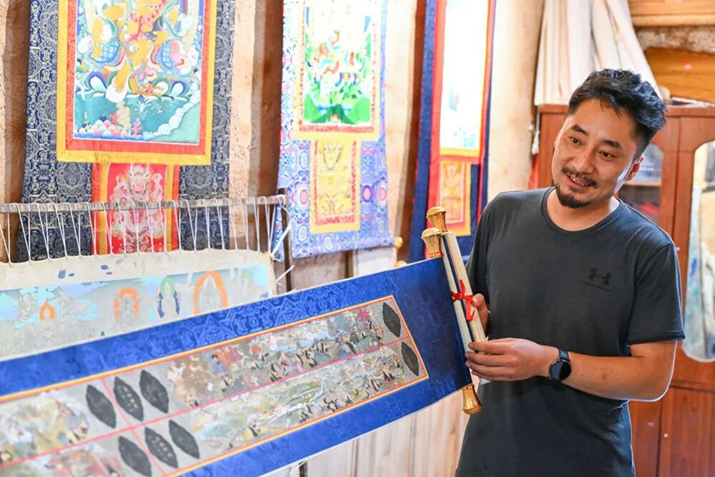
Samlang Lhawor introduces his Red Army-themed Thangka work that integrates traditional Jiarong Thangka craftsmanship with the story of the Long March, on July 7 (WEI YAO) Gazing at his exquisite painting and the prosperous Tibetan village outside the window, Samlang He spoke with emotion: “We now enjoy better food and finer clothes, and almost every household owns multiple cars. Living and working in peace and contentment, we no longer merely seek basic subsistence but pursue high-quality intellectual and cultural fulfillment.” He infuses this sense of wellbeing into his creations: “Today’s China features ethnic unity and peace. People sincerely admire the revolutionary martyrs of older generations. And I am using Thangka to record those times and showcase the great ethnic unity under the leadership of the CPC.” (Reporting from Xisuo, Sichuan Province) Copyedited by G.P. Wilson Comments to taozihui@cicgamericas.com |
|
||||||||||||||||||||||||||||
|