|
| China |
| Hongyuan’s red legacy and modern prosperity | |
|
|
|
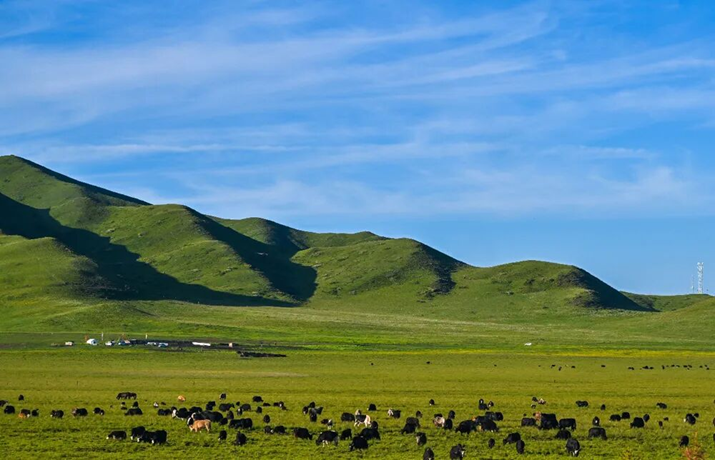
Yak herds on the Zoige Grassland in Aba Tibetan and Qiang Autonomous Prefecture, Sichuan Province, on July 8 (WEI YAO) With its name translating to "red grassland," Hongyuan County in Aba Tibetan and Qiang Autonomous Prefecture of Sichuan Province is China's only county named after the historic Long March. Bestowed by Premier Zhou Enlai in 1960 with the meaning "the grassland traversed by the Red Army during the Long March," the name was intended as a permanent commemoration of the epic journey—a series of strategic relocations the Red Army undertook between 1934 and 1936 to break through the encirclement by the Kuomintang party's repressive regime. Home to about 747,000 hectares of natural alpine meadows, the county has one of west Sichuan's largest contiguous grasslands. Most of the legendary "crossing the grasslands" stretch of the Red Army's arduous trek lies within today's Hongyuan. Alongside its boundless grassland vistas, Hongyuan's most iconic sight is its herds of Maiwa yaks, which often dot the grassland all the way to the horizon. A prized local plateau yak breed native to the Qinghai-Xizang Plateau, the Maiwa yak takes its name from the Maiwa Tribe in Hongyuan, its core birthplace. As Aba's sole purely pastoral county, Hongyuan's residents raise over 470,000 yaks, with 86 percent of the herd having been improved through selective breeding. The yak industry is the county's economic backbone and has built a complete modern industrial chain, Garang Phuntsog, Director of the Hongyuan County Animal Husbandry Center, told Beijing Review.
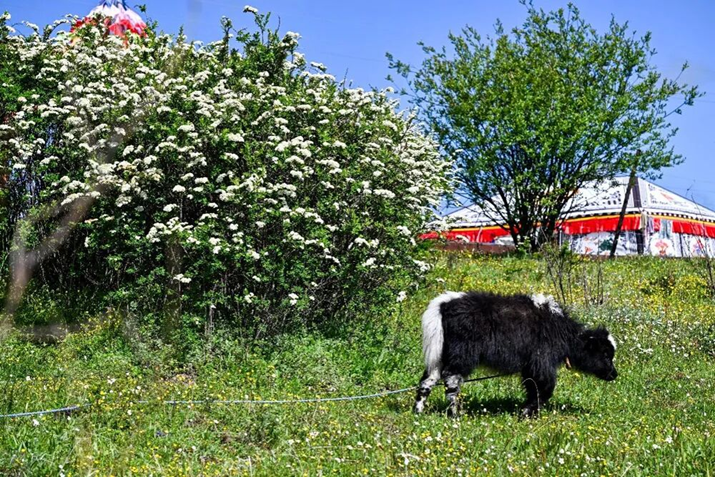
A Maiwa yak calf in Hongyuan County, Aba Tibetan and Qiang Autonomous Prefecture, Sichuan Province, on July 8 (WEI YAO) The yak revolution Between 1935 and 1936, the first, second and fourth front armies of the Red Army were stationed on the northwest Sichuan Plateau, present-day Aba, for 16 months. Back then, herders barely produced enough grain and livestock to sustain their own basic survival, but even amid such hardship, local people of Tibetan, Qiang and other ethnic groups rallied wholeheartedly to support the Red Army. Historical records documented that over those 16 months, they donated more than 15,000 tons of grain, over 200,000 yaks and other livestock, while over 5,000 young highland residents volunteered to march north with the Red Army. Yang Wenming, a local historian from Hongyuan who has studied the Long March in this area for more than three decades, explained to Beijing Review that Tibetans have relied on yaks for survival for generations. Yaks are the only highland livestock that are able to supply meat, milk, hides and transport. These 200,000-plus yaks proved indispensable on the Long March. "Yaks served as mounts, their meat sustained the Red Army on their trek across the grasslands and their hides shielded the soldiers from bitter cold," Yang noted. All of the peoples across this land relied on yaks to pull the Red Army out of mortal peril, Yang said, adding that Mao Zedong referenced this chapter of history as the "yak revolution" in his 1936 interview with American journalist Edgar Snow, as well as in conversations with Tianbao (Sanggyai Yexe), one of the first Tibetans to have joined the Red Army. Tianbao, an 18-year-old lama in a local temple in 1935, later served as secretary of the Communist Party of China (CPC) Xizang Autonomous Regional Committee and chairman of the People's Government of Xizang Autonomous Region. "For people living in areas with large ethnic minority populations today, especially those in Aba, the 'yak revolution' remains an invaluable spiritual asset," Gonbo Huaching, Executive Vice President of the Party School of the CPC Hongyuan County Committee, told Beijing Review. "It does not refer to a single isolated historical event. It embodies the profound sense of community for the Chinese nation forged between local people and the Red Army during those 16 months. Traversing Aba's snow peaks and marshlands together in their darkest hour, they shared life and death, honor and disgrace, weal and woe, bound by a shared destiny."
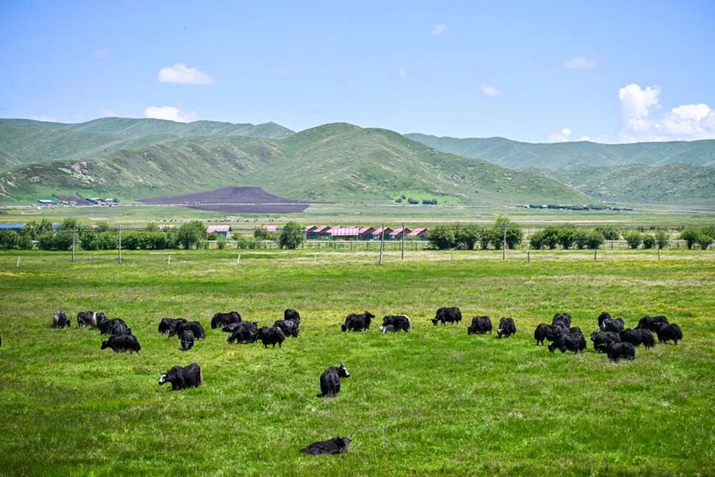
Maiwa yaks graze in Lower Halama Village, Hongyuan County, Aba Tibetan and Qiang Autonomous Prefecture, Sichuan Province, on July 8 (WEI YAO) Powering local development Since the founding of the People's Republic of China in 1949, a cascade of supportive policies has been rolled out to drive the region's development: the implementation of regional ethnic autonomy, boosted fiscal transfer payments, highway networks opening up the highlands, 15-year free education covering all pastoral areas, special funds for advancing the full Maiwa yak industrial chain, ecological compensation, affordable housing and medical care, plus development assistance through being paired with Zhejiang Province in east China. Today, yaks drive high-quality economic growth across Hongyuan County. In Lower Halama Village in Anqu Township, 238 households raise more than 20,000 Maiwa yaks. Zebenjia, Secretary of the CPC Lower Halama Village Branch, told Beijing Review that Hongyuan's yak trading market is the largest specialized live yak market in Sichuan, Gansu and Qinghai provinces, letting villagers sell livestock for cash right at their doorsteps. Thanks to the high quality of local yak milk and the presence of two leading local dairy enterprises, villagers sell their fresh yak milk every dawn for 7 yuan ($1) per kg, far above regular cow milk prices. Raw milk sales alone deliver stable annual income to each household. Zebenjia recounted that with backing from Party committees and governments at all levels, the village in recent years has secured ethnic minority development-related projects totaling 14.68 million yuan ($2.16 million), enabling the integration of grazing and tourism and the village's collective economies. In 2025, the total revenue generated by village collectives in the village was 1.15 million yuan ($161,300), with half distributed directly to villagers as dividends. Leveraging national pilot policies for transforming grassland animal husbandry, Hongyuan has invested over 600 million yuan ($88.5 million) to upgrade industrial infrastructure, building a full industrial ecosystem covering grass seed breeding, improved livestock farming, intensive deep processing of produce and integrated cultural tourism. Garang said Hongyuan will continue prioritizing grassland ecological protection while shifting its animal husbandry focus from "raising fine yaks" to "selling yak products profitably." This will further boost supporting sectors including processing, logistics and cultural tourism, steadily lifting the income of residents. "I often reflect that we must not only remember the Red Army's hardships on the Long March, but also grasp the deeper meaning of their journey. The harmonious, united and happy life all ethnic peoples enjoy on this grassland today, I believe, is the purpose behind all the sacrifices the Red Army made crossing these marshes all those years ago," Chen Zhimin, member of the Standing Committee of the CPC Hongyuan County Committee and head of the Publicity Department of the CPC Hongyuan County Committee, told Beijing Review. (Reporting from Hongyuan, Sichuan Province) Copyedited by G.P. Wilson Comments to liangxiao@cicgamericas.com |
|
||||||||||||||||||||||||||||
|