
|
| China |
| Factories of the future | |
|
|
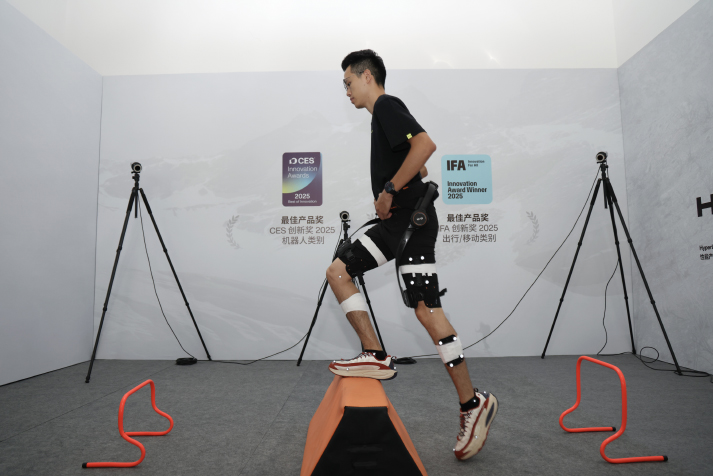 A staff member tests an exoskeleton at a tech company in Shenzhen, Guangdong, on July 3 (XINHUA)
In the production workshop of Guangdong Fenghua Advanced Technology Holding Co. Ltd. (Fenghua) in Zhaoqing, Guangdong Province, ceramic films as thin as cicada wings glide silently along the assembly line. Following more than a dozen intricate processes, they are transformed into multi-layer ceramic capacitors (MLCCs). These specialized components, composed of alternating layers of ceramic material, serve as critical insulators.
Often dubbed "the rice of the electronics industry," these fundamental components are indispensable, powering everything from smartphones and computers to smart TVs and new-energy vehicles (NEVs). MLCCs are the backbone of device stability and performance; without them, modern electronic terminals would simply fail to function. A single smartphone requires over 1,000 MLCCs, an NEV can utilize 10,000, and an advanced AI server rack may house over 400,000. Historically, the MLCC market was dominated by overseas giants. Today, however, Guangdong has achieved large-scale mass production, successfully breaking this monopoly. By combining stable product quality with highly competitive costs, the province has integrated itself into the mainstream electronic supply chains both at home and abroad. 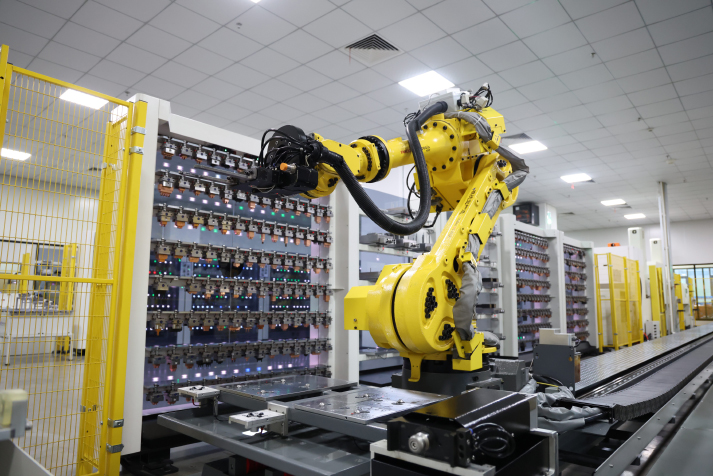 An industrial robot operates at the workshop of Dongguan Moldbao Smart Technology Co. Ltd. in Dongguan, Guangdong Province, on July 2 (XINHUA)
Achieving autonomy "Many are aware that chip research and development (R&D) is arduous, but few realize that the technical challenges associated with MLCCs are equally formidable," Cao Xiuhua, Vice President of Fenghua, told Beijing Review. The complexity is immense: A single MLCC requires 14 independent processes, with a production cycle spanning 30 to 50 days. Front-end workshops must maintain purification standards that rival the semiconductor industry. The greatest hurdle, however, remains material science. Core components, such as ultra-fine barium titanate powder and specialized molding polyvinyl butyral resins, long relied on imports from Japan. "The market demand for such niche raw materials is relatively small, yet the technical requirements are exceptionally high. Many companies are hesitant to invest in independent R&D due to the high risks," Cao noted. To accelerate R&D and resolve persistent industry pain points, Fenghua has pioneered an intelligent R&D ecosystem, deploying cutting-edge platforms such as an AI-assisted R&D system and a fully automated laboratory. Through these efforts, Fenghua has not only achieved mass production but has also realized leapfrog upgrades, reducing MLCC dielectric thickness from 2 microns to 0.6 microns, placing it among the industry's elite. "Iterative development in MLCC technology is a systemic upgrade. Every incremental breakthrough necessitates comprehensive innovation across core materials, critical equipment and manufacturing processes," Cao added. Fenghua's success is no isolated occurrence; it is the natural byproduct of Guangdong's robust innovation ecosystem. Zhang Zhansheng, Deputy Director of the Department of Science and Technology of Guangdong Province, told Beijing Review that the province, guided by industrial demand, has implemented major scientific projects such as the Guangdong Strong Chip project and the Bright Action initiative for the display industry. By intensifying R&D in these fields, the province has secured groundbreaking results in key materials, software and equipment, effectively bolstering the self-reliance of its industrial supply chains. The path of innovation Scientific and technological progress in Guangdong extends beyond hi-tech firms like Fenghua; it has also flourished within time-honored brands like Foshan Haitian Flavoring & Food Co. Ltd. (Haitian). Primarily known for producing soy sauce, oyster sauce and other condiments essential to Chinese cuisine, the Haitian brand, which has accompanied Chinese families for nearly three centuries, has long since shed the image of a traditional manual workshop and is now striding ahead on a brand-new track of intelligent manufacturing. To cater to the evolving dietary habits of modern consumers, Haitian has established a digital consumer research platform. By leveraging big data to capture real-time consumption trends, the company has launched products tailored to modern lifestyles, such as "zero-additive" and reduced-sodium soy sauces, allowing a centuries-old brand to rejuvenate itself through technology. Traditional soy sauce brewing is a complex craft. In the past, every step depended on the experienced eyes and keen sense of smell of master craftsmen. Today, Haitian is redefining brewing through data and algorithms. Huang Shuliang, Chief Engineer of Digital Intelligence at Haitian, told Beijing Review that the company has transformed its experience-driven manufacturing into an intelligent management system centered on AI. "Every single soybean undergoes 'facial recognition.' Haitian screens 2.5 trillion soybeans annually, precisely selecting raw materials that meet our stringent standards for color, size and shape," he said. Flavor, the soul of soy sauce, is also being digitized. Haitian has developed a proprietary AI "electronic nose" system. By converting decades of human expertise into digital models, the system analyzes flavor components, generates an exclusive profile, and matches it against an internal standard to ensure quality. "Previously, this relied on the subjective intuition of masters, which is prone to fatigue and subjective bias. Now, our electronic nose operates 24/7. The experience of the masters has been codified into the machine, ensuring consistent precision," Huang said. Haitian's transformation is not a simple case of "machines replacing humans." Instead, it's a new integrated process that combines technological empowerment with traditional craftsmanship. Intelligent equipment handles standardized, repetitive and high-precision tasks, while human sensory evaluation remains the final gatekeeper, preserving the artisanal nuance that defines the brand. This model provides a compelling blueprint for the transformation of traditional manufacturing across China. Sci-tech innovation hub Whether it is hi-tech firms breaking supply chain bottlenecks or traditional brands embracing digital change, stories of innovation abound throughout Guangdong. A comprehensive ecosystem bolstered by policy support continues to enable enterprises to pursue a future powered by intelligent manufacturing, injecting additional momentum into the province's high-quality development. Chen Yushan, Deputy Director of the Guangdong Institute of Science and Technology Information, noted that as a new round of scientific and technological revolution accelerates, China is doubling down on its innovation-driven development strategy. At the national level, the country has designated three major international innovation centers—the Beijing-Tianjin-Hebei region, the Yangtze River Delta region and the Guangdong-Hong Kong-Macao Greater Bay Area (GBA)—as strategic pillars for building a nation strong in science and technology. The GBA is a major Chinese economic and innovation hub, comprising Hong Kong, Macao and nine cities in Guangdong. The GBA has effectively formed a cohesive loop encompassing basic research, technology transfer and industrial application. Over the past five years, Guangdong's investment in basic research has grown at an average annual rate of over 15 percent. The province now hosts 74,000 hi-tech enterprises, ranking among the top in China, and has fostered global tech leaders such as Huawei, Tencent and Midea. Wu Shiwen, Deputy Director of the Guangdong Provincial Development and Reform Commission, emphasized that Guangdong has consistently adhered to the principle of "the real economy as the foundation and manufacturing as the priority." The province views the development of new quality productive forces—the shift toward innovation-driven growth, technological advancement and high-quality development in multiple sectors of the economy—as a long-term strategic necessity. By aggregating innovation resources and deepening the integration of industry and academia, the province is fostering new forms of business. Currently, Guangdong is focusing on AI, quantum technology and the low-altitude economy, integrating the strengths of Guangdong, Hong Kong and Macao to create world-class industrial clusters. Talent is the foundation of scientific and technological innovation. Zhang Qiangyu, Deputy Director of the Guangdong Provincial Talent Work Bureau, explained that in recent years, Guangdong has been vigorously recruiting high-end international sci-tech talent, in such fields as AI, integrated circuits and biomedicine. Guangdong is also cultivating a large number of urgently needed industrial and technological experts by selecting and training high-level local talent in emerging and future industrial fields. Since last year, the Million Talents Gather in South Guangdong Action Plan implemented by the province has helped over 1.1 million college graduates find employment or start businesses in Guangdong. The large-scale spring job fair held in Guangzhou on March 15-16 attracted over 170,000 students and professionals from across the country and was dubbed the "strongest spring recruitment in Guangdong's history." Looking ahead, the Guangdong Provincial Development and Reform Commission confirms that the province will further deepen institutional cooperation within the GBA. By fostering coordinated basic research and accelerating technology transfer, Guangdong is solidifying its position as a global sci-tech hub, contributing unique pathways and strength to China's national scientific and industrial modernization. (Reporting from Guangdong Province) Copyedited by G.P. Wilson Comments to lanxinzhen@cicgamericas.com |
|
||||||||||||||||||||||||||||
|