|
| China |
| Nanjing and the burden of historical truth | |
|
|
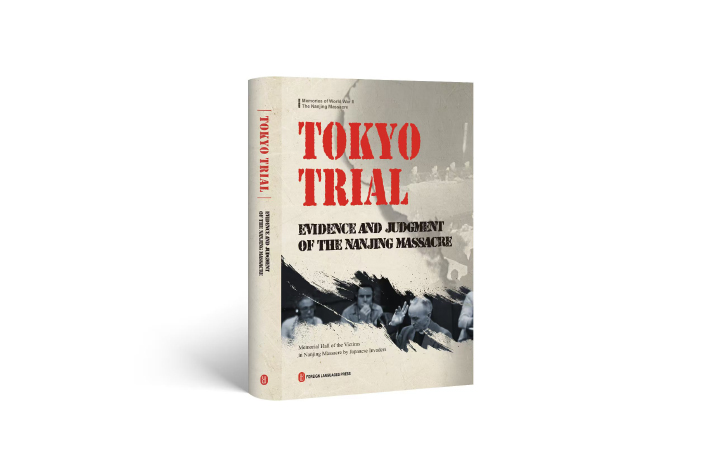 The front cover of Tokyo Trial: Evidence and Judgment of the Nanjing Massacre
On April 29, I participated in an event in Nanjing commemorating the 80th anniversary of the opening of the International Military Tribunal for the Far East, also known as the Tokyo Trial. Established on January 19, 1946, the tribunal was composed of 11 judges representing China, the United States, the Soviet Union, the United Kingdom, the Netherlands, France, Australia, New Zealand, Canada, then British India and the Philippines, who examined the responsibility of Japanese leaders for atrocities committed during World War II (WWII) and held them accountable for war crimes. Japan's 20th-century hostilities against China began on September 18, 1931, when Japanese troops seized the Mukden, now Shenyang, Liaoning Province. July 7, 1937 entered history as the beginning of the bloodiest phase of the Chinese People's War of Resistance Against Japanese Aggression. For the Chinese people, it is September 18, 1931, rather than the German invasion of Poland on September 1, 1939, that marks the beginning of WWII. Likewise, for China, WWII did not end on May 8, 1945, with the surrender of Nazi Germany, but several months later, on September 2 of that year, with the official and unconditional surrender of Japan. In December 1937, before the war reached the European continent, one of the greatest tragedies in human history took place: the Nanjing Massacre. Tens of thousands of Japanese soldiers captured what was then the capital of China and carried out mass executions. Among the victims were thousands of elderly people, children and women, many of whom suffered systematic sexual violence. More than 300,000 Chinese civilians and unarmed soldiers were killed. It remained one of the most tragic and brutal episodes of the 20th century, yet it is still insufficiently remembered when the history of WWII is told. 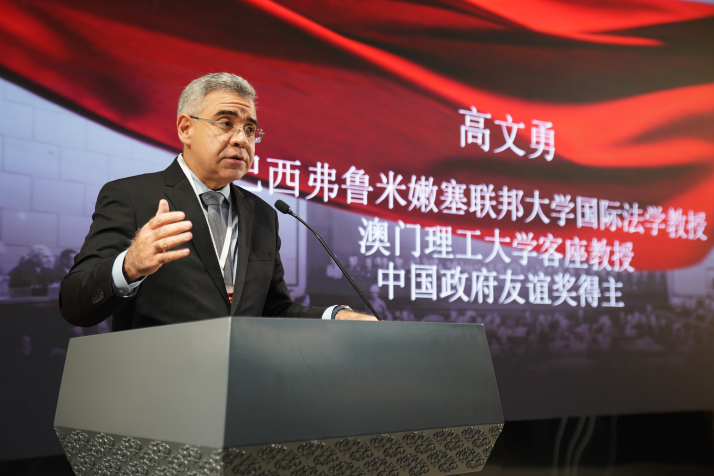 Evandro Menezes de Carvalho delivers a speech at an event commemorating the 80th anniversary of the opening of the International Military Tribunal for the Far East at the Memorial Hall of the Victims in Nanjing Massacre by Japanese Invaders in Nanjing, Jiangsu Province on April 29, 2026 (ZHANG WEI)
When I visited the Memorial Hall of the Victims in Nanjing Massacre by Japanese Invaders several years earlier, I was already able to understand the historical significance of this tragic episode for the Chinese people and for humanity. Now, during my 2026 visit, my feelings were even more profound. I was there as a guest to pay tribute to the victims. As I entered the memorial, seeing its dark and solemn architecture and white flowers placed before the Eternal Flame, I felt as if everything around me had fallen silent. I felt myself becoming part of that silence. It was a paradoxical feeling. Though standing there among the living, we seemed to disappear for a moment so that the memory of the victims could become present once again. In my speech, delivered a few hours later in the memorial's auditorium before a distinguished audience and many journalists, I recalled that the Tokyo Trial, like its counterpart in Nuremberg, Germany, helped establish principles that would later be refined and institutionalized, including individual criminal responsibility for war crimes and the idea that certain crimes offend the international community as a whole. 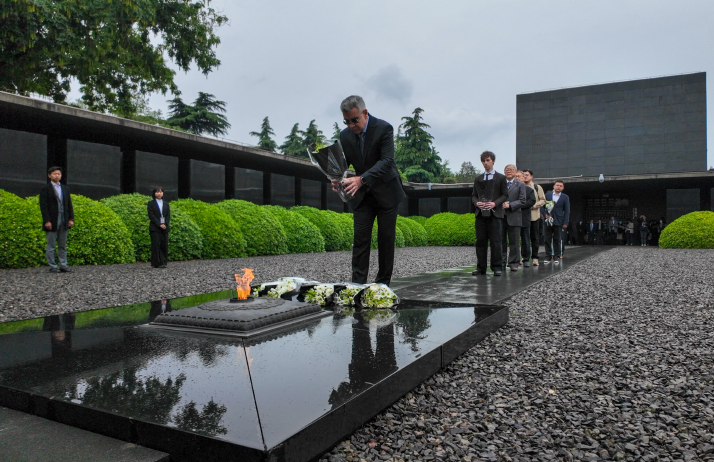 Evandro Menezes de Carvalho offers flowers to the victims in the Nanjing Massacre by Japanese invaders in Nanjing, Jiangsu Province, on April 29 (ZHANG WEI)
The documents related to the Nanjing Massacre have received international recognition, including their inscription on UNESCO's Memory of the World Register. This recognition confirms that what we have here is not merely a matter of national narrative but part of humanity's shared memory. The evidence presented before the tribunal was not only testimonial but also statistical and material. Trial records indicate that, in the weeks following the fall of Nanjing, tens of thousands of rapes occurred, vast areas of the city were destroyed and mass killings reached a scale that shocked even contemporary observers. These are not numbers detached from reality; they represent extinguished lives, destroyed families and a social fabric violently torn apart. During the commemorative event, Gao Anming, Editor in Chief of China International Communications Group, gave me a copy of the book Tokyo Trial: Evidence and Judgment of the Nanjing Massacre. This book joins other important works published in previous years, such as A Survivor of the Nanjing Massacre: Chang Zhiqiang's Life, also published by the Foreign Languages Press in 2020. The book Tokyo Trial contains several shocking testimonies from both foreign and Chinese witnesses who directly observed the daily, systematic murders and rapes committed by Japanese soldiers in Nanjing, all with the complicity of the military generals and the Japanese government of that period. Among these testimonies is that given before the Tribunal by American John Magee. He served as a minister of the Episcopal Church in Nanjing from 1912 to 1940 and witnessed the massacre firsthand. When asked about the attitude of Japanese soldiers toward women and children in Nanjing after the city's occupation, he responded: "It was again the same story, unbelievably terrible. The rapes continued day by day. Many women were killed and even children. If a woman resisted or refused, she was either killed or stabbed. I took pictures, moving pictures of the wounds of many of these women—women with their necks slit, stabs all over their bodies. If the husband of the woman tried to help her in any way, he was killed." In another passage, Magee recounts what he heard from a widow then approximately 40 years old and her then 77-year-old mother: "This widow, when the Japanese first entered, had been raped repeatedly. Then they decided to try to escape to our Safety Zone. On their way, as they were going along the street in the dark, the woman got separated from her old mother. The mother told us that she had been taken into a house on the way and raped twice. Seventy-seven years old!" Magee's grandson participated in this memorial event remotely. In his remarks, he said of his grandfather, "Perhaps his most dangerous and profound act of defiance was the decision to secretly film the Japanese atrocities unfolding around him." Telling and showing the truth can cause discomfort for some, including diplomatic discomfort. But would it not be even more disturbing not to tell it? We cannot silence the voices of those who suffered and died in Nanjing. Thanks to the book Tokyo Trial, the testimonies of witnesses bring us not only the pain endured by the victims, but also the assurance that they will never be forgotten. After all, the memory of traumatic and inhuman events does not belong solely to the people who experienced them, but to humanity as a whole. Just like the Holocaust, the Nanjing Massacre must be remembered so that similar tragedies are never repeated. The Nanjing Massacre must become part of the global moral heritage, warning humanity against barbarism. Looking at the present, the judgments of the Tokyo Trial invite us to undertake profound reflection. Nazifascism, as well as Japanese militarism, which we believed had been defeated in 1945, seems not to have disappeared entirely. There are signs that they have resurfaced in recent years, often disguised through extreme nationalist discourses that promote hatred against minorities and manipulate the truth. The genocide in Gaza is the clearest symbol that we stand on the edge of a new global conflict, given the world's inability to put an end to evil and allow peace and reason to prevail. Nazifascist and militaristic ideologies have already shown that they are never satisfied in their darkest ambitions. This is why the memory of the Chinese resistance, and of the global effort in the World Anti-Fascist War, must be preserved and transmitted. This is why we must remain vigilant. BR The author is chief executive editor of China Hoje magazine, published in conjunction with Beijing Review. He is also a professor of international law at Macao Polytechnic University and Wutong chair professor at Beijing Language and Culture University Copyedited by G.P. Wilson Comments to linan@cicgamericas.com |
|
||||||||||||||||||||||||||||
|