
|
| China |
| Boundless without gravity | |
|
|
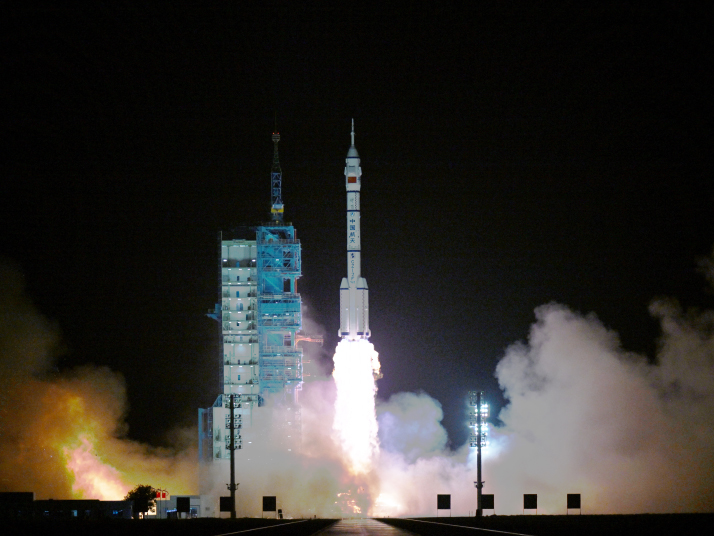 The Shenzhou-23 crewed spaceship, atop a Long March-2F carrier rocket, blasts off from the Jiuquan Satellite Launch Center in northwest China on May 24 (XINHUA)
China's newest team of taikonauts roared into the sky on the late night of May 24, blasting off aboard Shenzhou-23 for the Tiangong space station. The launch set the stage for a celestial changing of the guard. Hours later on the next day, the incoming and outgoing crews embraced aboard the station. This is the seventh crewed mission to take place during the space station's application and development stage that started in May 2023, and was the 40th flight mission of China's manned space program. Commanding the Shenzhou-23 crew is Zhu Yangzhu, a veteran astronaut who previously flew on the Shenzhou-16 mission. Joining him are spaceflight rookies Zhang Zhiyuan and Li Jiaying (also known as Lai Ka-ying). Before their selection by the space program, Zhang served as an air force pilot and Li was a member of the Hong Kong Police Force. Li's historic journey adds a particularly compelling chapter to this mission's coverage. The 43-year-old mother of three has made history as the first taikonaut from the Hong Kong Special Administrative Region (HKSAR) to travel into space, the fourth Chinese woman to do so and the nation's very first female payload specialist in space. 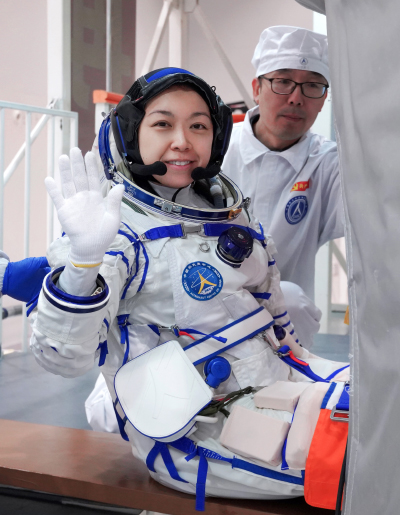 Li Jiaying (Lai Ka-ying) takes part in an integrated spacecraft-and-crew test in Jiuquan in northwest China on December 20, 2025 (XINHUA)
Discoveries in orbit The Shenzhou-23 lineup itself represents a series of historic milestones for China's manned space program. Zhu is set to make history as the nation's first flight engineer to step into the role of mission commander. Furthermore, one crew member will remain aboard the orbital outpost for a full year, which will be China's longest single space residency to date. While officials have yet to announce which of the three taikonauts will carry out the marathon stay, spokesperson of China Manned Space Agency (CMSA) Zhang Jingbo noted that this extended residency will generate vital health data on the impacts of prolonged weightlessness for research on long-duration space stay. This extended mission is designed to push the boundaries of human adaptability and performance, with researchers aiming to map out a comprehensive, multi-system and multi-omics biological atlas of how the human body reacts to a year in space. Furthermore, the year-long stay will serve as a rigorous test for the station's life support systems, helping engineers upgrade onboard medical and protective hardware. It also opens up a rare window for scientists to run continuous, uninterrupted experiments that require long-term observation in microgravity. According to the spokesperson, over 100 scientific and application experiments will be carried out during the Shenzhou-23 mission, spanning cutting-edge disciplines from aerospace medicine and materials science to microgravity fluid physics and advanced space tech. A major focus will be placed on space life sciences, with the crew studying zebrafish, mouse embryos and stem-cell-derived "artificial embryos." The goal is to build a groundbreaking developmental research framework that tracks how life grows in microgravity, tracking everything from simple vertebrates to complex mammals. Meanwhile, scientists are sending a novel strain of rice seeds to the space station to see if they can successfully reproduce in space, noted Cang Huaixing, a researcher with the Chinese Academy of Sciences' Technology and Engineering Center for Space Utilization. "Our goal is to cultivate two consecutive generations of rice entirely in orbit for the very first time," Cang said. "This will help us understand exactly how prolonged microgravity impacts the crop's genetic stability over generations." The mission will also delve into human health, exploring how microgravity alters cellular behavior—specifically how biological phase separation affects liver cell metabolism. Unlocking these molecular secrets could pave the way for medical interventions to protect astronauts from conditions like fatty liver disease during long-haul space voyages. Outside the station, a five-month radiation biology study will take place using an extravehicular exposure device, which will host three distinct types of specimens: nanozymes, actinomycetes and plant seeds. Cang introduced that exposing these specific samples to the harsh vacuum of space will allow researchers to scrutinize the deep-seated impacts of cosmic radiation, shedding light on microbial adaptation, plant mutations and the behavior of catalysts linked to the origins of life. In the realm of materials science, the crew's research focuses on manufacturing next-generation materials in microgravity. This includes fabricating high-performance rare-earth permanent magnets and lightweight, high-entropy alloys, while studying how to manipulate and optimize their structural properties in space. The mission will also be a major milestone with the first-ever dynamic, in-orbit testing of perovskite solar cells aboard Tiangong. These tests are designed to gather real-time data on how extreme cosmic environments degrade energy conversion efficiency. By observing these cells in action, researchers hope to map out the performance lifespans and specific failure points of perovskite materials when subjected to the harsh realities of open space. Ultimately, Cang noted, this research will build crucial technological groundwork for the next generation of low-orbit satellites, deep-space exploration vessels, lunar outposts, and the energy systems required for in-situ manufacturing on other worlds. Beyond their heavy scientific workload, the crew faces a demanding operational schedule. They will perform multiple spacewalks, manage cargo logistics, and install or retrieve external hardware, all the while continuing the station's tradition of broadcasting science education lectures to audiences back on Earth. 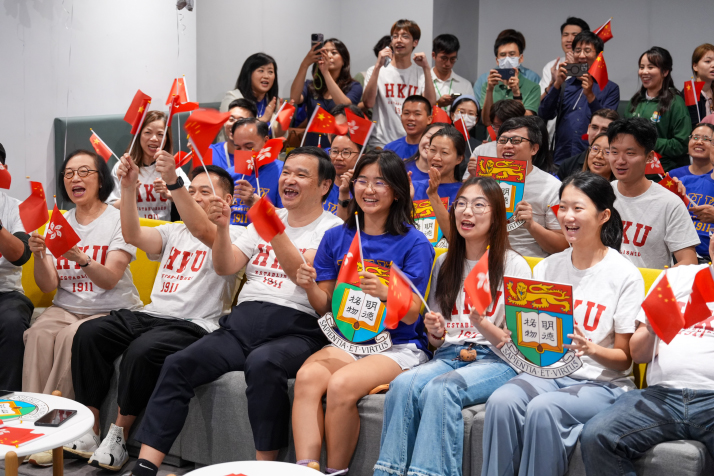 Teachers and students of the University of Hong Kong celebrate the successful launch of the Shenzhou-23 crewed spaceship while watching the event via live broadcast in south China’s Hong Kong Special Administrative Region on May 24 (XINHUA)
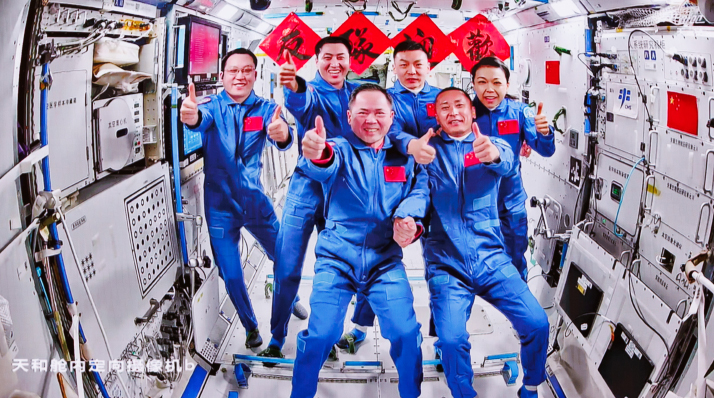 A group picture of the crews of the Shenzhou-21 and Shenzhou-23 spaceships, captured at the Beijing Aerospace Control Center on May 25 (XINHUA)
Reaching for space Millions tuned in to watch the live broadcast of the liftoff, and the excitement was felt especially in Hong Kong. As Hong Kong's first astronaut soared into orbit, her journey sent an inspiring wave through the city, especially among the youth, proving that even the grandest space dreams are within reach. "As an ordinary native of Hong Kong, I never imagined I could join the taikonaut corps, let alone be selected for this spaceflight," Li said during a press conference on May 23, just a day before her maiden voyage. "This precious opportunity was far beyond my wildest expectations." Her journey to the stars began in 2022. At the time, Li had spent a decade specializing in electronic forensics and cybersecurity in the Hong Kong Police Force. When the CMSA announced it would recruit its fourth generation of astronauts, opening the door to payload specialists from Hong Kong and Macao special administrative regions for the very first time, she seized the opportunity. After a rigorous selection process, she ultimately beat out a competitive pool of 120 applicants from Hong Kong. All residents of Hong Kong are thrilled and proud, HKSAR Chief Executive John Lee Ka-chiu said on May 24, offering his congratulations following the flawless launch. Lee noted that with Beijing's backing, Hong Kong has successfully transitioned from a mere "supporter" of the nation's aerospace ambitions into an active "executor." The milestone, he added, not only highlights the city's technical capabilities but also showcases how Hong Kong can better integrate into and serve national development. Closer to home, the energy was electric at the University of Hong Kong, where nearly 50 faculty members and students gathered to cheer on their alumna. "Li has become an incredible role model for us," a biology undergraduate surnamed Yeung told Xinhua News Agency, noting that the breakthrough is inspiring for her. "Her journey into space makes the country's grand dreams of innovation feel concrete, real and attainable." Li's historic flight is just the beginning of an era when the crew aboard the space station will become increasingly diverse. This April, the CMSA announced that two Pakistani candidates had been selected as the first international astronauts to join China's space training program. Upon completing their rigorous evaluations, one will eventually log flight time as a payload specialist, becoming the first foreign astronaut aboard Tiangong. BR Copyedited by G.P. Wilson Comments to yuanyuan@cicgamericas.com |
|
||||||||||||||||||||||||||||
|