
|
| China |
| A taste of Chile | |
|
|
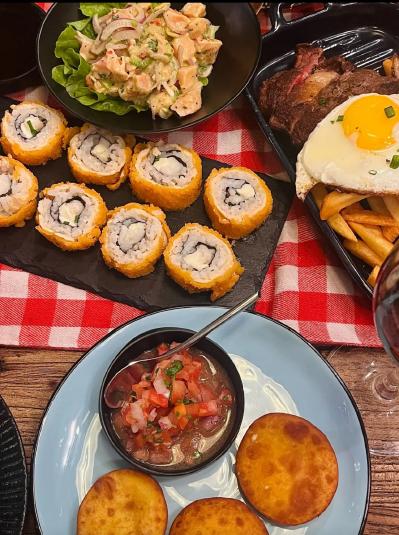 Some typical dishes from Casa Chile's menu (COURTESY PHOTO)
Rodrigo Riveros has carved out a name for himself as one of the leading international entrepreneurs in Shanghai's food and beverage industry. Yet, despite his lifelong love for events and food, he once never imagined he would one day make them his career. Like many of life's paths, his journey was shaped by coincidence, luck and persistence—all of which gradually opened the doors to where he stands today. Riveros' story began in Chile, when curiosity and a passion for languages led him to study Chinese. In 2009, thanks to a scholarship from a Confucius Institute in the country, he had the chance to visit Shanghai for a month. Confucius Institutes, named after the ancient Chinese philosopher Confucius (551-479 B.C.), serve as non-profit public institutions to help foreigners better understand China by teaching Chinese language and culture at universities in their host countries. A year later, he returned to Shanghai as a translator for a Chilean company, deepening his connection with China. Testing his luck Though Shanghai had already left a lasting impression on him, Riveros' youthful desire to see the world took him to Australia through a 12-month working holiday program. When his journey came to an end on March 28, 2014, his destination was not Chile—where his family, friends and professional network were waiting—but China. "I chose Shanghai because I had already been there in 2009 and 2010 and loved it," he recalled. "It was such a dynamic city, full of opportunities, with lots of foreigners and endless chances to meet new people." His instincts were correct, and although he arrived without a job, opportunities appeared quickly. By 2010, China had already emerged as the world's second largest economy, creating a business environment brimming with possibility—the perfect backdrop for Riveros to settle down and start over. "Just a few days after arriving, I met some fellow Chileans," he said. "During one of those gatherings, I bought a bottle of pisco from someone who was launching a wine magazine—that ended up being my first job in China." Chile ranks among the world's top wine producers and is recognized globally for its excellent quality-to-price ratio compared with Old World wine nations like France or Spain. As a result, the country now sits among the three leading exporters of wine to China—a booming market with strong purchasing power. Still, Riveros noticed that many Chinese consumers, more familiar with baijiu (Chinese liquor distilled from grain), knew little about wine culture. "Before coming to Shanghai, I worked at the Chinese company ZTE in Chile," he explained. "I often went out with clients and realized that many of them didn't know how to choose wines for different occasions." That prompted him to deepen his wine knowledge through tastings and to join Chile's largest wine community, the Club de Amantes del Vino, founded in 1997 to connect vineyards with consumers. Alongside wine imports, Riveros began experimenting with meats, salmon and chicken—eventually launching his own online store to meet rising demand. "Over time, we ended up building an online supermarket focused on imported products," he said. The opportunity arose largely because of Shanghai's growing expatriate population at the time. 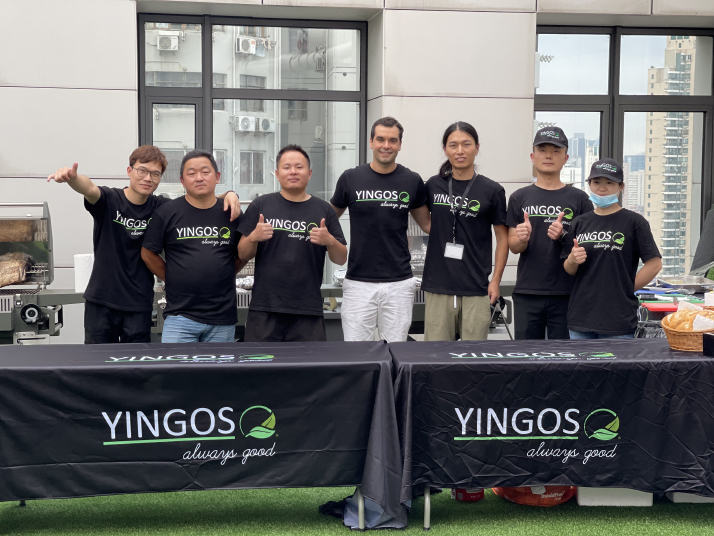 Rodrigo Riveros (center) with members of his Yingos team at an event (COURTESY PHOTO)
Tailoring the experience One day, a foreign couple approached him for help organizing a dinner for 70 people. But there was a twist. "Many of the men were French, and their partners were from Francophone African countries. In Africa, the meat is eaten very well done, while in France it's practically raw," Riveros laughed. Fortunately, the meal was a hit. Word spread quickly, and more clients began hiring him for events and celebrations. What started as a one-off opportunity gradually evolved into a well-known catering brand in Shanghai. Today, the Chilean entrepreneur, who is married to a German woman with a background in the restaurant industry, oversees between 1,000 and 1,500 events a year, catering everything from intimate gatherings to massive events for up to 5,000 guests. The first few years, he said, were full of learning and investment, but eventually his company—Yingos, named both after a popular Chilean TV show (2007-13) and a nickname given by a friend who helped him with his Chinese visa—found solid footing. Now, Yingos can handle up to 10 simultaneous events in one day, even in other cities. "We have a warehouse with all the equipment we need, and our restaurant Casa Chile, which serves as our food production center," he explained. Riveros now works with around 140 part-time employees, allowing him to handle large-scale events without the cost of full-time staff. Managing his own supply chain—selling frozen products online—has also made the business more flexible. "These days, the biggest challenge isn't operations but costs," he said. "Prices for many products, especially meat, have gone up sharply, while clients' budgets have gone down." Despite the ups and downs, the brand he has built is known for its quality and reliability and is always tailored to meet each client's needs. His catering offer now extends far beyond barbecues to include dishes from American, Greek, Mexican and, of course, Chilean cuisines. Riveros has collaborated with consulates, international schools and private companies, and was even in charge of catering when La Esmeralda—the Chilean Navy's training ship—visited Shanghai last June after its participation in Expo 2025 Osaka. Other memorable events include Coca-Cola's anniversary celebration during the COVID-19 pandemic and a private dinner for a former president of Panama aboard a yacht—an event he had less than 24 hours to organize. Although his hard work has paid off, Riveros acknowledges the difficult side of entrepreneurship. "You see many people with steady salaries and few worries," he said. "Being an entrepreneur means living with uncertainty and responsibility. I don't know many who've managed to keep their businesses running for so many years." A unique bet One of the things Riveros misses most about Chile, besides family and friends, is the food. Fortunately, he has Casa Chile. Serving classic Chilean dishes such as empanadas de pino and pastel de choclo, the restaurant—which opened to the public last June—is currently the only Chilean restaurant in China. Originally conceived as a food production kitchen—"something like a dark kitchen"—it gradually evolved into a full-fledged restaurant and a meeting point for various projects connecting Chile and China. "Today it's also a hub for collaboration on initiatives related to adventure tourism, the Patagonia region (which includes parts of Chile and Argentina), mining, cherries, wines and more," he explained. Unlike other Latin American cuisines such as Mexican or Peruvian, Chilean food is relatively unknown internationally—especially among Chinese consumers—so a key goal for Riveros is to raise its profile. So far, he said, the response has been encouraging. "Many Chinese ingredients are similar to Chilean ones—potatoes, rice, soups, bread, corn and empanadas—so the flavors don't feel foreign," he said. Looking to the future, Riveros hopes to partner with larger companies on e-commerce, events and culinary ventures. "The idea is to expand the business through these partnerships," he said. It's a bold move, but with determination, hard work and perseverance, Riveros has shown he can overcome challenges and create new opportunities—making the road ahead both wide and promising. BR Copyedited by G.P. Wilson Comments to yanwei@cicgamericas.com |
|
||||||||||||||||||||||||||||||
|