|
| China |
| Top diplomat meets the press | |
|
|
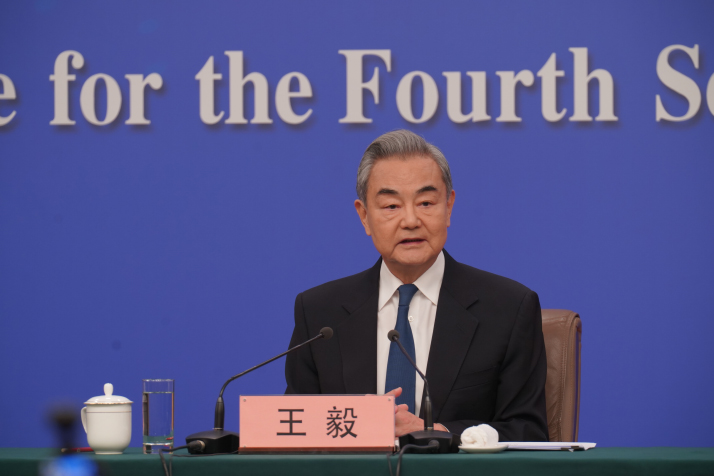 Foreign Minister Wang Yi, also a member of the Political Bureau of the Communist Party of China Central Committee, at a press conference on China's foreign policy and external relations held on March 8 during this year's session of the National People's Congress in Beijing (ZHANG WEI)
On March 8, Chinese Foreign Minister Wang Yi, also a member of the Political Bureau of the Communist Party of China Central Committee, answered questions from the media on the sidelines of the Fourth Session of the 14th National People's Congress, the country's top legislature. Edited excerpts of his remarks on selected topics follow: Head-of-state diplomacy Head-of-state diplomacy is the anchor of China's diplomacy. Navigating international relations over the past year, President Xi Jinping charted a course through rough waters with extensive head-of-state diplomacy, which was captured in a number of historic moments. In his meetings and strategic communication with world leaders over the past year, Xi pioneered new practices of dialogue and coordination between major countries; he visited Southeast Asia, Russia, Central Asia and the Republic of Korea, building up the new momentum of good neighborliness and friendship; he hosted the Shanghai Cooperation Organization Summit in Tianjin and the China-CELAC (Community of Latin American and Caribbean States) Forum, gathering new impetus for the great unity of the Global South; he attended a series of commemorations of the 80th anniversary of the victory of the Chinese People's War of Resistance Against Japanese Aggression and the World Anti-Fascist War, sounding a new, powerful call for safeguarding peace and justice. Through head-of-state diplomacy over the past year, the international community has gained a better understanding of, drawn closer to, and developed greater trust in and higher expectations of China. More and more countries have come to see that under Xi's guidance and stewardship, China's diplomacy provides the most-needed stability and certainty to a world in turmoil and serves as an irreplaceable mainstay amid global turbulence. In particular, the series of initiatives and propositions Xi put forward demonstrate exceptional strategic foresight and broad global vision. They point out the right way forward amid changes in the world unseen in a century. In 2026, Xi will receive guests from around the world, host major diplomatic events such as the APEC Economic Leaders' Meeting and the Second China-Arab States Summit, and make several visits abroad. These diplomatic engagements are bound to further advance China's relations with the world in a positive direction, open up new space for building a community with a shared future for humanity, and enable the Chinese nation to make new, greater contributions to world peace and development. China-Russia partnership This year is the 30th anniversary of the China-Russia strategic partnership of coordination and the 25th anniversary of the China-Russia Treaty of Good-Neighborliness and Friendly Cooperation. In a fluid and turbulent world, China-Russia relations have stood rock-solid against all odds. I think the main reason for this is that the China-Russia strategic partnership of coordination has been based on equality, respect and mutual benefit since day one. It embodies the essence of a new type of international relations. It represents the direction of a new type of major-country relations. China and Russia are strategically independent. We always respect each other's core interests, do not impose the will or agenda of one on the other, and keep to the principle of non-alliance, non-confrontation and not targeting any third party. China and Russia share a high degree of political mutual trust. Working back-to-back lies at the heart of this relationship. And the strong strategic resilience enables it to defy any external instigation or pressure. China and Russia act in close coordination. In major international and regional affairs, China and Russia share the broadest strategic consensus and closest strategic coordination, including defending international rules and order. 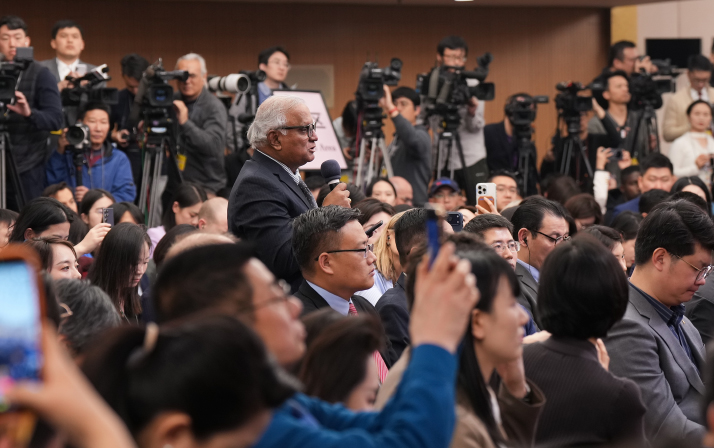 Journalists at Wang's press conference on March 8 (XINHUA)
China-U.S. relations The relationship between China and the United States is one of far-reaching and global implications. Turning our backs on each other would only lead to mutual misperception and miscalculation. Sliding into conflict or confrontation could bring disaster to the world. China and the U.S. are both big countries. Neither side can remodel the other, but we can choose how we want to engage, that is, to commit to a spirit of mutual respect, to hold the bottom line of peaceful coexistence, and to strive for the prospect of win-win cooperation. That's what serves the interests of Chinese and American peoples, and that's also the expectation of the international community. It is heartening to see that the presidents of the two countries have led by example. By maintaining positive top-level interactions, they have provided important strategic safeguards for the China-U.S. relationship to improve and move forward, and they have brought the relationship back onto an even keel. This year is a "big year" for China-U.S. relations. The agenda of high-level exchanges is already on the table. What the two sides need to do now is to make thorough preparations accordingly, create a suitable environment, manage the risks that do exist, and remove unnecessary disruptions. China is always committed and open. It is critical that the U.S. side work in the same direction. I believe that when the two sides treat each other with sincerity and good faith, we will be able to lengthen the list of cooperation and shorten the list of problems; we will be able to, under the strategic guidance of the two presidents, produce results that are satisfactory to both peoples, achieve consensus that is welcomed by the whole world, and make 2026 a landmark year of sound, steady and sustainable development of China-U.S. relations. China-Europe ties Since last year, relations between China and European countries have been regaining strength. Two-way trade topped $1 trillion, over 2 million European tourists traveled here under visa-free policies, and, on top of that, European leaders paid a number of visits to China. A host of new cooperation agreements have been reached. China-Europe relations draw stability from shared interests and certainty from mutually beneficial partnerships. China has a clear stance on developing relations with Europe. We consistently believe that Europe should naturally be a pole in a multipolar world, that Europe is an important force underpinning the stability of the international order, and that Europe is a key partner for China in our modernization. For China-Europe relations to remain steady and sound, it is crucial for Europe to have a correct perception of China. We are witnessing a growing consensus among wise minds in Europe that China is not a competitor but a global partner. This is especially true among young people. They are looking at China in a more objective and positive way. In trade and economic ties, China and Europe are mutually complementary. A dynamic balance is entirely within reach amid strengthening ties. As has been demonstrated through China-Europe cooperation, interdependence is not a risk, intertwined interests are not threats, and openness and cooperation will not weaken economic security, but building walls and barriers will only lead to self-isolation. We are glad to see Europeans stepping out of the "small attic" of protectionism and walking into the "fitness club" of the Chinese market to build their strength and competitiveness. China-Latin America relations Old scripts from the 19th century shouldn't be acted out on the international stage of the 21st century. The resources of Latin America and the Caribbean (LAC) belong to the people there, the path of LAC countries should be chosen by their people, and their choice of friends is a decision for them alone. China-LAC cooperation is about the mutual help and support between Global South countries. China-LAC relations have grown significantly in the past 50-plus years. The key lies in the fact that China always respects Latin American people and commits to equal treatment and mutual benefit with LAC countries. We never engage in geopolitical schemes, nor interfere in other countries' internal affairs, nor ask others to pick sides. At last year's Ministerial Meeting of the China-CELAC Forum, we jointly launched five programs for solidarity, development, civilization, peace and people-to-people bonds, drawing a blueprint for China and LAC countries' joint march toward modernization. Cooperation between China and LAC countries does not target any third party and should not be subject to interference by any third party. We have great confidence in the future of China-LAC relations. No matter how the situation evolves, China stands ready to work with LAC countries toward building a China-LAC community with a shared future and spreading the benefits of our comprehensive cooperative partnership to more people on both sides. China-Africa cooperation For 70 years, China-Africa friendship has stood the test of changing international circumstances and shown strong vitality. For 36 years, China's foreign minister has kicked off the year with a visit to Africa, a tradition that has been honored rain or shine. This consistency reflects the spirit and commitment of China's diplomacy. During my visit to Ethiopia early this year, people fondly recalled the touching scenes of Premier Zhou Enlai's visit to Africa [from December 1963 to February 1964]. Then in Tanzania, people still cherished the memory of Chinese assistance in building the Tazara Railway [in the 1960s and 1970s]. They remember the young Chinese engineers and workers who laid down their lives for it and never made it home. It's no exaggeration to say that China-Africa friendship has been passed down from generation to generation—forged heart to heart, and built with sweat and blood. In this new era, President Xi Jinping still deeply values the bond with Africa. He emphasizes sincerity, real results, amity and good faith in working with Africa—always reminding us of our friendship and shared interests with the continent. This year, China-Africa relations will see many new developments, three of which I'd like to draw your attention to. First, fresh steps in building the China-Africa community with a shared future. We will host multiple African leaders to strengthen mutual support as all-weather partners and write a new chapter of our shared journey. Second, full implementation of zero-tariff access for 100 percent of African imports as from May 1. As part of China's commitment to high-standard opening up, we are removing tariffs completely to boost trade, multiply benefits for the people and help Africa access the enormous opportunities of the Chinese market. Third, the nearly 600 exciting events that will take place under the China-Africa Year of People-to-People Exchange. We are always ready to work with our African brothers and sisters to draw inspiration from our civilizational heritages, forge a stronger bond between our peoples and carry forward our friendship for many, many generations to come. Relations with Japan The future of China-Japan relations hinges on Japan's choices. Last year was the 80th anniversary of the victory of the Chinese People's War of Resistance Against Japanese Aggression. In such a special year, Japan should have deeply repented for the wrong path it chose, including its brutal invasion and colonization of Taiwan. Yet the current Japanese leader claimed that a Taiwan contingency could constitute a "survival-threatening situation" for Japan, under which Japan may exercise its so-called "right of collective self-defense." It's well-known that the right of self-defense shall be invoked only when a country has come under armed attack. One would ask: Since Taiwan affairs are purely China's internal affairs, what gives Japan the right to interfere with them? Why is Japan entitled to invoke self-defense in response to events in China's Taiwan region? Is exercising the "right of collective self-defense" simply a way to hollow out Japan's pacifist Constitution which renounces the right of belligerency? Given that Japanese militarists once used a "survival-threatening situation" as a pretext for launching aggression, such rhetoric can only make the people in China and the rest of Asia alert and deeply worried: Where exactly is Japan headed? Another significant 80th anniversary that takes place this year is that of the opening of the Tokyo Trials. Eighty years ago, judges from 11 countries commenced proceedings that would span two and a half years, reviewed a mountain of irrefutable evidence and laid bare the innumerable crimes of Japanese militarists. The Tokyo Trials, a litmus test of humanity's conscience, delivered historical justice. Today, 80 years on, Japan is given another opportunity for serious soul-searching. As Chinese adages remind us, "History is a mirror that reflects the rise and fall of human affairs" and "The past, if not forgotten, can serve as a guide for the future." We hope the Japanese people will keep their eyes wide open and never allow anyone foolish enough to tread the same disastrous path today. A strong China with 1.4 billion people will never allow anyone to justify colonialism or reverse history's verdict on aggression. China-India ties President Xi and Prime Minister Narendra Modi had a successful meeting in Tianjin last August. Building on the fresh start enabled by their Kazan meeting in 2024, it brought about further improvement in China-India relations. Both sides are earnestly implementing the important understandings of our leaders. We are heartened to see reenergized interactions at all levels, a new record in bilateral trade and closer people-to-people exchange. All this has brought tangible benefits to the two peoples. First, China and India must maintain the correct strategic perception of each other as partner rather than rival, and opportunity instead of threat. Second, we must uphold good-neighborliness and friendship, and jointly safeguard peace and stability in the border areas. Third, we must focus on development, which is the biggest common denominator of our two countries, and produce more visible outcomes of practical cooperation. Fourth, we must step up to the plate and support each other's BRICS presidency over the next two years, so as to make BRICS cooperation more substantive and bring new hope to the Global South. The South China Sea The South China Sea is home to the world's busiest, safest and freest shipping lanes. Over the past year, cooperation in the South China Sea has kept a sound momentum. Yet lasting peace and stability requires solid institutional support. As we continue with the full and effective implementation of the Declaration on the Conduct of Parties in the South China Sea, consultation on a Code of Conduct in the South China Sea (COC) has reached crunch time. All relevant parties look forward to wrapping it up this year. Together with the parties, China has the confidence and the resolve to remove interference, bridge differences, expand common ground and reach an agreement as soon as possible. The COC will provide the golden rules for the parties to effectively manage differences, build trust and advance cooperation. We also hope that as this year's chair of the Association of Southeast Asian Nations, the Philippines will recognize and fulfill its responsibility, resist the pull of self-interest, and play a positive role for peace and stability in the region. The Taiwan question Taiwan has been an integral part of China since ancient times. It never was, is not and never will be a country. Its return to China is a victorious outcome of the Chinese People's War of Resistance Against Japanese Aggression and World War II. Its status has been definitively fixed by a series of international legal instruments, including the Cairo Declaration, the Potsdam Proclamation, Japan's Instrument of Surrender and Resolution 2758 of the UN General Assembly. Any attempt to create "two Chinas" or "one China, one Taiwan" is doomed to fail. The Democratic Progressive Party authorities' obstinate pursuit of their separatist agenda is the root cause undermining peace and stability across the Taiwan Straits. It has been proven time and again that the more the international community stands against "Taiwan independence" and upholds the one-China principle, the more assured peace and stability will be across the Taiwan Straits. The one-China principle has overwhelming support in the international community. More and more countries are standing with China—not only reaffirming their commitment to the one-China principle and recognizing Taiwan as part of China, but also taking a clear stand against all activities for "Taiwan independence" and supporting the cause of China's reunification. This is irrefutable proof that opposing "Taiwan independence" and promoting China's reunification is the trend of the times, and meets the expectations of the international community. Iran We have stated our principled position on multiple occasions, which can be summarized into one key message, that is, to bring about ceasefire and end hostilities. Ancient Chinese wisdom warns that weapons are ominous tools and should not be used without discretion. Seeing the Middle East engulfed in flames, I want to say that this is a war that should not have happened—it is a war that does no one any good. The history of the Middle East tells the world time and again that force provides no solution and armed conflicts will only increase hatred and breed new crises. Once again, China calls for an immediate stop to military operations to avoid the spiraling escalation of the situation and prevent the conflict from spilling over and spreading. China is of the view that to find the right and proper solution to the issues relating to Iran and the Middle East, the following fundamental principles must be observed: respect for national sovereignty, rejection of the abuse of force, noninterference in internal affairs, promotion of political settlement of hotspot issues, and major countries playing a constructive role and using their strengths in goodwill. Palestinian-Israeli conflict The situation in Gaza tests the very foundation of international justice. The international efforts that enabled the ceasefire are welcome, but hard work still lies ahead to consolidate the ceasefire, advance reconstruction, and find a comprehensive and lasting solution to the question of Palestine. There is only one equitable and widely recognized solution to the Palestinian question, which is the two-state solution. Any other arrangements or new mechanisms must reinforce—rather than undermine—the two-state solution. The international community should not allow the Palestinian question to be marginalized again. The UN has a greater responsibility to play a lead role in driving the process. BR (Source: Ministry of Foreign Affairs) Copyedited by G.P. Wilson Comments to mamm@cicgamericas.com |
|
||||||||||||||||||||||||||||
|