
|
| China |
| Food bank provides a safety net for underprivileged people | |
|
|
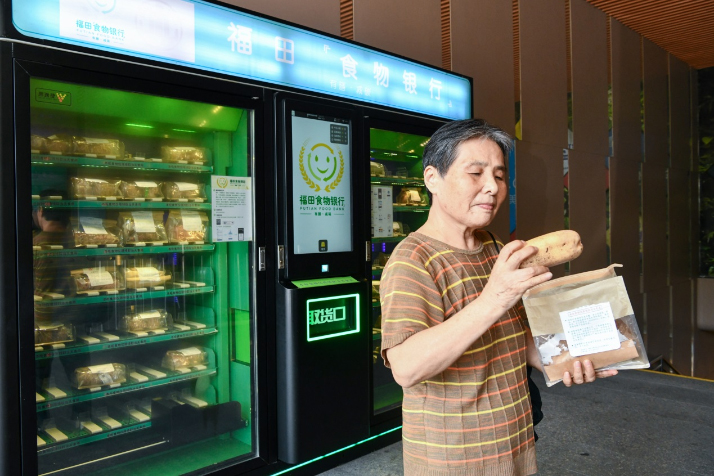 A senior resident collects a vegetable package from a food bank in Futian District, Shenzhen, Guangdong Province, on November 11, 2024 (XINHUA)
Twenty-five-year-old Chen had been unemployed for eight months when he first went to a food bank in Futian District in Shenzhen, Guangdong Province. The food bank actually looked like a large regular vending machine. Inside, rows of steamed buns, packaged vegetables, yogurt, fruits and fresh bread sat neatly arranged under soft interior lighting. Chen scanned a QR code with his phone, tapped the screen a few times and with a gentle click, a compartment opened. He retrieved a bag labeled "cauliflower" for dinner. "I used to walk past these cabinets without really seeing them," Chen told Beijing Review. "Then my savings began dwindling. I couldn't turn to my parents for help, and I didn't want any of my friends to learn about my problems. I had been having one meal a day for a whole week when I saw the news about this bank in community group on Weixin (the Chinese super app known internationally as WeChat). I came here the next day." What Chen used is part of Futian's 24-Hour Food Bank network, a project launched in May 2022 that has since placed 22 smart food cabinets across all 10 of the district's subdistricts. The free dinner from the food bank has become a fixture in Chen's daily routine. After spending 10 yuan ($1.4) on breakfast and skipping lunch, he uses vegetables from the vending machine to supplement his usual bow of noodles. "It helps me save about 30 yuan ($4.25) on a regular meal here in Shenzhen. I'll keep depending on it until I find a new job," Chen said. More than a charity "The food bank adheres to the principle of 'prioritizing special groups before extending to the general public.' It prioritizes meeting the needs of special and low-income groups, including recipients of subsistence allowances, people with disabilities, children in difficult situations, elderly individuals who have lost their only child, sanitation workers and landscaping maintenance workers (responsible for creating and maintaining the green spaces that are increasingly prioritized in cities and residential areas)," Tang Yuhong, an official from the Futian District Civil Affairs Bureau, told newspaper Shenzhen Daily in October 2022, five months after the project's launch. "We hope more caring enterprises and individuals will join this cause to help foster a social trend of conserving food and actively engaging in public welfare," he added. Over the past more than three years, the program has provided over 484,000 meals and prevented nearly 195 tons of food waste. Recognized with multiple provincial and municipal awards and featured in national media, it has inspired other cities and companies to replicate its model. The process is straightforward: Local supermarkets, hotels and bakeries donate food nearing its sell-by date that is still safe to eat. Volunteers check, sort and store the items in temperature-controlled cabinets. People facing hardship, on a list approved by the subdistrict office, can reserve food via the iShenzhen app—the official, all-in-one "smart city" mobile platform for Shenzhen residents—and pick it up at their convenience. The remaining supplies are made available to the general public after 8 p.m. in order to reduce food waste. Any expired items are safely disposed of the following day. "This priority principle ensures those most in need are served first. All anyone needs to do is to scan a QR code within the app to obtain them," Zeng Jiawen, an official from the Futian District Civil Affairs Bureau, told China National Radio. What sets it apart from other social services is its design. Unlike traditional food banks, there are no queues, no paperwork and no face-to-face handouts. "We want to avoid embarrassment for those asking for help. The goal is to make receiving support as normal as picking up a package," Zeng added. An efficient system The food bank is far from an ad-hoc charity. It is a carefully structured collaboration between government, businesses, non-governmental organizations and the public. Eighty seven businesses have partnered with the project, including major retail and grocery chains Hema Fresh, Yonghui Superstores, Olé, Didi Maicai and the Grand Hyatt Shenzhen hotel. In return for donating surplus food, they receive tax incentives based on a standardized valuation of goods, along with public recognition including logo placement on cabinets and honorary certifications. Hema Fresh is a leading donor to the Futian food bank at Yitian Plaza Subway Station, according to its Shenzhen Regional Operations Director, Shang Jun. Since the food bank opened four months ago, the adjacent Hema store has provided nearly 4,000 portions of food. This is made possible by a nightly routine where staff box up surplus fruits, vegetables, baked goods and other items nearing their best-by date for immediate donation. "The current daily supply still falls short of demand. During certain periods, it's difficult for ordinary citizens to get the remaining supplies. We urgently need more large chain enterprises to join the project and inject more momentum into it," another official from the Futian District Civil Affairs Bureau told Shenzhen Daily. In addition to major supermarkets and chain stores, many small business owners have also started donating food. Liu Dailu, an individual donor to the food bank, told newspaper Yangcheng Evening News, "I am a veteran who retired in 1983. Initially, I donated 100 portions of so-called veteran's buns (steamed buns served in the military) each month. Now, due to high demand, this number has since gone up to 300 a month." Before joining the food bank last June, Liu had already been supplying the buns to local veterans in need through community donations for two years. "The staff told me that sanitation workers also really enjoy these buns. I intend to donate more in the future," he added. The operation of the food bank relies not only on government advocacy and rule-making, and donations from businesses and individuals, but also on the dedicated services of local communities and volunteer teams. Their work encompasses everything from liaising with donors and collecting and distributing the food, to inspecting its quality and maintaining cleanliness. "We check everything—expiration dates, packaging, quality," Zeng said. "We need to make sure that nobody gets sick or poisoned eating these foods. Each food pack is trackable. There are labels with the source of suppliers and the date of donation." The program accepts only specific, lower-risk food categories, such as bread, fruits, vegetables and dry goods, while excluding higher-risk items like meat and dairy. Each donation undergoes two rounds of inspection: first by the donor and again by the on-site operating team. All donated items are stored in temperature-controlled cabinets kept below 10 degrees Celsius, covered by liability insurance and are subject to random spot checks by market regulators. Zeng also shared a story of a food bank recipient who was so moved that he returned as a volunteer. She said, "We want this project to create a ripple effect, turning everyone into an active participant in sustainability and charity, and building a more compassionate society." Copyedited by Elsbeth van Paridon Comments to zhangyage@cicgamericas.com |
|
||||||||||||||||||||||||||||
|