
|
| Business |
| For multinationals, the island province is more than a shopping hub | |
| What is the precise economic calculus leading companies to anchor their futures in the tropical island? | |
|
|
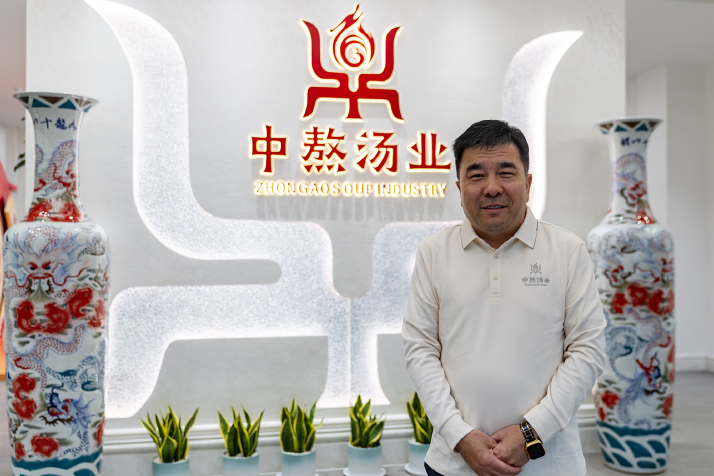 Yu Lianfu, President of Zhongao Soup Industry Co. Ltd., at his company in the Yangpu Economic Development Zone, Hainan Province, on January 16 (DUAN WEI)
In June 2020, China released a master plan for the Hainan Free Trade Port (FTP), aiming to build the southern island province into a high-level FTP of global influence. For Yu Lianfu, the document read like a signal flare. After nearly three decades building a career in northeast China, he was drawn south by the promise of Hainan and sought opportunities in Yangpu, an economic development zone in Danzhou City on the island's northwestern coast. But what awaited him there was stark. "Back then, there wasn't even a McDonald's or a Starbucks in sight," Yu recalled. "And you couldn't get a taxi." Driven by similar curiosity and expectations, German technology company Siemens Energy also sent teams to Hainan. Their assessment revealed a challenge: The island's manufacturing ecosystem was still in its infancy. "For a heavy-duty gas turbine comprising tens of thousands of components, not a single part could be sourced locally at the time," Li Rui, Deputy General Manager of the Energy Development Department at Yangpu International Investment Consulting Co. Ltd., said. Despite the challenges, both ultimately chose to put down roots in Hainan. On November 28, 2025, Dufengxuan Group, a company specializing in bone-based seasonings founded by Yu, inaugurated its Zhongao Soup Industry Technology Co. Ltd. project in Yangpu. The seasoning production facility spans 40,000 square meters. On December 18, 2025, the very day the Hainan FTP launched island-wide special customs operations, allowing freer entry of overseas goods, expanded zero-tariff coverage and more business-friendly measures, Siemens Energy broke ground on one of its only two global gas turbine assembly bases, with the other located in Germany. Simultaneously, the company launched a comprehensive regional service center and officially established Siemens Energy (Hainan) Co. Ltd. in Yangpu. What is the precise economic calculus leading companies to anchor their futures in the tropical island? Strong incentives Under special customs operations, the Hainan FTP, which covers more than 30,000 square km, has been designated as a special customs supervision zone, where the number of tariff-free product categories has expanded from around 1,900 to roughly 6,600, covering about 74 percent of all categories. Eligible imported goods are exempt from import duties, value-added tax and consumption tax. Under the zero-tariff policy, the combined tax rate for bones imported into the Hainan FTP, for example, is reduced by 22.08 percent—meaning that 1 million yuan ($143,785) worth of imports save over 220,000 yuan ($31,633). For Yu, the math was straightforward. His company mainly uses imported beef bones as raw materials. "Chinese consumers have a longstanding tradition of incorporating animal bones into food products, whereas in many overseas markets, bones are considered low-value byproducts, making them relatively inexpensive and cost-effective for importers like us," he said. Once the imported bones are processed locally, another preferential policy comes into play: Products from encouraged industries in the Hainan FTP that undergo at least 30 percent value-added processing will be exempt from tariffs when entering the Chinese mainland. Yu's company's products exceed the 30-percent threshold comfortably. This means that when sold to the Chinese mainland, they are subject to only a 9-percent value-added tax, with the consumption tax for these products being zero, bringing the total tax savings to 13.08 percent. "We import nearly 1 billion yuan ($144 million) worth of bones each year, which translates to roughly 130 million yuan ($18.7 million) in tax cuts," Yu said. "Reduced costs boost our profits, which in turn enable us to lower product prices, both benefiting consumers and strengthening our competitiveness." As tax rates vary by product, higher-taxed raw materials can generate even greater savings. Take pearls for example. A shipment worth 1 million yuan would incur 520,000 yuan ($74,769) in taxes without the tariff-free policy, but only 260,000 yuan ($37,384) when the incentives are applied for sales into the mainland. But what about companies that are not eligible for the policy? Song Pengjun, Deputy Manager of the Planning and Operations Department at SINOPEC Hainan Petrochemical Co. Ltd., highlighted this challenge. His company imports propane to produce polypropylene locally, but the industrial value-added still falls short of the 30-percent requirement. Under a cumulative value-added policy, they partner with Danzhou Weida Chemical Co. Ltd., which further processes the polypropylene into packaging films and bags. This brings the total value added to the required 30 percent, qualifying the final goods for tariff exemption when entering the mainland. Song said this approach has already saved the company over 9 million yuan ($1.3 million). These savings have lowered costs, boosted competitiveness and helped upgrade the entire value chain. The company also benefits from a "two-ends-out" policy, which grants enterprises zero-tariff treatment when both raw material procurement and product sales take place in overseas markets. Last December, it imported 225,000 tons of mixed xylene, processed the liquid mixture into para-xylene locally and then exported finished products to Europe. By leveraging the policy, its tax savings exceeded 2 million yuan ($287,570). In addition, eligible enterprises in Hainan enjoy a 15-percent corporate income tax rate, while eligible individuals are exempt from any portion of personal income tax above 15 percent. "The normal corporate income tax rate on the Chinese mainland is 25 percent," Yu said. "We already qualify for a reduced 15-percent rate on the mainland as a national-level hi-tech enterprise, but in Hainan, all companies are entitled to this preferential treatment." Tax incentives are only part of Hainan's appeal, the business environment matters just as much. Siemens Energy's decision to invest in Yangpu was supported by local authorities. "To address its concerns about the lack of localized production for certain components, we established a task force to identify viable sources or alternatives, calculate import costs and develop transport solutions," Li from Yangpu International Investment Consulting Co. Ltd. recalled. "On this basis, we compared the cost of manufacturing in Hainan with that at the company's facilities on the Chinese mainland or abroad and concluded that Hainan offers a cheaper option." Siemens Energy highly values Hainan's role in facilitating the interplay between domestic and international markets, as well as the island's strategic position within global supply chains, Li added. 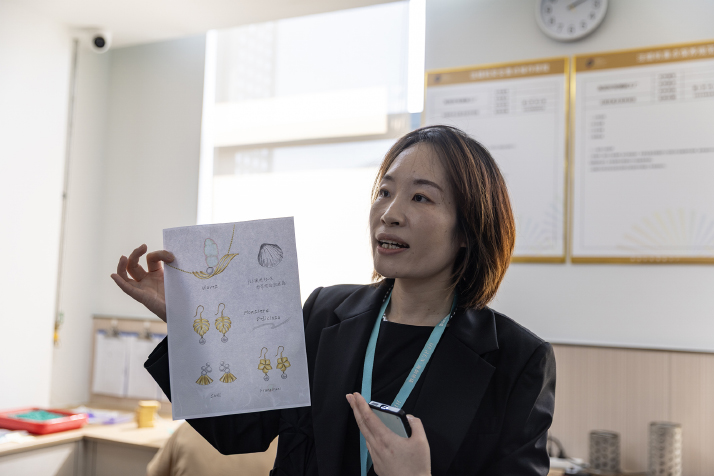 Yang Dan, Deputy General Manager of Sanya-based Hainan Hairun Pearl Co. Ltd., explains how imported pearls are processed in Hainan Province on January 17 (DUAN WEI)
Just a start Today, Yangpu has taken on a new look. Wide, clean roads stretch across the industrial zone, hotels and commercial complexes are springing up and state-of-the-art infrastructure has replaced nearly all traces of the desolation that existed just five years ago. Yu is preparing to launch the second phase of his Hainan project, covering 80,000 square meters of land. The new investment aims to create an exemplary industrial cluster in partnership with several large food companies. "More and more international clients are visiting our facilities. Some Australian businesses, for instance, are preparing to sell our products in their country," he said. For SINOPEC Hainan Petrochemical, policy incentives are important, but location proves equally crucial. "The Yangpu Port is a natural deepwater harbor," Song said. "Many mainland ports require annual dredging due to silt—the Yangpu Port does not." The port, Hainan's largest container port located in Yangpu, sits at a strategic crossroads between the Chinese mainland and overseas markets. "The crude we refine comes from the Middle East, Africa and the Americas, and the Yangpu Port serves as a vital hub for sourcing these supplies, giving us a cost advantage over any mainland competitor," Song added. Siemens Energy's presence in Yangpu is already attracting upstream suppliers to invest and operate there, signaling the beginning of a precision manufacturing cluster for high-end gas turbines. This clustering effect will further strengthen local manufacturing capacities as the industrial chain matures. For the Hainan FTP and local businesses, the launch of special customs operations was just the beginning. BR (Reporting from Hainan Province) (Print Edition: The Hainan Calculus) Copyedited by Elsbeth van Paridon Comments to zhangshsh@cicgamericas.com |
|
||||||||||||||||||||||||||||||
|