|
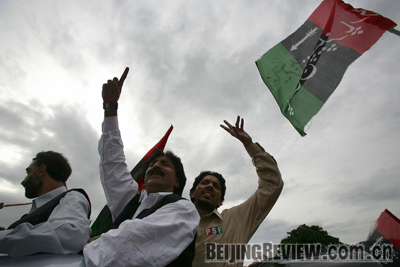
ALL CHEERS: Supporters celebrate in Islamabad on September 6, after Asif Ali Zardari won Pakistan's presidential election
The PML-N is the second largest party in the National Assembly, occupying 91 of its 342 seats. Since Musharraf stepped down, the former ruling PML-Q has showed signs of splitting. The PML-Q, a breakaway group from the PML-N, has 54 seats in the National Assembly. Many of its parliamentarians are secretly in touch with the PML-N and are likely to rejoin the party. This trend, as well as the support of some independent parliamentarians, has strengthened the PML-N enough to check the PPP-led government. With its rich experience in political struggles, the PML-N stands ready to replace the PPP if it fails.
The PML-N also boasts an absolute advantage in Pakistan's pivotal province-Punjab. The province, which is home to more than half the nation's population, is a major source of Pakistan's soldiers. In history, Punjab's ruling party would always rise to take over the reins of the Central Government. PML-N leader Nawaz Sharif's younger brother, Shahbaz Sharif, is the current head of Punjab's provincial government and enjoys widespread popularity. In the presidential election, Zardari received far fewer votes from Punjabi representatives than his PML-N opponent, a testament to the PML-N's solid status in the province.
The PML-N is a veteran political party in Pakistan that represents the interests of Punjab's major capitalists. Its leader, Nawaz Sharif, served as the country's prime minister twice in the 1990s before being ousted by Musharraf in 1999 and going into exile. A politician like him will never be satisfied with a position below Zardari. He has designs on a third term as prime minister and will be Zardari's biggest rival.
Social headaches
On top of this, Pakistan's economic crisis has deepened against the backdrop of soaring oil prices and a global economic slowdown. The country's stock market has plummeted 40 percent since April. Inflation hit 25 percent in August, a 30-year high. Meanwhile, the Pakistani rupee is depreciating rapidly against the U.S. dollar. Pakistan's trade deficit increased to $20.77 billion in the 2007-08 fiscal year, accounting for 12.3 percent of its gross domestic product. Its foreign exchange reserve decreased from $16.49 billion in October 2007 to $10.49 billion in July 2008. Pakistan is one of the 39 countries with the most severe food shortages. Power is also in short supply and blackouts are common, even in the capital city of Islamabad.
The public and the international community also worry about security in Pakistan. By September 2, more than 3,200 had been killed in domestic terrorist attacks. Prime Minister Yousuf Raza Gilani's motorcade was attacked on September 3. Suicide attacks have plagued the country since Musharraf's resignation in August, inflicting major casualties. On September 6, the day the presidential election was held, a police checkpoint in Peshawar, northwest frontier province, suffered a suicide car bomb attack that killed or injured more than 100 people. How to quickly reverse Pakistan's worsening economic and security situation is an issue that has a direct bearing on Zardari's political survival.
Stability is the key
For Zardari, support from the PML-N is crucial to political stability. The PML-N has been striving toward its goal of abolishing presidential powers and restoring full executive powers to the parliament. In a Senate speech on September 2, Gilani vowed to push for constitutional amendments. On September 5, Zardari also said he would respect the parliament's leading role, and he is likely to forge ahead with amending the constitution in a measured manner. In order to sustain the two parties' cooperation, Zardari has also announced that the PPP has no intention to subvert the PML-N's rule in Punjab.
The reinstatement of the judges fired by Musharraf last year was one of the prime reasons for the PML-N's withdrawal from the governing coalition last month. The PPP addressed the issue shortly before the presidential election to rein in antagonistic sentiments among legal professionals. On August 28, sacked judges from the Supreme Court and provincial high courts began returning to their posts. However, because Zardari failed to honor his promise, deposed Chief Justice Iftikhar Muhammad Chaudhry could only be reinstated as an ordinary judge, sparking discontent among legal professionals. The potential judicial crisis will be one of the opposition's main weapons against Zardari.
The United States and Britain were quick in offering congratulations to Zardari on his election. Michael Mullen, Chairman of the U.S. Joint Chiefs of Staff, urged Kayani to prevent terrorists from flowing across the border into Afghanistan at a meeting on August 26. On September 5, Democratic presidential candidate Barak Obama called on the United States to increase pressure on Pakistan. At the National Defense University on September 9, President George W. Bush also said Pakistan has a responsibility to defeat Taliban terrorists and should not provide a safe haven for terror.
In a bid to mount pressure on Pakistan, the U.S. military recently launched attacks on Pakistan's tribal areas despite the Pakistanis' hostility toward the United States. Since early September, U.S. forces in Afghanistan have attacked Pakistan's tribal areas with missiles and armed helicopters, causing a number of local casualties. At the same time, the United States continues to provide assistance to Pakistan. Pakistan's state news agency reported on September 5 that the United States had reimbursed Pakistan $365 million for operations and logistical support in the war on terror. Zardari will be more determined to fight terrorism given the U.S. pressure and the rampant terrorist activities at home. He wrote in The Washington Post on September 4 that he would cooperate with the United States to ensure that Pakistan does not become a base for Al Qaeda and the Taliban to attack U.S. troops deployed in Afghanistan.
The author is an assistant research fellow at the China Institutes of Contemporary International Relations |