|
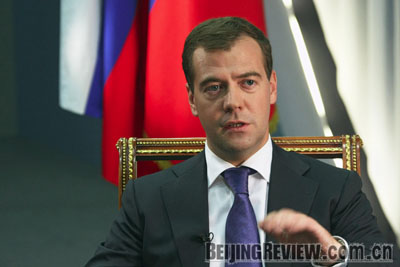
NO FEAR: Russian President Dmitry Medvedev speaks during a TV interview
in the southern city of Sochi on August 26. Russia is not afraid of
a new cold war, the president said
Russian President Dmitry Medvedev declared that Russia would formally recognize the independence of South Ossetia and Abkhazia, Georgia's two breakaway republics, on August 26. In a televised speech, he stressed that the decision was made in light of the "freely expressed will" of the people in the two regions and based on the UN Charter, the Helsinki Final Act of the 1975 Conference on Security and Cooperation in Europe, among other international instruments. The United States and other Western countries strongly opposed the move, which they believe will increase instability in the region. Medvedev, however, claimed that Russia does not fear a new cold war while calling on other countries to back the Russian policy.
It was a hard choice for Russia to recognize the independence of South Ossetia and Abkhazia. The two pro-Russian regions have long been at odds with Georgia. They first declared independence in the early 1990s as the Soviet Union dissolved, sparking armed conflicts with Georgia. Russia mediated between the parties and sent peacekeeping forces to the region. While the legal status of South Ossetia and Abkhazia remained unresolved, their clashes with Georgia over independence became "frozen conflicts."
The two regions have close ties with Russia, which provides them with economic and security guarantees. Most of the residents there hold Russian passports, while the ruble is widely used. Over the years, the two regions have been calling for independence and integration with the Russian Federation. Facing international pressure and separatist threats at home, however, Russia stayed silent. It was Georgia's attack on South Ossetia in August that prompted it to finally recognize South Ossetia and Abkhazia as independent states.
Russia made this decision for several reasons. The first is to strengthen the Putin-Medvedev regime. When the Russia-Georgia crisis broke out, Medvedev returned to Moscow from his holiday to chair an emergency meeting. He accused Georgia of aggression and vowed to protect the lives of Russian citizens and punish anyone who killed Russian nationals. Russian Prime Minister Vladimir Putin, who was in Beijing to watch the opening ceremony of the Summer Olympics, also said Russia would respond to Georgia's aggression. Various Russian political parties reached an unprecedented consensus on recognizing the independence of South Ossetia and Abkhazia. Both the Federation Council and the State Duma voted unanimously in support of recognition on August 25. This unity is conducive to strengthening Russia's leadership.
|