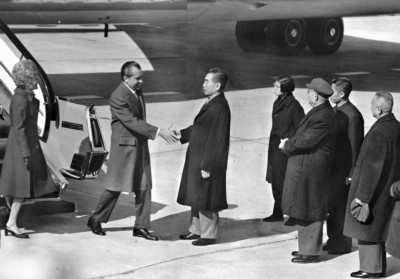
U.S. President Richard Nixon visited China from February 21-28, 1972, a trip that concluded with a rapprochement between China and the United States. The handshake from across the Pacific Ocean put an end to the confrontation that had haunted the two countries since the founding of the People's Republic in 1949.
On February 28, the day Nixon wrapped up his tour, a joint communique was issued in Shanghai, known as the Shanghai Communique. The relaxation in China-U.S. tensions had profound repercussions in the international community, as Western media hailed Nixon's stay in China as "the week that changed the world." Thirty-five eventful years have passed since then.
Extraordinary expansion
The depth, breadth and maturity of China-U.S. relations today are beyond the wildest estimations 35 years ago. Take trade for example. Bilateral trade was next to zero in 1972. In 2006, however, the trade volume was expected to exceed $260 billion, according to Chinese customs statistics. The two countries are each other's second largest trading partners with a high economic interdependence. The foundations on which the edifice of bilateral cooperation is built have been greatly expanded.
China-U.S. relations exhibited a distinctive character at the very beginning. Unlike most diplomatic documents, which tend to focus on common ground, the Shanghai Communique mainly deals with differences. China and the United States devoted two thirds of the communique to stating their respective positions. What they had in common only takes up a small fraction of the document. In this way, they succeeded in shelving the sensitive question of Taiwan, thereby reaching a solid consensus on the strategic issue of opposing Soviet hegemony, which paved the way for the development of their relations in the years to come.
China and the United States improved bilateral relations out of their own considerations. China wanted to lessen the Soviet Union's security pressure on its northern border with the support of the United States, raise its international standing and gain an upper hand in the wrangling across the Taiwan Strait. The United States intended to find a new lever against the Soviet Union, extricate itself from the catastrophe in Viet Nam and reshape China according to its ideology.
Judging from the current state of affairs, both countries have fulfilled their goals. What's more, the improvement in China-U.S. relations has yielded additional bonuses. It helped put the Cold War to an earlier end with a U.S. victory, facilitated China's reform and brought about stability and development in Asia. Good relations between China and the United States are important "public goods" that benefit Asia as a whole.
Two conclusions can be drawn as we review China-U.S. relations over the past years. First, the two countries share a wide range of common interests, which lay the groundwork for the sustained development of bilateral relations. Second, the governments' cooperative policies are vital in this regard.
|