|
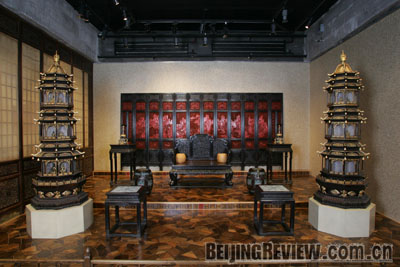
PRIZE EXHIBIT: The Red Sandalwood Hall at Guanfu Museum holds a pair of red
sandalwood towers, the most valuable antiques in the museum
The rows of flat shabby houses in the east Beijing suburb of Zhangwanfen are broken by a building that looks decidedly out of place. It's new, draws heavily on Chinese architecture and has turned the sleepy hollow into a tourist attraction.
The building is China's first private antique museum, the Guanfu Museum, and the hordes of people beating a path to its door come not only for the antiques. There is another attraction, the museum's owner- Ma Weidu.
A well-known antique collector, Ma gained national attention after he gave a series of lectures on antique collecting on the TV program Lecture Room on China Central Television.
Fascinated by all things old
"I was born to be a collector," said Ma, 53. "I prefer old things to new things and I am also interested in the unknown. It is really a pleasure for me to discover the stories hiding behind every antique."
Ma started his antique collection in the 1980s, when he was a literature editor at China Youth Press. He is also a widely published writer, having written several famous novels and TV series scripts with other writers. "The experience of being a literature editor and writer helps me to have a better understanding of the cultural meaning of antiques," he said.
Becoming increasingly interested in antiques, Ma finally quit his job as an editor and dedicated himself to his collection. "When you see a bowl more than 500 years old, and you can tell when it was made, who the owner was, and where it was buried, you simply get excited," he said.
His collections at first focused mainly on china, pottery and furniture of Ming (1368-1644) and Qing (1644-1911) dynasties. In the 1990s, the number of his collection surpassed 1,000. "From these antiques, we can see the living conditions and attitude of ancient people," Ma said. Using an ancient bed as an example, he explained how in the past people slept in beds with curtains surrounding the four sides of the bed. It created an atmosphere of safety, said Ma.
In 1997, Ma established China's first private museum-Guanfu Museum in Beijing. The word guanfu comes from a sentence in the classic Dao De Jing (Classic of the Way and Virtue) written by ancient philosopher Laozi, and means looking back.
Ma said that in 1992 he held an exhibition and realized that many people were eager to know more about antiques. He decided to set up a museum to give people more opportunities to enjoy the many artifacts.
In the early 1990s, the idea of private museums was new, and people thought he had bitten off more than he could chew.
| .jpg)