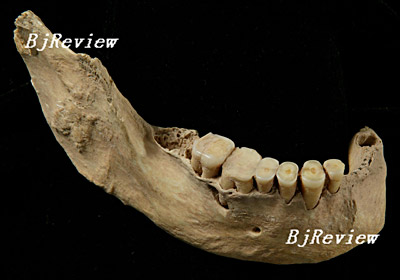
Chinese and foreign scientists have recently confirmed that fossils of modern human beings found in Tianyuan Cave at Zhoukoudian near Beijing traced back to around 40,000 years ago.
A joint research report on the discovery will be published on the Proceedings of the National Academy of Sciences of the United States America (PNAS) Tuesday.
Scientists from the Institute of Vertebrate Paleontology and Paleoanthropology of the Chinese Academy of Sciences, including Shang Hong and Professor Erik Trinkaus from Washington University in St. Louis, completed the research on the fossils.
Beijing Evening News reported on Monday that the modern human fossils dated back 42,000 or 38,500 years, making them the oldest to be found in the eastern part of the Eurasian continent.
Scientists said the discovery implies that the date Homo sapiens migrated out of Africa is earlier than previously thought.
The characteristics of the fossils found in Tianyuan Cave are for the most part similar to modern humans, though some share similarities with late archaic Homo sapiens. They show a mixture of genes from ancient human groups from the south and west.
The findings indicate that research into the transformation of archaic Homo sapiens into modern humans in eastern Asia is significant.
39 kinds of fossils of both human beings and mammals were found in June 2001 in Tianyuan Cave at the Zhoukoudian site southwest of Beijing.
(crienglish.com April 2, 2007)
|