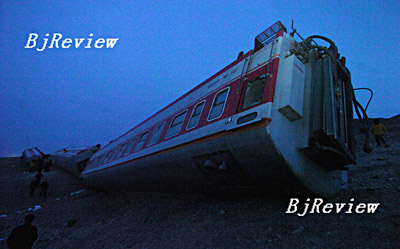
A gale warning system is being developed to protect passengers traveling by trains, after three people were killed when a train was blown off its tracks in western China.
The Ministry of Railways commissioned the warning system in response to the freak accident in the Xinjiang Uygur Autonomous Region last Wednesday, which left more than 30 passengers injured.
If successful, the system will be used across the country.
Currently only the Qinghai-Tibet Railway is equipped with a strong wind warning system, said Lu Zhizhong, an expert with the High-speed Railway Research Center.
The Qinghai-Tibet Railway's system involves a research center run by the Central South University in Changsha, Hunan Province, gathering weather information for statistic analysis, before sending warnings to train drivers according to their location.
"In the case of the Qinghai-Tibet Railway, we send out warnings if the wind speed reaches more than 18 meters per second," said Lu.
So far, the center has sent at least 50,000 warnings, and the Qinghai-Tibet Railway has not experienced any accidents caused by strong wind.
However, for most railways, the current practice is that local meteorological stations send the latest weather information to train dispatchers who have to use their own judgement to decide whether a train should run.
In areas with strong year-round winds, some special measures have been taken to ensure safety, such as installing wind-measuring facilities along railways in Xinjiang, which automatically collect wind data every three seconds, sending it to train dispatchers.
But in general, China needs to improve the railways' strong wind warning system, say experts.
Lu said research into the effect strong winds can have on trains began rather late, because trains running faster than 160 kilometers an hour, which are particularly prone to high winds, were only introduced to China in recent years.
Last Wednesday, 11 of the 19 cars of a passenger train on its way from Urumqi to Aksu in Xinjiang were knocked off the rails by a sudden gust of force 13 gale force wind.
The families of the three passenger who died in the derailment will each receive 200,000 yuan (US$25,800) in compensation from the Railways Ministry, the Beijing News reported, quoting a relative of victim Shi Lei.
The ministry yesterday refused to confirm the amount. According to railway compensation rules, each passenger, whether dead or injured, is entitled to no more than 40,000 yuan (US$5,170) in compensation.
(China Daily March 6, 2007)
|