|
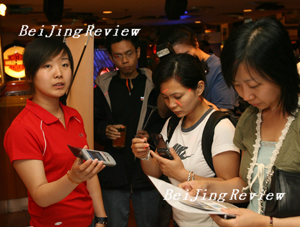
Of course, there's no mobile TV without the right chips, so the message is clear to chipmakers: Innovate!
"Although Siano spent only two years in coming up with the multi-standard silicon of the mobile phone TV, it usually takes a company at least three to four years for a comprehensive technology package," noted Wang Wei, Chief Representative of Siano Mobile Silicon who is in charge of the China market.
Siano is a silicon solution provider based in Israel and is also the first to provide the silicon chip that supports multi mobile phone TV standards.
"We are applying for joining the CMMB working group," Wang Wei said. "The application procedure will be a bit complicated. Our company plans to produce the second-generation product to support CMMB in 2007. We are working on a multi-standard support and are 80 percent sure that we can support the CMMB standard next year."
However, Wang Wei said, time is short.
It is widely suspected the chip solution that supports multiple standards will become the development trend for mobile phone TV and mobile digital TV.
"Just like the TV sets," noted Wang Wei, "We buy TV sets regardless of which standards it supports, because at present, each TV set supports all TV standards."
Wang said the same thing should also apply to mobile phone TV.
The number of multi-standard chip solution providers won't be many, and Wang Wei estimated that by the end of 2007, only three or four manufacturers in the world could provide such a chip solution.
Apart from Siano, some emerging semiconductor companies have also explored research and development of mobile phone TV chips.
A number of international chip solution providers also stated that once the Chinese standard is set up, they will set off to provide mobile phone TV chips. Luis Pineda, Vice President of Qualcomm, noted the Qualcomm chip solution for multi-standard mobile phone TV is scheduled to be put into the market in the first season of 2007.
However, many people hold the standard proposed by SARFT is just a recommendation-neither compulsory nor the national standard. The unidentified nature of the standard will give rise to reorganization of the market.
Wang Lian added, "Most of the domestic broadcasting and TV standards are recommended instead of being compulsory to service providers. The standardization Administration of China has not planned to upgrade our standard to a national level. But many South Korean companies have stated clearly that as long as the industry standard of mobile phone TVs is set up, they will immediately follow up."
|