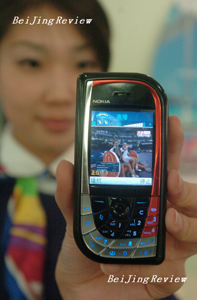
At the 2008 Beijing Olympic Games, Yao Ming might look a little smaller than usual. That will at least be the case for the estimated 1 million Beijing residents watching the Olympic Games on their mobile phones.
As you can imagine, that has various industry players salivating, at least when they're not busy sifting through the implications of a new mobile TV broadcasting standard that will impact how they air a cellular Olympics.
The State Administration of Radio Film and Television (SARFT) issued an industry standard called the CMMB (China Mobile Multimedia Broadcasting) system on September 24, which is colloquially known as the mobile phone TV standard. SARFT claimed that the transmission technology-the key part of the standard-has been resolved. StiMi technology (Satellite Terrestrial Interactive Multi-service Infrastructure) was adopted from November 1 this year.
The issuance of the SARFT standard attracted wide attention from industry insiders.
The partners-also known as cooperators-of the CMMB standard include China Telecom, China Unicom, broadcasting institutions like China Central Television, China National Radio, China Radio International, Beijing All Media and Culture Group, and others.
These big names have, in effect, indicated that the disputed mobile phone TV standard has finally been resolved with the acceptance of the CMMB standard.
SARFT noted that StiMi transmission technology is the key component of CMMB. The CMMB standard system also involves other attributes touching on video and audio, etc.
According to the blueprint for developing mobile phone TV, by the end of 2006, the country will complete the trial testing of the ground data link and interchange station system-the infrastructure. By the middle of 2007, the ground data link and interchange will be constructed and put into commercial use. By the first half of 2008, the satellite system will be integrated into this network and will form a nationwide network for formal operation. If all goes to plan, mobile phone TV will be ready for the 2008 Beijing Olympic Games.
Statistics provided by IMS Research, a market analysis company, show that the Chinese mobile phone TV market could expand to as much as 500 billion yuan by 2008.
But relevant organizations need to cooperate for this to happen. SARFT should provide the TV content for users, while telecom operators and manufacturers must provide necessary technology.
Li Guangzeng, a professor at Nanjing University of Posts & Telecommunications, pointed out that judging by the development trend of media, the mutual integration of telecom and radio, film and television industries is unavoidable.
The mutual integration will create, as the Chinese love to say, a win-win situation.
The announcement of the new mobile phone TV standard offers radio, film and TV industry insiders brand new opportunities. For instance, TV programs and radio stations can look forward to an extra channel to broadcast their programs and bring in more advertisement revenue. On the other hand, by charging users who watch mobile phone TV, telecommunications companies will expand their businesses.
Wang Lian, Deputy Director of the Science & Technology Department of the SARFT, agreed.
"SARFT has advantages in terms of channels, content and policy, while telecommunication companies enjoy relatively more capital and user networks," Wang said. "The Chinese mobile phone TV standard relies on independent innovation to enact a unified standard so as to boost the integration of three networks-the TV network, radio network and telecom service. Our objective is to create a comprehensive mobile multi-media broadcasting network."
Chips' shot
Before the SARFT standard was announced, some manufacturers had already begun to try out mobile phone TV technology. However, as the industry standard was not established, all sides had been cautious in investment. After SARFT announced the CMMB standard, many chip manufacturers actively set up production plans in line with the standard so as to follow up with the market trend.
|