|
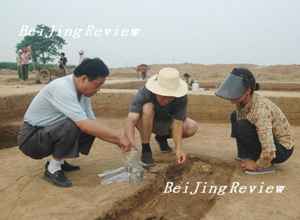
More than 80 tombs have been excavated at the site in Hengshui, with the tombs of Pengbo and his wife the largest ones. The couple was buried side by side with many funerary objects such as bronze ware, carriages and jade, said Song Jianzhong, deputy director of the Institute of Archaeology of Shanxi Province.
One of the most important findings in the graves is the remains of a pall covering the coffins. The remains of the pall, even after thousands of years, are still a vivid red color. Phoenix patterns can be seen on the pall, said Song.
“This is the oldest, best preserved and largest tomb decoration so far discovered in China,” said Song.
A total of 16 pieces of bronze were unearthed from the two tombs. The inscriptions on the bronze show that one of the tombs belonged to Pengbo and the other to his wife. “Ding” bronzeware was a symbol of power and status in the Western Zhou Dynasty. Archeologists(9¥Œ) noted that five pieces of Ding ware were found in Pengbo’s wife’s tomb, and only three in Pengbo’s tomb.
“It’s quite rare in ancient China, since males enjoyed higher status than females,” said Li, adding that it is probably because Pengbo’s wife’s parents were of high status. Five serial bells, of great value to the study of China’s musical history, were also found in the graves.
|