|
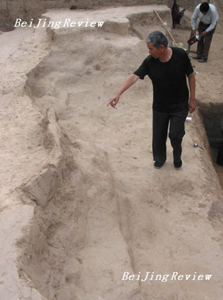
The major excavation work for 2005 was to uncover a big altar of about 1,000 square meters, but some 7,800-year-old pottery has also been discovered. On the pottery are delicate patterns of birds, wild animals and stars.
Some experts hold that the Chinese people’s worship of the phoenix stemmed from the Gaomiao culture. According to He Gang, the leading researcher of the Gaomiao relics, the combined pattern of animals, the sun and the sacred bird represented the phoenix in primitive people’s eyes. It represented the people’s worship of the sun, rain and harvests.
Before the discovery of the Gaomiao culture, an ivory carving with two birds on it which was found among the Hemudu relics was believed to be the earliest phoenix totem in China. The phoenix found in Gaomiao is 400 years older than that of the Hemudu, and it is of great value in researching the history of religion and art in China.
In April 2005, some small colored jars with the image of the sun on them were unearthed among the Gaomiao relics and they are believed to be China’s earliest pottery handicraft articles. They also reflect the ancestors’ worship of the sun. The pottery found in Gaomiao showed that for the first time primitive men began to represent the spiritual world on such wares, said He.
Remnants of more than 20 houses and 30 tombs were also unearthed during the excavation. One of the most important tombs is a joint grave for a couple, because a stack of valuable jade was found in their tomb. “It’s the first time in Hunan that we have found advanced jade articles with such craftsmanship,” noted He.
Animal remains were also discovered at the Gaomiao site, such as deer, bear, pig and elephant, as well as shells. Other findings included stone implements, indicating that at that time the major methods for humans to obtain food were fishing, hunting and gathering. Some of the pig teeth were identified as coming from domesticated animals, which means that animal husbandry existed at that time. These animal remains are sources for the study of the food structure, livestock raising and ecology at that time.
Hengshui Relics
The Hengshui tomb site is in Hengshui Town in Shanxi Province. Archeologists deduced the tombs are from a small state of the ancient Western Zhou Dynasty (1100-771 B.C.). The owners of the tombs were the ruler of the state, Pengbo (meaning Count of Peng State), and his wife.
Li Boqian, director of the archaeological research center of Peking University, said the discovery of the Western Zhou graves in Hengshui is the most important archaeological discovery since the excavation of the graves of the Marquis of Jin, another state of the Western Zhou Dynasty, in Quwo County of Shanxi Province.
The tombs will help archeologists(9¥Œ) and historians better understand the history of the Western Zhou Dynasty and its jurisdiction, Li said.
|