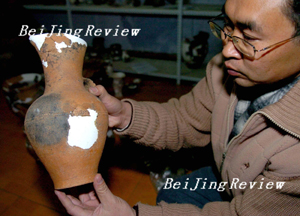
The top 10 archaeological discoveries of 2005 were unveiled in Beijing, with more than half of them coming from outside the Yellow River Valley, considered the cradle of Chinese civilization.
The top spots were selected from about 100 archaeological discoveries last year. “This selection is based on their historical, scientific and aesthetic values and their significance in the development of archeology,” said Xu Pingfang, president of the Chinese Society of Archaeology.
Xiaohuangshan Relics
The Xiaohuangshan relics in Zhejiang Province, which date back 8,000-10,000 years, could rewrite the country’s archaeological history, because they are much older than the Hemudu site in the province, which was previously believed to have nurtured the earliest Neolithic culture in south China, about 7,000 years ago.
The site was discovered in 1984. It has two settlements dating from the same era, which is very rare among the Neolithic sites that have been discovered so far. At the same time, the Xiaohuangshan relics, which are located in a river valley area, are supportive of the theory that human civilization developed from mountainous areas toward the plains and coastal islands.
At the site, researchers found several deep ditches that they believed to be storerooms and some signs of cooking with fire. “We found that around the site there’s a man-made ditch, about 12-14 meters wide. It was used to protect against animals. Such a man-made ditch is of great antiquity in China,” said Wang Haiming, head of the archaeological team in Zhejiang.
The team also found a carved stone head that is estimated to be 9,000 years old. The stone head is made of basalt and is about half the size of a man’s palm. “This is the earliest stone head sculpture that has been discovered from the Neolithic era in China,” noted Wang.
Few sculptures from the Neolithic era have been excavated, and such carved stone heads are particularly rare. Experts believe that primitive man seldom made objects beyond the basic necessities, so this 9,000-year-old stone head poses a riddle to the archeologists(9¥Œ): is it a totem, or a sign of some tribe, or just a decoration? Who owned this stone head? How did it come into being?
The other two Neolithic sites in Zhejiang, the 10,000-year-old Shangshan site in Pujiang County and 7,000-year-old Kuahuqiao site, bear witness to the complexity of the Neolithic culture in Zhejiang. The origin of the Kuahuqiao relics remained a mystery for a long time among archeologists(9¥Œ). The excavation of the Xiaohuangshan site, however, reveals some connections with the Shangshan site and Kuahuqiao site, whose origins are about 2,000 years apart.
The pottery discovered at the Xiaohuangshan site resembles that of the Hemudu site in the province. Therefore, archeologists(9¥Œ) conjecture that the Xiaohuangshan site might be one of the origins of the Hemudu culture.
Gaomiao Relics
Located in Hongjiang City, Hunan Province, the Gaomiao worship site is one of the well-preserved sites of the Neolithic age. It vividly reflects how the residents at that time conducted their religious activities, and it is very important to the origin and development of China’s religious worship.
The site was excavated three times, in 1991, 2004 and 2005, by a team of local archeologists(9¥Œ), with an excavation area of 1,700 square meters.
|